

Form 8965 at a glance
What it is: The 2018 Form 8965, Health Coverage Exemptions, is attached to Form 1040 and completed if you have a Marketplace-granted coverage exemption or you are claiming a coverage exemption on your return.
Where and when to file: Attach Form 8965 to Form 1040.[2]
File Form 8965 to report or claim a coverage exemption if all of the following apply: You are filing a Form 1040, even if you are filing it because you are a dual-status alien for your first year of U.S. residency or a nonresident or dual-status alien who elected to file a joint return with a U.S. spouse. You can't be claimed as a dependent by another taxpayer. For one or more months of 2018, you or someone else in your tax household didn't have minimum essential coverage or a coverage exemption. You can claim any part-year exemptions or exemptions for specific members of your tax household.[2]
Only one Form 8965 should be filed for each tax household.[2]
Form 8965 is used only to claim and report coverage exemptions.[2]
What to bring and attach to Form 8965
If you were granted a coverage exemption from the Marketplace, but didn't receive an ECN, or don't know your ECN, contact the Marketplace to obtain your ECN.[2]
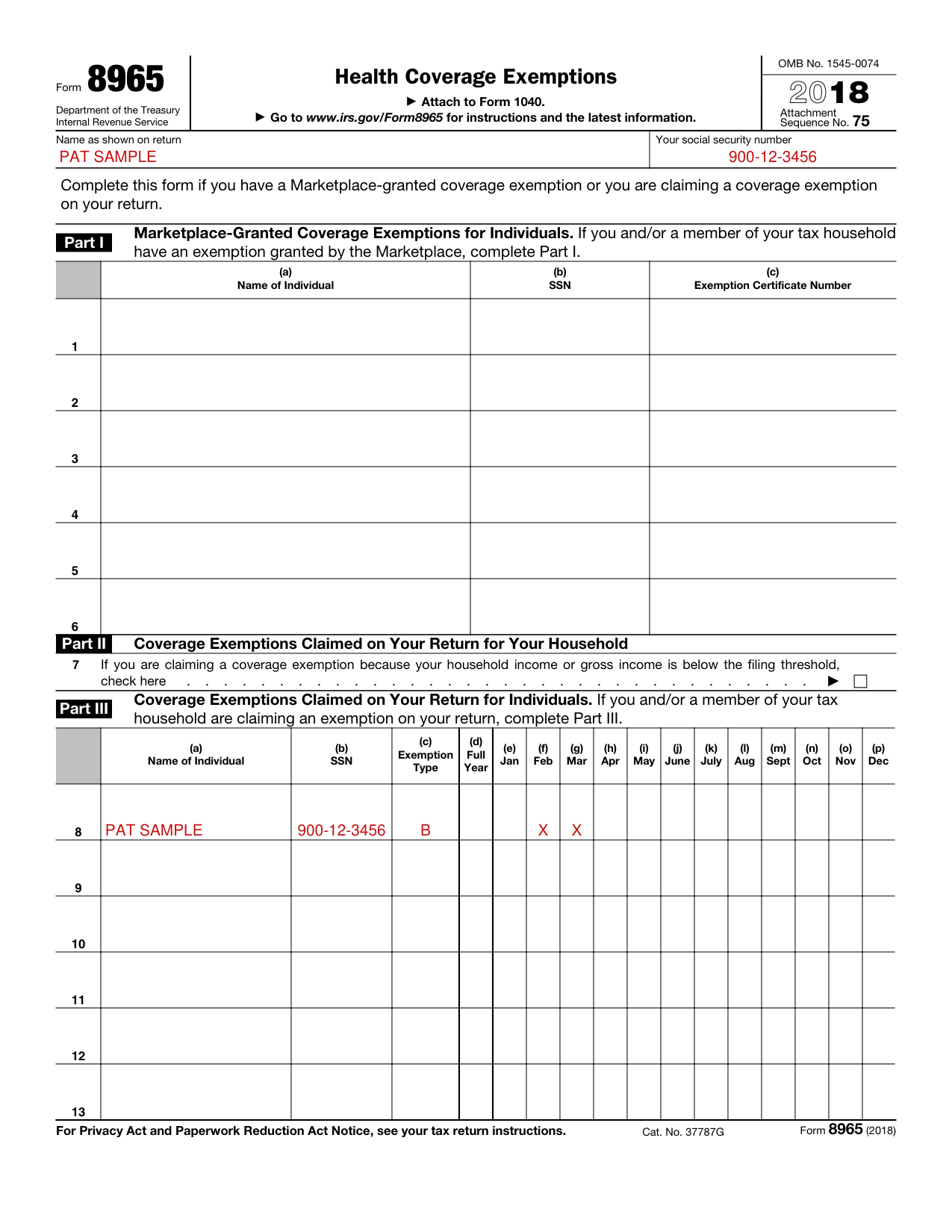
A filled-in Form 8965 example: a two-month short coverage gap
How to fill out Form 8965, box by box
Part I Marketplace-Granted Coverage Exemptions for Individuals
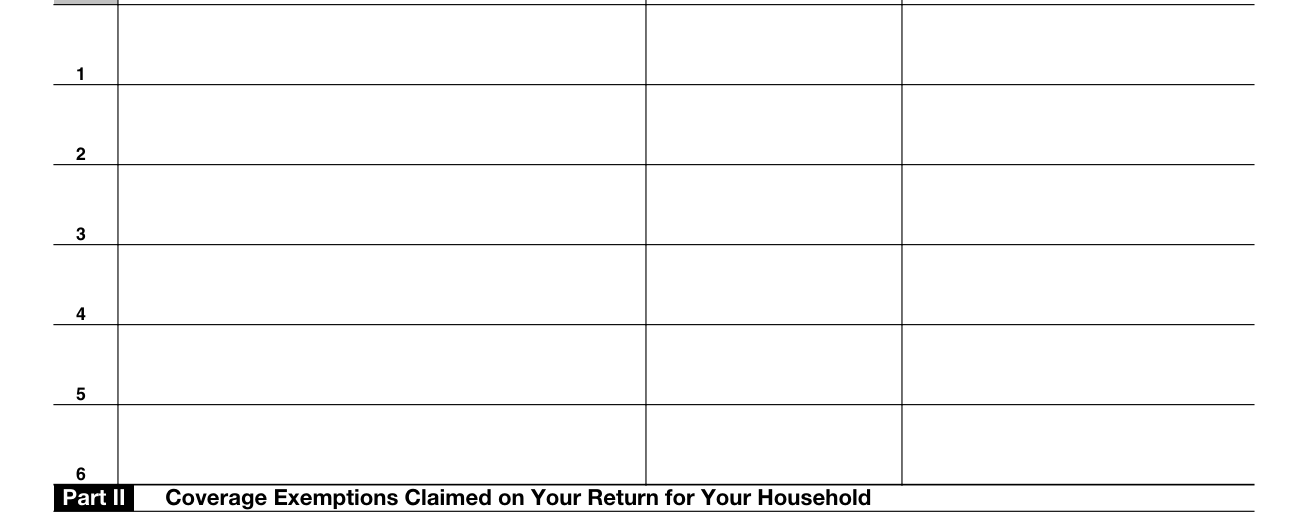
If you can't check the "Full-year health care coverage or exempt" box on page 1 of Form 1040, and you or another member of your tax household was granted a coverage exemption from the Marketplace that didn't cover every month of 2018, complete Part I of Form 8965.
Complete a line for each individual who was granted or has a pending application for a Marketplace-granted coverage exemption. If an individual was granted or has a pending application for more than one coverage exemption from the Marketplace, complete a separate line for each coverage exemption for that individual.
In lines 1-6, column (a), enter the name of each person in your tax household who was granted a coverage exemption from the Marketplace or has an application for a coverage exemption pending with the Marketplace. In column (b), enter the SSN of the individual listed in column (a).
For the individual listed in column (a), enter in column (c) the Exemption Certificate Number (ECN) that you received from the Marketplace. If the Marketplace hasn't processed your application by the time you file, enter "pending."
The Marketplace exemption approval notice that you received also indicates the months for which the coverage exemption is granted. Don't enter that information in Part I.[2]
Part II Coverage Exemptions Claimed on Your Return for Your Household

On line 7, if you are claiming a coverage exemption because your household income or gross income is below the filing threshold, check here.
Line 7: you can check the "Full-year health care coverage or exempt" box on Form 1040 if your household income or gross income is less than your filing threshold. You don't need to file Form 8965.[2]
Part III Coverage Exemptions Claimed on Your Return for Individuals
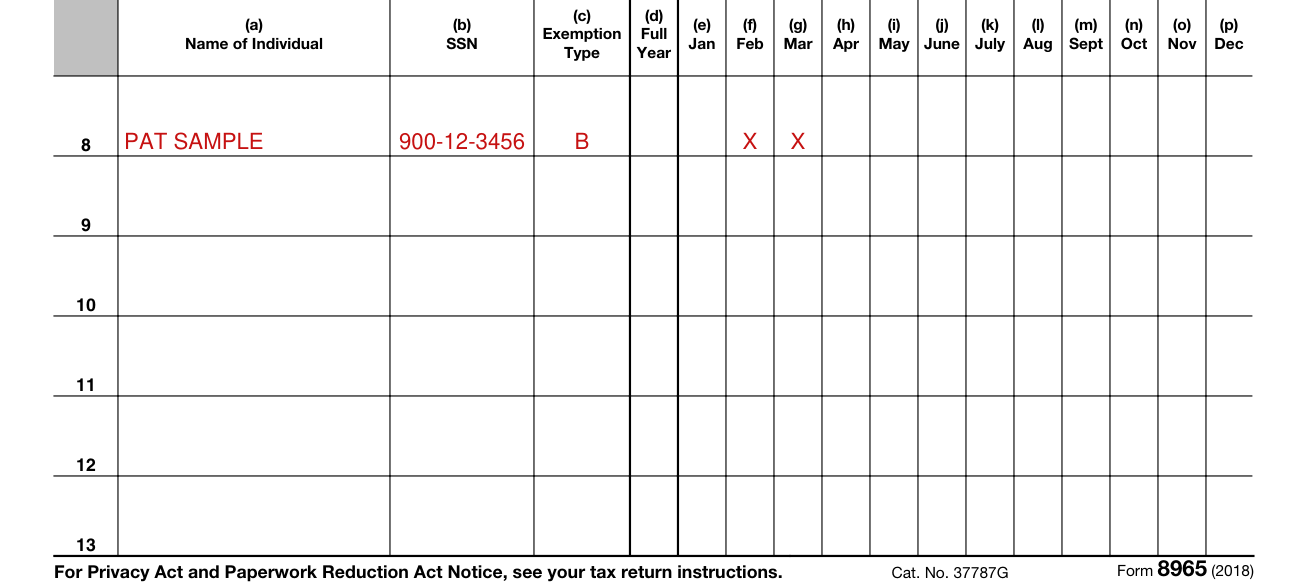
If you can't check the "Full-year health care coverage or exempt" box on page 1 of Form 1040, use Part III to claim a coverage exemption on your tax return for yourself or another member of your tax household. Complete a line for each individual for whom you are claiming a coverage exemption.
If you are claiming more than one coverage exemption for any individual, you must generally complete a separate line for each coverage exemption. But if, for any individual, you are claiming two or more different types of coverage exemptions that have the same code listed in the Types of Coverage Exemptions chart, use a single line to claim those coverage exemptions.
In lines 8-13 column (a), enter the name of each person in your tax household for whom you are claiming a coverage exemption on that line. In column (b), if the individual is listed on page 1 of your tax return, the SSN in this column should match the individual's SSN listed on your tax return.
Use column (c) to identify the type of coverage exemption you are claiming for yourself or another member of your tax household. Enter the code for the appropriate coverage exemption listed in the Types of Coverage Exemptions chart. Use only the codes listed in the Types of Coverage Exemptions chart. Don't leave column (c) blank.
For code A, coverage considered unaffordable, you can claim a coverage exemption for yourself or another member of your tax household for any month in which the individual is eligible for coverage under an employer plan and that coverage is considered unaffordable. You can also claim it for any month in which the individual isn't eligible for coverage under an employer plan and the coverage available for that individual through the Marketplace is considered unaffordable.
Coverage is considered unaffordable if the individual's required contribution (described later) is more than 8.05% of household income. To claim this coverage exemption, enter code "A" in Part III, column (c).
For code B, short coverage gap, you generally can claim a coverage exemption for yourself or another member of your tax household for each month of a gap in coverage of less than 3 consecutive months. If an individual had a gap of 3 months or more, the individual isn't exempt for any of those months. For example, if an individual had coverage for every month in the year except February and March, the individual is exempt for those 2 months. If an individual had more than one short coverage gap during the year, the individual is exempt only for the month(s) in the first gap.
If you don't have minimum essential coverage for a continuous period that begins in 2017 and ends in 2018, for purposes of applying the short coverage gap rules to 2018, the months in 2017 are counted.
For each coverage exemption claimed in rows 8 through 13, check the appropriate box or boxes in columns (d) - (p) for the months for which the particular exemption applies. If the coverage exemption applies for the full year, check the box in column (d) and don't check the boxes in columns (e) - (p) (page 15).[2]
Dependents and Form 1040NR
You can be claimed as a dependent by another taxpayer
If you can be claimed as a dependent by another taxpayer, you don't need to file Form 8965 and don't owe a shared responsibility payment.[2]
You file a Form 1040NR or Form 1040NR-EZ
If you file a Form 1040NR or Form 1040NR-EZ (including a dual-status tax return for your last year of U.S. residency) or someone claims you as a dependent on a Form 1040NR or Form 1040NR-EZ, you are exempt from the shared responsibility payment. Don't attach Form 8965 to your Form 1040NR or Form 1040NR-EZ.[2]
Sources
[1] Form 8965 (2018), Health Coverage Exemptions, Department of the Treasury Internal Revenue Service (the Official source link on this page).
[2] 2018 Instructions for Form 8965, Health Coverage Exemptions, Internal Revenue Service.
