Please rate Joint Template Check

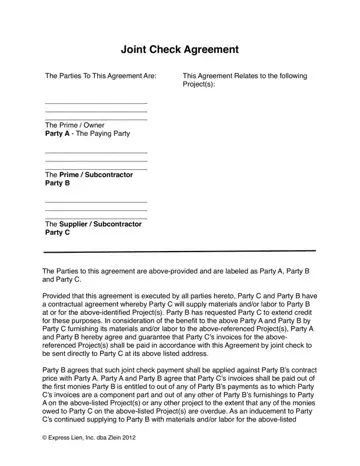
In the realm of construction projects, financial transactions and agreements take on a complexity that requires careful navigation to ensure all parties are protected and obligations are clearly defined. At the heart of such arrangements can be the Joint Check Agreement, a pivotal document that outlines the financial interdependencies between the owners, contractors, and suppliers or subcontractors involved in a project. This agreement, binding once signed by all parties—labeled Party A (the paying party or prime/owner), Party B (the prime/subcontractor), and Party C (the supplier/subcontractor)—serves as a safeguard to ensure that suppliers and subcontractors are paid for materials and labor provided. It dictates that payments from Party A to Party B for work or materials supplied by Party C will be made via joint checks sent directly to Party C. This mechanism ensures that Party C is compensated out of the first monies payable under Party B's contract with Party A, related to the specified project(s). Further, the agreement stipulates the conditions for notification of insufficient funds, endorsing of checks, prohibitions against unconsented agreement revocation, and outlines the consequences of payment default, including the coverage of legal fees. In essence, this agreement is designed not only to facilitate the smooth flow of funds and thereby materials and labor to a project but also to offer a layer of financial security to those down the contract chain, all while stipulating clear fiscal responsibilities among the parties involved.
| Question | Answer |
|---|---|
| Form Name | Joint Template Check |
| Form Length | 2 pages |
| Fillable? | No |
| Fillable fields | 0 |
| Avg. time to fill out | 30 sec |
| Other names | joint check herein search, joint check agreement, joint check agreement examples, construction joint check agreement form |
Joint Template Check isn’t the one you’re looking for?
Please rate Joint Template Check