
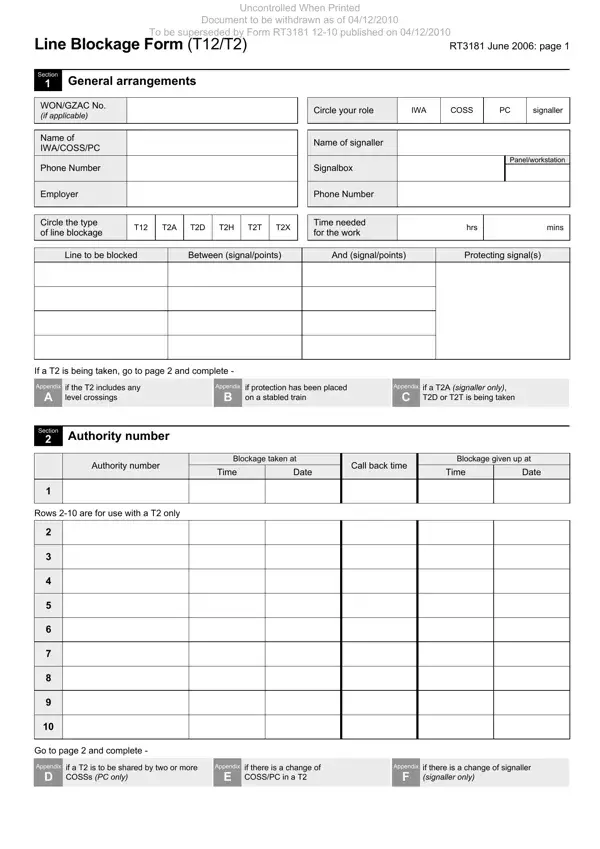
In the realm of railway maintenance and safety, the intricacies of ensuring a safe work environment cannot be overstated. Among the myriad of procedures and documentation required, the Line Blockage form plays a pivotal role, acting as both a logistical and safety blueprint for workers and signallers alike. Initially introduced in June 2006, the form, designated as RT3181, underwent significant development, leading to its withdrawal in December 2010 to be replaced by a more comprehensive version. Its primary purpose is to document the temporary cessation of rail traffic in specific sections for maintenance or emergency work. The form categorizes blockages into types like T12, T2A, T2D, T2H, T2T, and T2X, each specifying different scenarios and requirements such as the involvement of level crossings, stabled trains, or particular signaller-only operations. Additionally, it meticulously records the necessary details ranging from the identity of the person in charge (IWA/COSS/PC) to the exact location and duration of the blockage. Appendices attached to the form further detail procedures for sharing blockages among multiple workers, changes in personnel, and specific conditions at level crossings or with stabled trains. This documentation is critical in maintaining the delicate balance between operational efficiency and safety, providing a structured approach to managing the many variables involved in line blockage scenarios.
| Question | Answer |
|---|---|
| Form Name | Line Blockage Form |
| Form Length | 2 pages |
| Fillable? | No |
| Fillable fields | 0 |
| Avg. time to fill out | 30 sec |
| Other names | form t12, what is t12 in real estate, t 12 form, t12 tax form |