
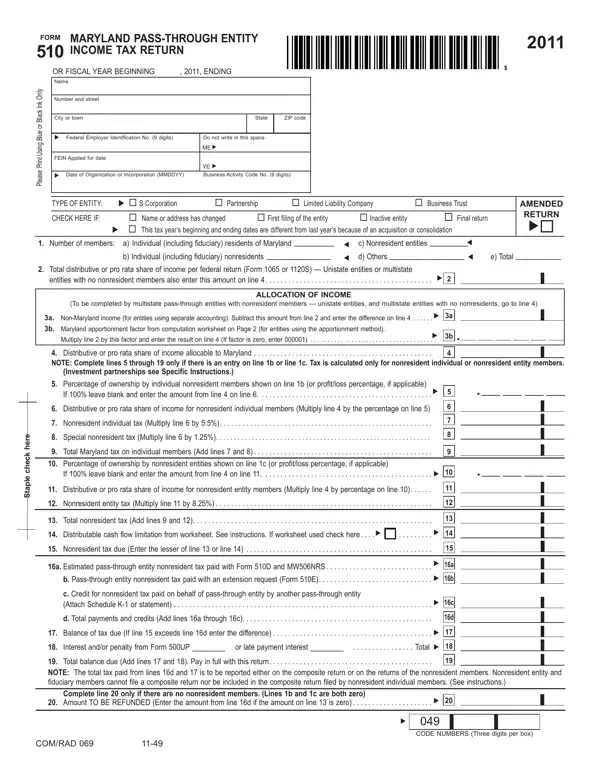

Form 510 at a glance
What it is: Form 510 is the Maryland Pass-Through Entity Income Tax Return.
Who signs: Sign as general partner, officer or member, and enter the Date.
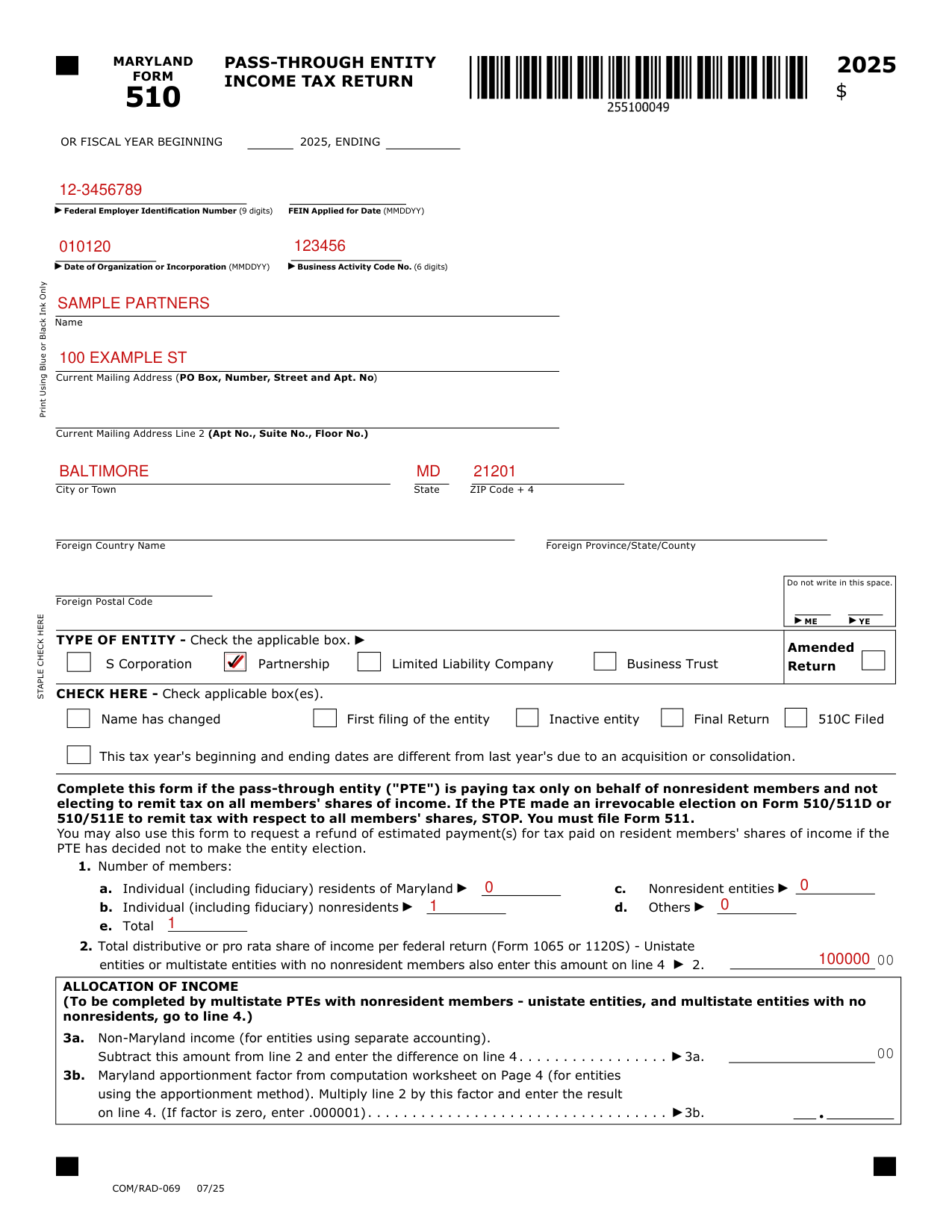
A filled-in Form 510 example: a partnership with one nonresident member
How to fill out Form 510, box by box
FEIN, dates and business activity code

Enter the Federal Employer Identification Number (9 digits), the FEIN Applied for Date (MMDDYY), the Date of Organization or Incorporation (MMDDYY) and the Business Activity Code No. (6 digits).
Name and mailing address
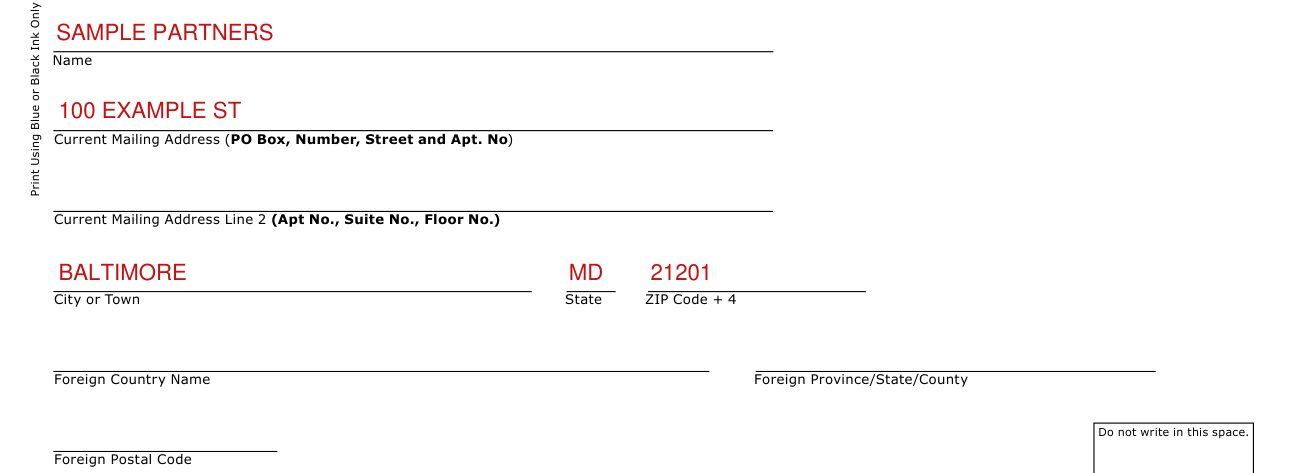
Enter the Name, the Current Mailing Address (PO Box, Number, Street and Apt. No), Current Mailing Address Line 2 (Apt No., Suite No., Floor No.), City or Town, State and ZIP Code + 4.
Type of entity

Under TYPE OF ENTITY, check the applicable box: S Corporation, Partnership, Limited Liability Company or Business Trust.
Check here

If amending, check the Amended Return box.
Under CHECK HERE, check applicable box(es): Name has changed, First filing of the entity, Inactive entity, Final Return, 510C Filed, or This tax year's beginning and ending dates are different from last year's due to an acquisition or consolidation.
Number of members and total income

On line 1, enter the number of members: a. Individual (including fiduciary) residents of Maryland, b. Individual (including fiduciary) nonresidents, c. Nonresident entities, d. Others, e. Total.
On line 2, enter the total distributive or pro rata share of income per federal return (Form 1065 or 1120S). Unistate entities or multistate entities with no nonresident members also enter this amount on line 4.
Allocation of income
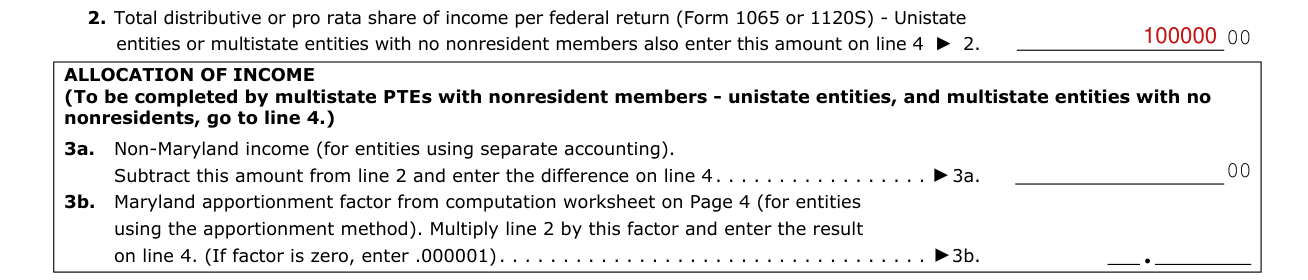
ALLOCATION OF INCOME is to be completed by multistate PTEs with nonresident members. Unistate entities, and multistate entities with no nonresidents, go to line 4.
On line 3a, enter the Non-Maryland income (for entities using separate accounting). Subtract this amount from line 2 and enter the difference on line 4.
On line 3b, enter the Maryland apportionment factor from computation worksheet on Page 4 (for entities using the apportionment method). Multiply line 2 by this factor and enter the result on line 4. (If factor is zero, enter .000001)
Tax on nonresident individual members
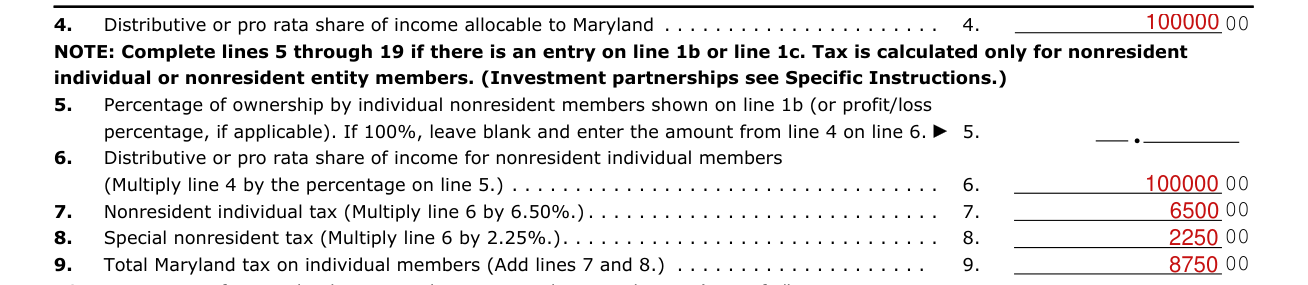
On line 4, enter the distributive or pro rata share of income allocable to Maryland.
Complete lines 5 through 19 if there is an entry on line 1b or line 1c.
Tax is calculated only for nonresident individual or nonresident entity members.
On line 5, enter the percentage of ownership by individual nonresident members shown on line 1b (or profit/loss percentage, if applicable). If 100%, leave blank and enter the amount from line 4 on line 6.
On line 6, enter the distributive or pro rata share of income for nonresident individual members (Multiply line 4 by the percentage on line 5.).
On line 7, enter the nonresident individual tax (Multiply line 6 by 6.50%.).
On line 8, enter the special nonresident tax (Multiply line 6 by 2.25%.).
On line 9, enter the total Maryland tax on individual members (Add lines 7 and 8.).
Tax on nonresident entity members
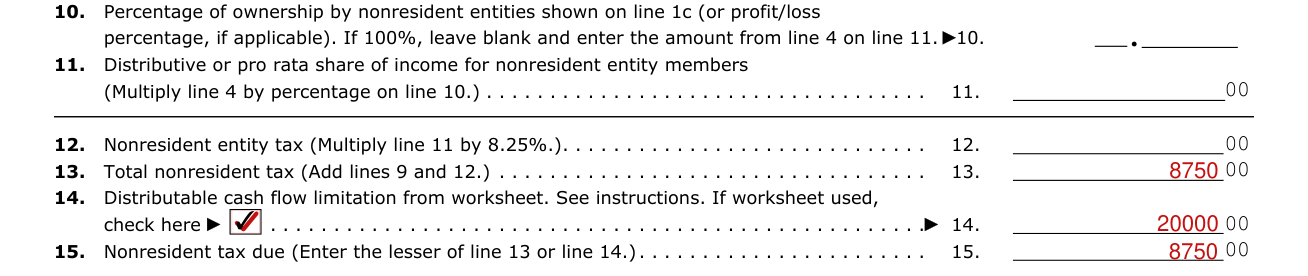
On line 10, enter the percentage of ownership by nonresident entities shown on line 1c (or profit/loss percentage, if applicable). If 100%, leave blank and enter the amount from line 4 on line 11.
On line 11, enter the distributive or pro rata share of income for nonresident entity members (Multiply line 4 by percentage on line 10.).
On line 12, enter the nonresident entity tax (Multiply line 11 by 8.25%.).
On line 13, enter the total nonresident tax (Add lines 9 and 12.).
Nonresident entity and fiduciary members cannot file a composite return nor be included in the composite return filed by nonresident individual members.
Nonresident tax due

On line 14, enter the distributable cash flow limitation from worksheet. If worksheet used, check here.
On line 15, enter the nonresident tax due (Enter the lesser of line 13 or line 14.).
Payments and credits
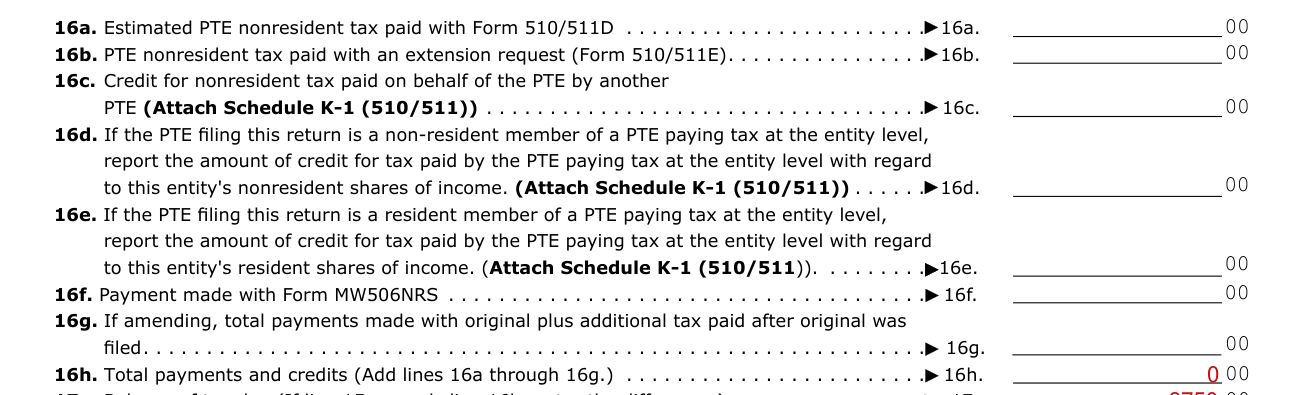
On line 16a, enter the estimated PTE nonresident tax paid with Form 510/511D.
On line 16b, enter the PTE nonresident tax paid with an extension request (Form 510/511E).
On line 16h, enter the total payments and credits (Add lines 16a through 16g.).
Balance due or overpayment
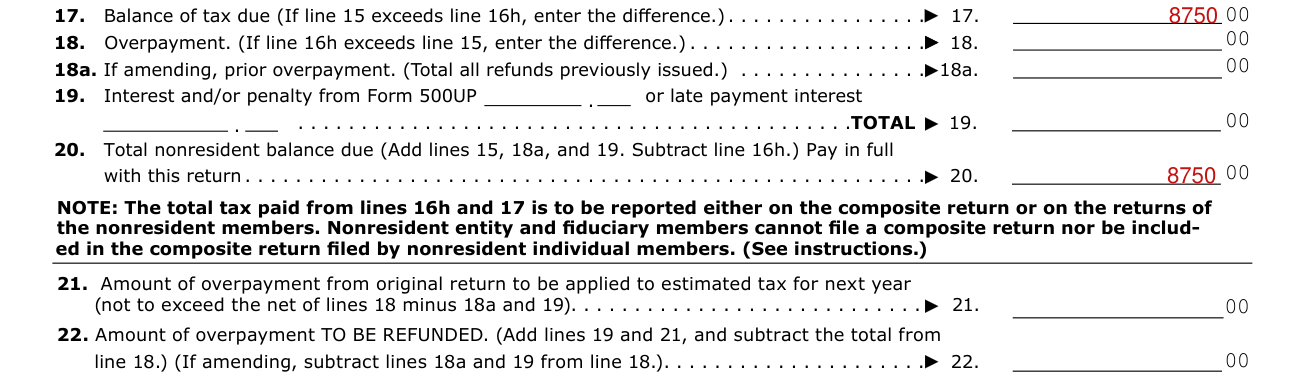
On line 17, enter the balance of tax due (If line 15 exceeds line 16h, enter the difference.).
On line 18, enter the overpayment (If line 16h exceeds line 15, enter the difference.).
On line 19, enter the interest and/or penalty from Form 500UP or late payment interest.
On line 20, enter the total nonresident balance due (Add lines 15, 18a, and 19. Subtract line 16h.). Pay in full with this return.
On line 21, enter the amount of overpayment from original return to be applied to estimated tax for next year (not to exceed the net of lines 18 minus 18a and 19).
On line 22, enter the amount of overpayment TO BE REFUNDED. (Add lines 19 and 21, and subtract the total from line 18.) (If amending, subtract lines 18a and 19 from line 18.)
Direct deposit of refund
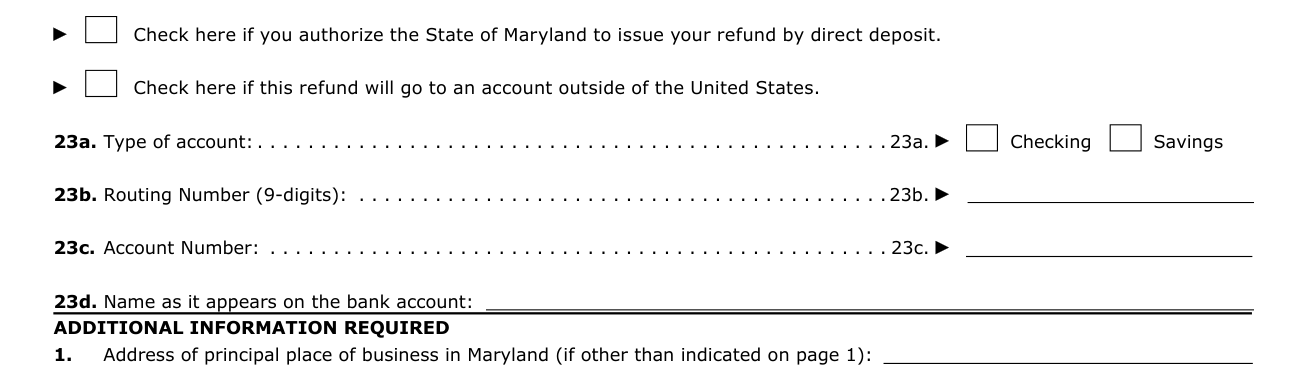
Under DIRECT DEPOSIT OF REFUND, check here if you authorize the State of Maryland to issue your refund by direct deposit.
On line 23a, enter the type of account: Checking or Savings. On line 23b, enter the Routing Number (9-digits). On line 23c, enter the Account Number. On line 23d, enter the name as it appears on the bank account.
Telephone number, state of organization and IRS adjustments
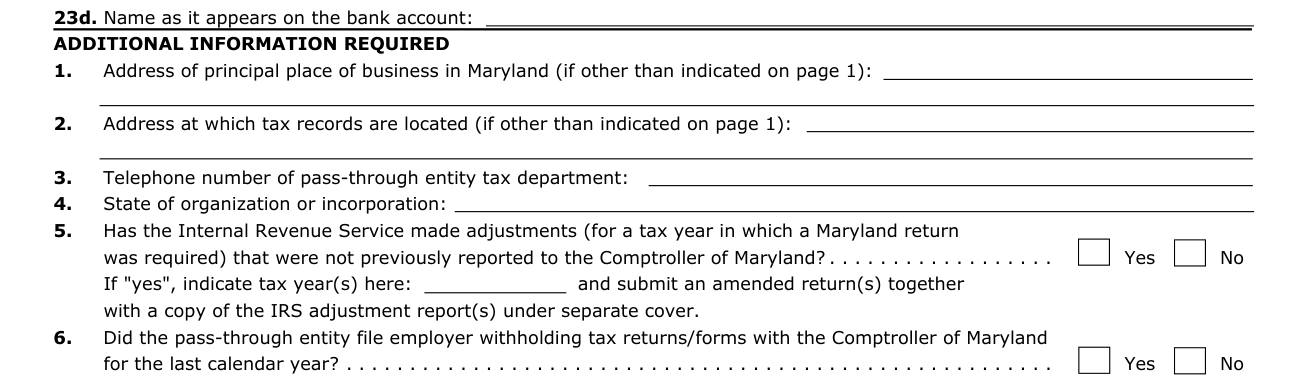
Enter the telephone number of pass-through entity tax department and the state of organization or incorporation, with the numbers 3, 4 and 5.
Has the Internal Revenue Service made adjustments (for a tax year in which a Maryland return was required) that were not previously reported to the Comptroller of Maryland? Yes No. If "yes", indicate tax year(s) here and submit an amended return(s) together with a copy of the IRS adjustment report(s) under separate cover.
Did the pass-through entity file employer withholding tax returns/forms with the Comptroller of Maryland for the last calendar year? Yes No.
Signature and verification
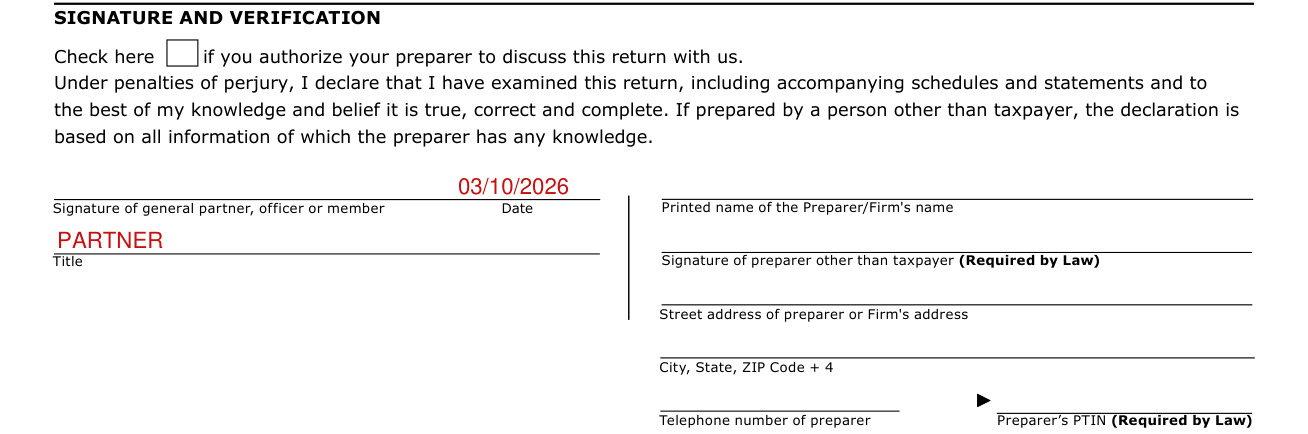
Under SIGNATURE AND VERIFICATION, you declare under penalties of perjury that you have examined this return, including accompanying schedules and statements and to the best of your knowledge and belief it is true, correct and complete.
Signature of preparer other than taxpayer (Required by Law). Enter the Telephone number of preparer and the Preparer's PTIN (Required by Law).
More rules for Form 510
Print using blue or black ink only.
In Schedule B, Part I, enter the individual members' information in Social Security Number order.
In Schedule B, Part II, enter the fiduciary members' information in Federal Employer Identification Number order.
You must file Form 510 electronically to pass on business tax credits from Form 500CR and/or Form 502S to your members.
Election and multistate pass-through entities
The PTE has decided not to make the entity election
You may also use this form to request a refund of estimated payment(s) for tax paid on resident members' shares of income if the PTE has decided not to make the entity election.
Check or money order, and Mail to
Make check or money order payable to Comptroller of Maryland. On your check or money order, in blue or black ink only, you must include the Federal Employer Identification Number, tax year, and tax type.
Failure to include this information will delay the processing of your payment.
Mail to: Comptroller of Maryland, Revenue Administration Division, 110 Carroll Street, Annapolis, Maryland 21411-0001.
Multistate pass-through entities
Schedule A, the computation of apportionment factor, applies only to multistate pass-through entities.
Report this factor on line 4 unless you use a special apportionment formula or alternative apportionment formula.
Common questions about Form 510
What is form 510 in Maryland?
Form 510 is the Maryland Pass-Through Entity Income Tax Return. Complete this form if the pass-through entity ("PTE") is paying tax only on behalf of nonresident members and not electing to remit tax on all members' shares of income.
Sources
[1] Form 510 (COM/RAD-069 07/25), Pass-Through Entity Income Tax Return, Comptroller of Maryland (the Official source link on this page).