
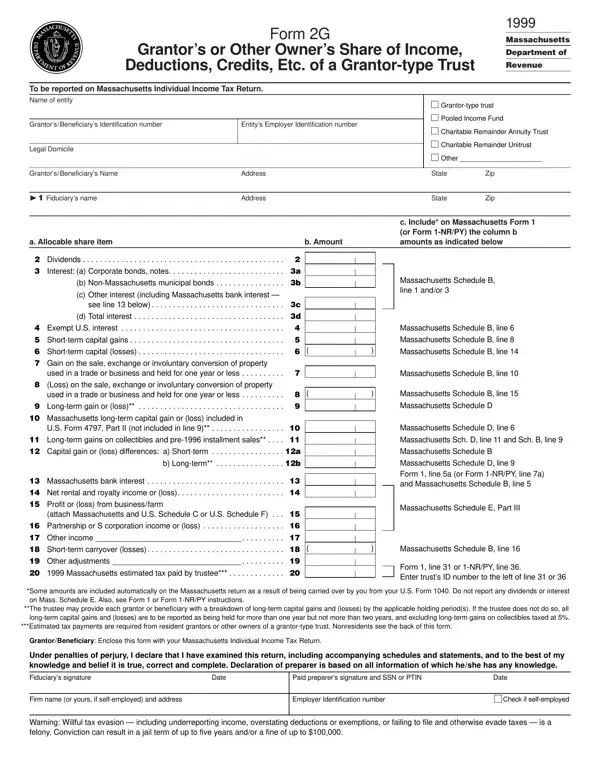
Calendar year filers enter 01-01-2025 and 12-31-2025 as the tax year; fiscal year filers enter appropriate dates.
Declaration: under penalties of perjury, the fiduciary declares that to the best of knowledge and belief this return and enclosures are true, correct and complete.
Fill in all that apply: Grantor-type trust, Charitable remainder annuity trust, Charitable remainder unitrust, Pooled income fund.
Line 24: Massachusetts income tax paid by trustee. If grantor or beneficiary enter this amount on Form 1, line 38c or Form 1-NR/PY, line 42c.
Line 25: amount of ch 63D Entity-Level Tax paid by electing entity on behalf of this grantor or beneficiary.
| Question | Answer |
|---|---|
| Form Name | Form 2G |
| Form Length | 2 pages |
| Fillable? | Yes |
| Fillable fields | 89 |
| Avg. time to fill out | 15 min |
| Edition | 2025 |
| Issuing agency | Massachusetts Department of Revenue |
| Where to send | Massachusetts Department of Revenue, PO Box 7017, Boston, MA 02204 |
| Other names | 2G, Form 2G, MA Form 2G, Massachusetts Form 2G |
| Official source | Form 2G (Rev 2025), Massachusetts Department of Revenue |
Massachusetts Form 2G isn’t the one you’re looking for?