
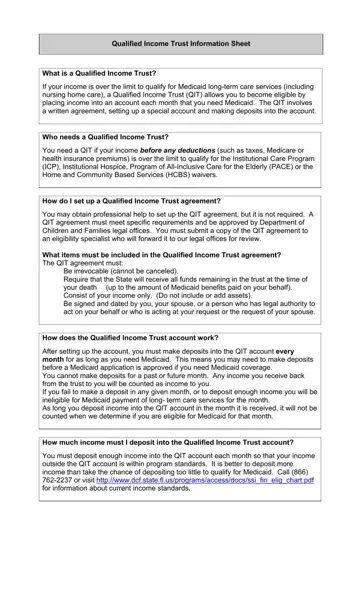
Navigating the waters of Medicaid eligibility can often feel like a daunting task, particularly for those individuals whose income exceeds the thresholds set for long-term care services, including nursing home care. This is where the Medicaid Income Trust, formally known as a Qualified Income Trust (QIT), steps in as a pivotal tool. Essentially, it's a mechanism that allows individuals to align their income with Medicaid eligibility requirements by placing excess income into a trust account. The necessity for a QIT arises when an individual’s gross income, before any deductions, surpasses the limits for qualification for various Medicaid programs. The process of establishing a QIT involves creating a legal agreement and setting up a special account into which income must be deposited every month that Medicaid assistance is required. It’s crucial to note that this agreement has specific conditions, such as being irrevocable and stipulating that the state will reclaim any remaining funds upon the death of the beneficiary, up to the total cost of Medicaid benefits provided. Moreover, the operation of the QIT account includes regular deposits matching or exceeding the income surplus to ensure eligibility, with the state assessing the account's flow to determine the beneficiary's financial responsibility towards their care costs. Understanding and managing a QIT properly is paramount, not only to secure Medicaid eligibility for essential long-term care services but also to meet the legal requisites for income handling and eventual settlement of the account in favor of the state, reflecting the intricate balance between personal financial management and compliance with program eligibility requirements.
| Question | Answer |
|---|---|
| Form Name | Medicaid Income Trust |
| Form Length | 2 pages |
| Fillable? | No |
| Fillable fields | 0 |
| Avg. time to fill out | 30 sec |
| Other names | florida qualified income trust, qualified income trust form, florida miller trust, miller trust template |