

Personal Management Merit Badge Workbook at a glance
What it is: The Personal Management Merit Badge Workbook can help you organize your thoughts as you prepare to meet with your merit badge counselor.
A filled-in Personal Management Merit Badge Workbook example: a Scout budgets Month 1
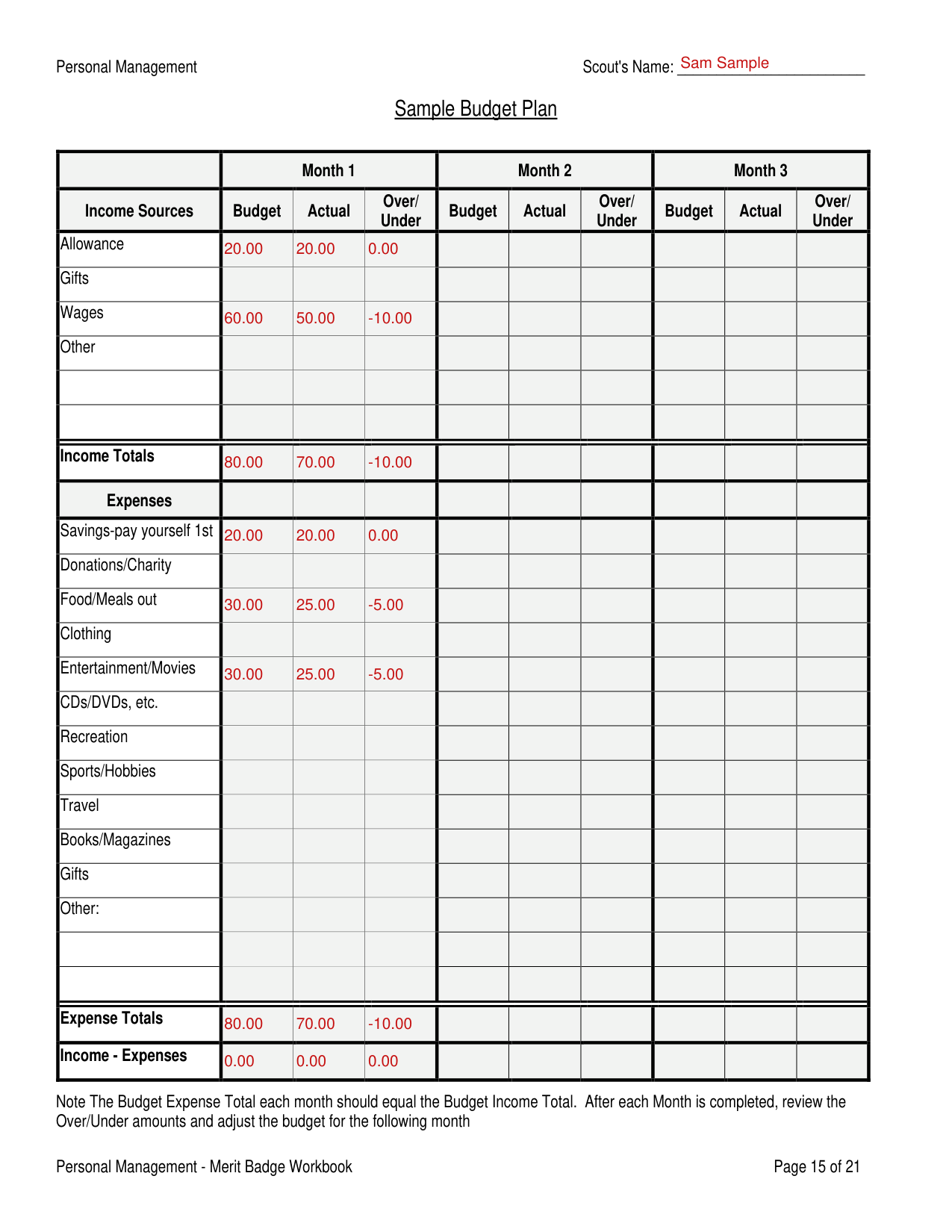
How to fill out Personal Management Merit Badge Workbook, box by box
Sample Budget Plan
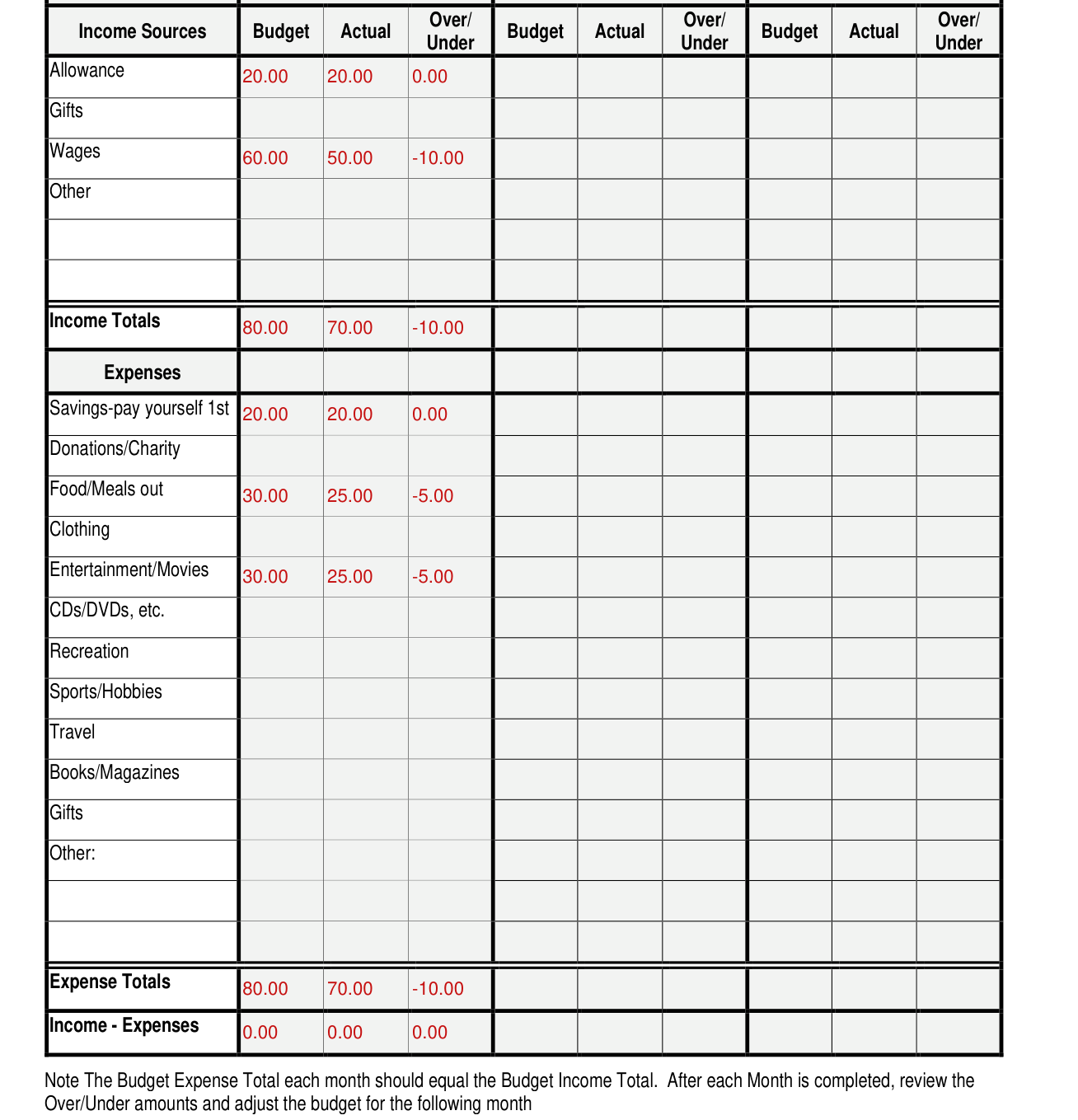
Sample Budget Plan.
After each Month is completed, review the Over/Under amounts and adjust the budget for the following month.
The Budget Expense Total each month should equal the Budget Income Total.
Date, Description of Daily Income or Expense, Category
Date, Description of Daily Income or Expense, Category, Income, Expense, Balance.
Week 1 Opening Balance.
Week 2.
Week 3.
Week 4.
Planned Schedule, To Do Tasks, Actual Results
Planned Schedule, Scheduled Time, Day 1, Day 2, Day 3, Day 4, Day 5, Day 6, Day 7.
To Do Tasks.
Actual Results.
More rules for Personal Management Merit Badge Workbook
You still need to read the merit badge pamphlet.
Merit Badge Counselors may not require the use of this or any similar workbooks. You still must satisfy your counselor that you can demonstrate each skill and have learned the information.
Use the work space provided for each requirement to keep track of which requirements have been completed, and to make notes for discussing the item with your counselor, not for providing full and complete answers.
If a requirement says that you must take an action using words such as "discuss", "show", "tell", "explain", "demonstrate", "identify", etc, that is what you must do. No one may add or subtract from the official requirements found on Scouting.org. The requirements were last revised on January 1, 2024.
Scout's Name, Unit, Date Started, Counselor's Name, Phone No. and Email.
Choose an item that your family might want to purchase that is considered a major expense.
Write a plan that tells how your family would save money for the purchase identified in requirement 1a. (1.) Discuss the plan with your merit badge counselor. (2.) Discuss the plan with your family. (3.) Discuss how other family needs must be considered in this plan.
Develop a written shopping strategy for the purchase identified in requirement 1a. Determine the quality of the item or service (using consumer publications or ratings systems).
(2.) Comparison shop for the item. Find out where you can buy the item for the best price. Provide prices from at least two different price sources.
Call around; study ads. Look for a sale or discount coupon. Consider alternatives. Can you buy the item used? Should you wait for a sale?
Prepare a budget reflecting your expected income (allowance, gifts, wages), expenses, and savings for a period of 13 consecutive weeks. There is a blank Sample Budget Plan table to set up a budget, summarize actual income and expenses, and compare them monthly at the end of this workbook, with a partially completed example.
Compare expected income with expected expenses. (1.) If expenses exceed budget income, determine steps to balance your budget. (2.) If income exceeds budget expenses, state how you would use the excess money (new goal, savings).
Track and record your actual income, expenses, and savings for 13 consecutive weeks (the same 13-week period for which you budgeted). You may use the forms provided in this pamphlet, devise your own, or use a computer-generated version. When complete, present the records showing the results to your merit badge counselor.
Compare your budget with your actual income and expenses to understand when your budget worked and when it did not work. With your merit badge counselor, discuss what you might do differently the next time.
Discuss with your merit badge counselor FIVE of the following concepts: The emotions you feel when you receive money. Your understanding of how the amount of money you have with you affects your spending habits.
Your thoughts when you buy something new and your thoughts about the same item three months later. Explain the concept of buyer's remorse. How hunger affects you when shopping for food items (snacks, groceries). Your experience of an item you have purchased after seeing or hearing advertisements for it. Did the item work as well as advertised? Your understanding of what happens when you put money into a savings account.
Charitable giving. Explain its purpose and your thoughts about it. What you can do to better manage your money.
Explain the following to your merit badge counselor: The differences between saving and investing, including reasons for using one over the other.
The concepts of return on investment and risk and how they are related. The concepts of simple interest and compound interest. The concept of diversification in investing. Why it is important to save and invest for retirement.
Explain to your merit badge counselor what the following investments are and how each works: Common stocks. Mutual Funds. Life Insurance. A certificate of deposit (CD). A savings account. A U.S. savings bond.
Explain to your counselor why people might purchase the following types of insurance and how they work: Automobile. Health. Homeowner's/renter's. Whole life and term life.
Explain to your merit badge counselor the following: What a loan is, what interest is, and how the annual percentage rate (APR) measures the true cost of a loan.
The different ways to borrow money. The differences between a charge card, debit card, and credit card. What are the costs and pitfalls of using these financial tools? Explain why it is unwise to make only the minimum payment on your credit card.
Credit reports and how personal responsibility can affect your credit report. Ways to reduce or eliminate debt.
Demonstrate to your merit badge counselor your understanding of time management by doing the following: Write a "to do" list of tasks or activities, such as homework assignments, chores, and personal projects, that must be done in the coming week. List these in order of importance to you.
Make a seven-day calendar or schedule. Put in your set activities, such as school classes, sports practices or games, jobs or chores, and/or Scout or place of worship or club meetings, then plan when you will do all the tasks from your "to do" list between your set activities.
Follow the one-week schedule you planned. Keep a daily diary or journal during each of the seven days of this week's activities, writing down when you completed each of the tasks on your "to do" list compared to when you scheduled them.
With your merit badge counselor, review your "to do" list, one-week schedule, and diary/journal to understand when your schedule worked and when it did not work. Discuss what you might do differently the next time. There is a Time Management Worksheet which can be used for planning your weekly set activities and tasks and for tracking your actual "to do" list results, at the end of this workbook, with an example.
Prepare a written project plan demonstrating the steps, including the desired outcome. This is a project on paper, not a real-life project. Discuss your completed project plan with your merit badge counselor.
Define the project. What is your goal? Develop a timeline for your project that shows the steps you must take from beginning to completion.
Describe your project. Develop a list of resources. Identify how these resources will help you achieve your goal. Develop a budget for your project.
Choose a career you might want to enter after high school or college graduation. Discuss with your counselor the needed qualifications, education, skills, and experience. Explain to your counselor what the associated costs might be to pursue this career, such as tuition, school or training supplies, and room and board. Explain how you could prepare for these costs and how you might make up for any shortfall.
Always be sure to have proper permission before using the internet.
Table for tracking your actual income, expenses, and savings for 13 consecutive weeks.
Sources
[1] Personal Management Merit Badge Workbook, U.S. Scouting Service Project (the Official source link on this page).
