
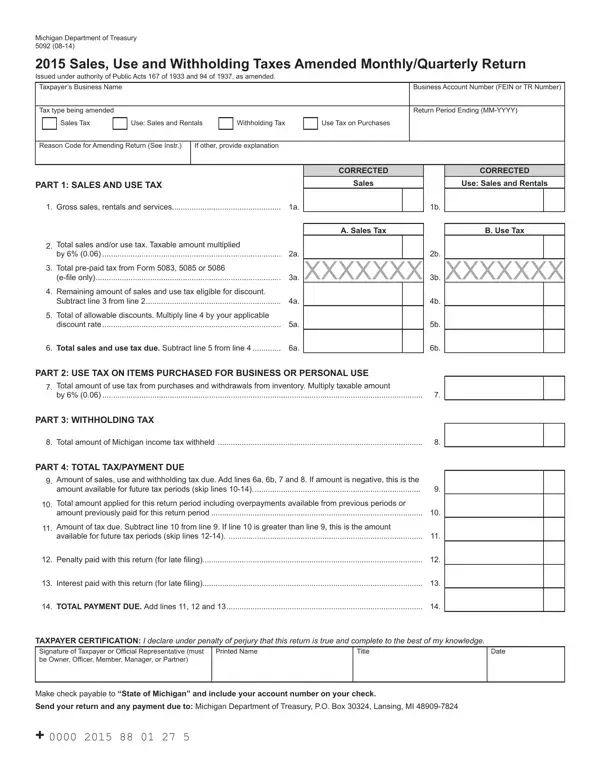

Form 5092 at a glance
What it is: Form 5092 is the 2026 Sales, Use and Withholding Taxes Amended Monthly/Quarterly Return, to correct the Monthly/Quarterly Return (Form 5080) that was initially filed for the tax period.
Where and when to file: Send the return and payment due to: Michigan Department of Treasury, P.O. Box 30324, Lansing, MI 48909-7824
What to bring and attach to Form 5092
Complete the Sales, Use and Withholding Taxes Monthly/Quarterly and Amended Monthly/Quarterly Worksheet (Form 5095, hereafter referred to as Worksheet 5095) prior to completing this form.
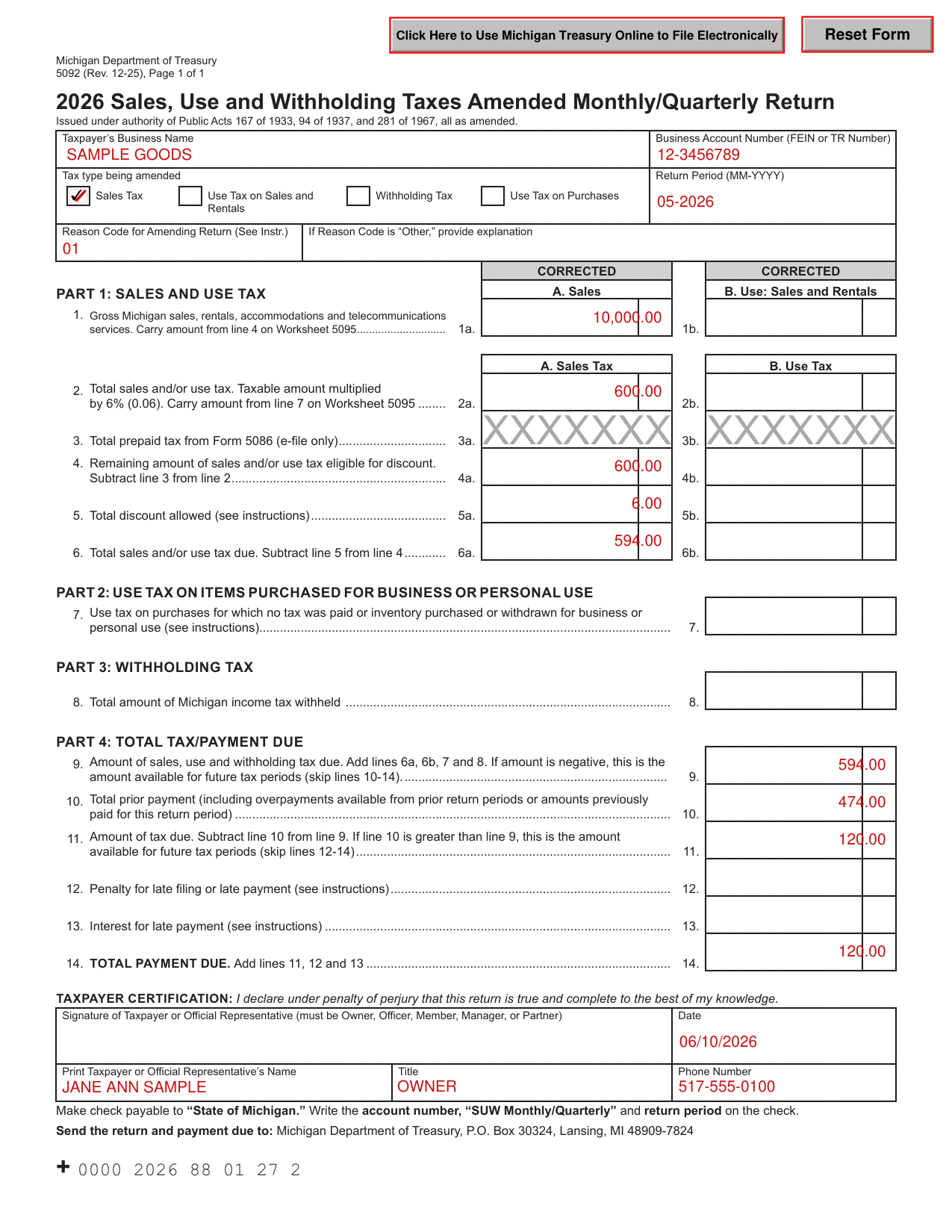
A filled-in Form 5092 example: amending a monthly sales tax return
How to fill out Form 5092, box by box
Taxpayer's business name, account number and return period

Enter the Taxpayer's Business Name, the Business Account Number (FEIN or TR Number) and the Return Period (MM-YYYY).
Tax type being amended

Check the tax type that is being amended and complete only the corresponding tax section.
Only enter figures for taxes the business is registered and/or liable for.
Reason Code for Amending Return

Select the two-digit code that best represents the reason for amending the return and enter the code in the Reason Code field at the top of page 1.
01 Increasing tax liability, 02 Decreasing tax liability, 03 Incorrect information/figures reported on original return, 04 Original return was missing information/incomplete, 05 Claiming previously unclaimed prepaid sales tax, 06 Dispute an adjustment, 07 Tax Exempt and 08 Other.
If the reason code is "Other," write an explanation for the amendment.
Part 1: Sales and use tax
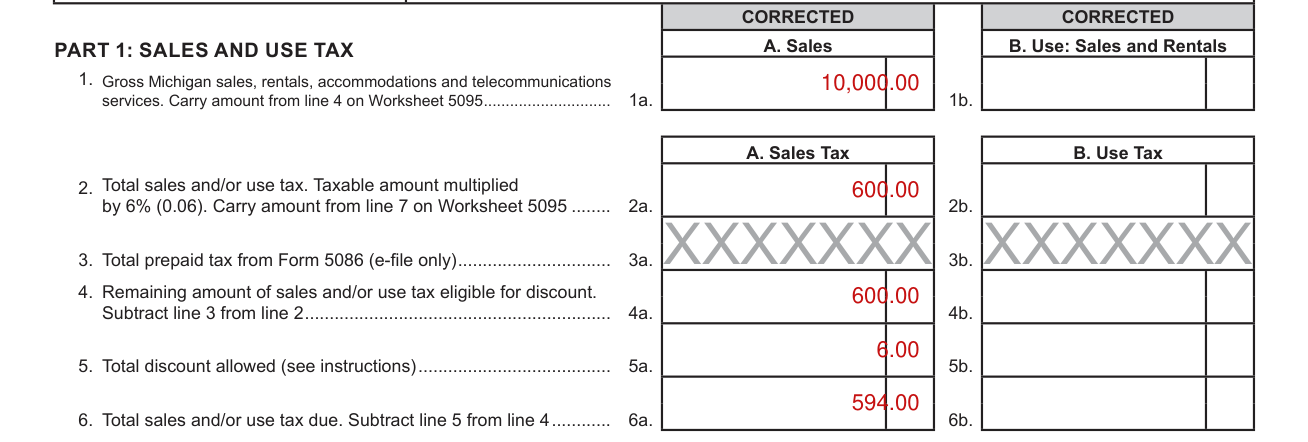
Part 1: Sales and use tax. Line 1a: Enter the amount from Worksheet 5095, line 4A.
Line 1b: Enter the amount from Worksheet 5095, line 4B.
Line 2a: Total Sales Tax. Negative figures are not allowed. Enter the amount from Worksheet 5095, line 7A. Gross sales minus allowable deductions, multiplied by 6%.
Line 2b: Total Use Tax. Negative figures not allowed. Enter the amount from Worksheet 5095, line 7B. Total receipts from sales, rentals, and services, minus allowable deductions, multiplied by 6%.
Line 3 is the total prepaid tax from Form 5086 (e-file only).
Line 4 is the remaining amount of sales and/or use tax eligible for discount. Subtract line 3 from line 2.
Line 5: Total Discount Allowed for Timely Filing and Payment. Discounts apply only to 2/3 (0.6667) of the sales and/or use tax collected at the 6 percent tax rate.
Monthly Filer: if the tax is less than $9, calculate the discount by multiplying the tax by 2/3 (.6667) (checked November 2, 2026).
Monthly Filer: if tax is $9 to $1,200 and paid by the 12th, or $9 to $1,800 and paid by the 20th, then enter $6 (checked November 2, 2026).
Monthly Filer: if the tax is more than $1,200 and paid by the 12th, calculate discount using this formula: (Tax x .6667 x .0075) The maximum discount is $20,000 for the tax period. (checked November 2, 2026).
Monthly Filer: if the tax is more than $1,800 and paid by the 20th, calculate discount using this formula: (Tax x .6667 x .005) The maximum discount is $15,000 for the tax period. (checked November 2, 2026).
Quarterly Filer: if the tax is less than $27, calculate the discount by multiplying the tax by 2/3 (.6667) (checked November 2, 2026).
Quarterly Filer: if tax is $27 to $3,600 and paid by the 12th, or $27 to $5,400 and paid by the 20th, then enter $18 (checked November 2, 2026).
Quarterly Filer: if the tax is more than $3,600 and paid by the 12th, calculate discount using this formula: (Tax x .6667 x .0075) The maximum discount is $20,000 for the tax period. (checked November 2, 2026).
Quarterly Filer: if the tax is more than $5,400 and paid by the 20th, calculate discount using this formula: (Tax x .6667 x .005) The maximum discount is $15,000 for the tax period. (checked November 2, 2026).
Accelerated Filer: if the tax is paid by the 20th, calculate discount using this formula: (Tax x .6667 x .005). No maximum discount applies.
Line 6 is the total sales and/or use tax due. Subtract line 5 from line 4.
Part 2: Use tax on items purchased for business or personal use

Part 2: Use tax on items purchased for business or personal use. Line 7: Enter the amount from Worksheet 5095, line 9. To determine use tax due from purchases and withdrawals, multiply the applicable tax base by 6%.
Part 3: Withholding tax

Part 3: Withholding tax. Line 8: Enter the total Michigan income tax withheld for the tax period.
Part 4: Total tax/payment due
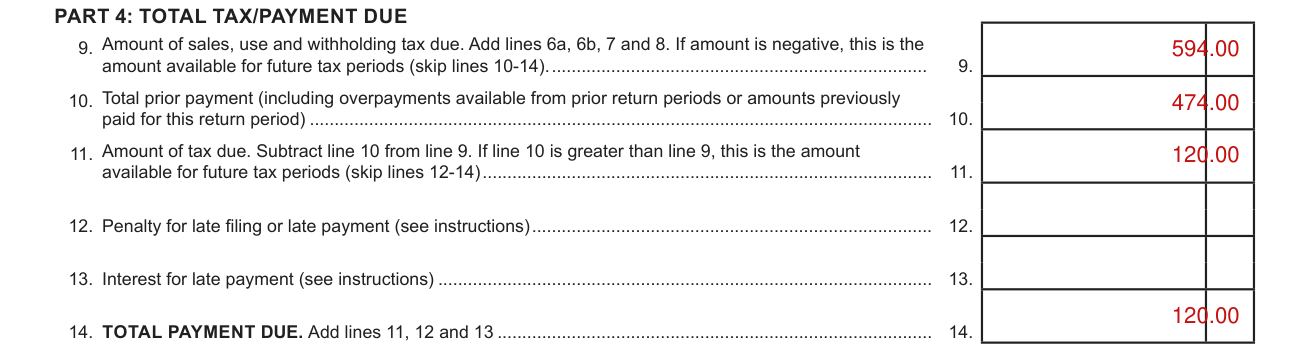
Line 9 is the amount of sales, use and withholding tax due. Add lines 6a, 6b, 7 and 8. If amount is negative, this is the amount available for future tax periods (skip lines 10-14).
Line 10: Enter any payments submitted for this period prior to filing the return or any overpayment from prior periods.
On page 3 of the 2026 Form 5092, liability minus prior/over payments for this period must be greater than or equal to zero. When claiming a prior/over payment, enter only the amount needed to pay the total liability for this return. In the event an overpayment still exists, declare it on the next return reporting a tax liability.
Line 11 is the amount of tax due. Subtract line 10 from line 9. If line 10 is greater than line 9, this is the amount available for future tax periods (skip lines 12-14).
Line 12 is the penalty for late filing or late payment.
Line 13 is the interest for late payment.
Interest is charged daily using the average prime rate, plus 1 percent.
Line 14: Total Payment Due. Add lines 11, 12 and 13.
Taxpayer certification and signature

Taxpayer certification: "I declare under penalty of perjury that this return is true and complete to the best of my knowledge."
Print the Taxpayer or Official Representative's Name, Title and Phone Number.
More rules for Form 5092
Submit payments electronically on MTO or make check payable to the "State of Michigan." Write the account number, "SUW Monthly/Quarterly" and return period on the check.
Page 2 of the 2026 Form 5092: Form 5092 is available for submission electronically using Michigan Treasury Online (MTO) at mto.treasury.michigan.gov or by using approved tax preparation software.
If it is determined that tax is owed the taxpayer will be liable for the deficiency as well as penalty and interest.
Do not pay if the amount due is less than $1 (checked November 2, 2026).
For assistance, call 517-636-6925. Assistance is available using TTY through the Michigan Relay Center by calling 711.
Common questions about Form 5092
Who signs it?
Sign the Signature of Taxpayer or Official Representative line, which must be signed by an Owner, Officer, Member, Manager, or Partner, and enter the Date.
Where do I file it?
Send the return and payment due to: Michigan Department of Treasury, P.O. Box 30324, Lansing, MI 48909-7824
Is there a penalty?
If the return is filed late with tax due, include penalty and interest with the payment. Penalty is 5% of the tax due and increases by an additional 5% per month or fraction thereof, after the second month, to a maximum of 25%.
Sources
[1] Form 5092 (Rev. 12-25), Michigan Department of Treasury (the Official source link on this page).