

NAT 3092 Tax file number declaration at a glance
What it is: NAT 3092-06.2019, Tax file number declaration: information you provide in this declaration will allow your payer to work out how much tax to withhold from payments made to you.
Who signs: You MUST SIGN here under the DECLARATION by payee: "I declare that the information I have given is true and correct."
You should complete this form before you start to receive payments from a new payer, for example payments for work and services as an employee, company director or office holder, payments under return-to-work schemes, labour hire arrangements or other specified payments, benefit and compensation payments, and superannuation benefits.
The information provided on this form is used to determine the amount of tax to be withheld from payments based on the PAYG withholding tax tables the Australian Taxation Office publishes.
A filled-in NAT 3092 Tax file number declaration example: a new employee changed her name
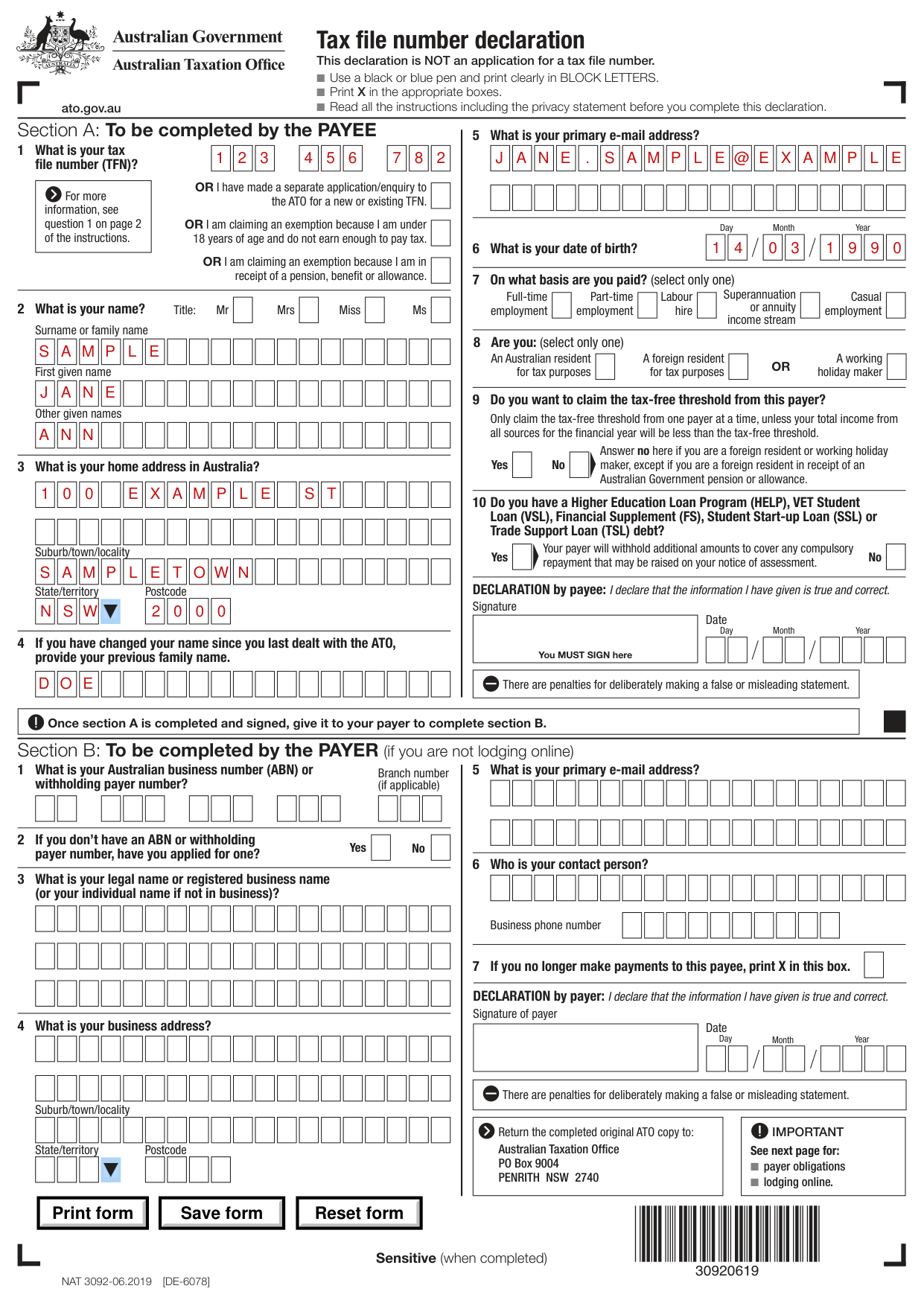
How to fill out NAT 3092 Tax file number declaration, box by box
What is your tax file number (TFN)?

Question 1: What is your tax file number (TFN)? You should give your TFN to your employer only after you start work for them. Never give your TFN in a job application or over the internet.
Your payer is required to withhold the top rate of tax from all payments made to you if you do not provide your TFN or claim an exemption from quoting your TFN.
It's not an offence not to quote your TFN. However, quoting your TFN reduces the risk of administrative errors and having extra tax withheld.
Print X in the appropriate box if you have lodged a TFN application form or made an enquiry to obtain your TFN. You now have 28 days to provide your TFN to your payer, who must withhold at the standard rate during this time.
After 28 days, if you haven't given your TFN to your payer, they will withhold the top rate of tax from future payments. You may be able to claim an exemption from quoting your TFN. Print X in the appropriate box if you are claiming an exemption from quoting a TFN because you are under 18 years of age and do not earn enough to pay tax, or you are an applicant or recipient of certain pensions, benefits or allowances from the Department of Human Services (however, you will need to quote your TFN if you receive a Newstart, Youth or sickness allowance, or an Austudy or parenting payment), the Department of Veterans' Affairs (a service pension under the Veterans' Entitlement Act 1986) or the Military Rehabilitation and Compensation Commission.
Question 2-6 Complete with your personal information
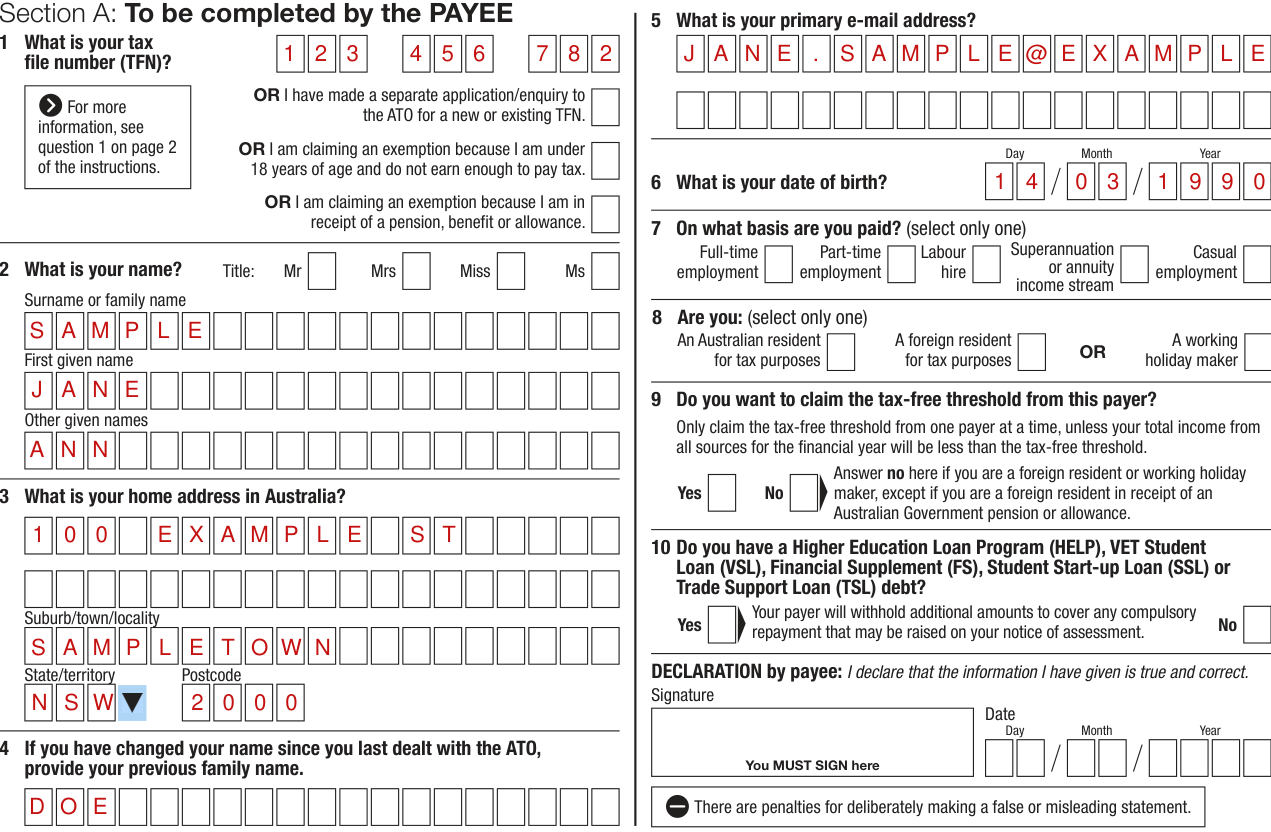
Question 2-6 Complete with your personal information.
If you have changed your name since you last dealt with the ATO, provide your previous family name.
Section B: To be completed by the PAYER
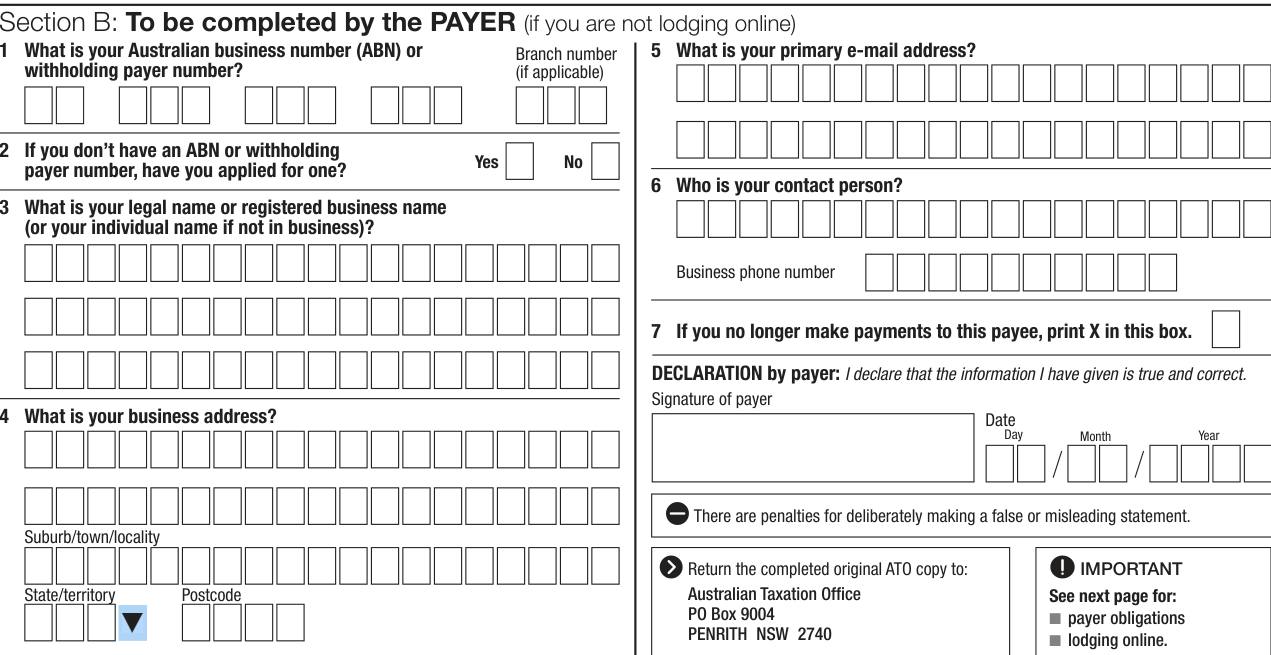
The payer completes Section B if the payer is not lodging online.
Give your completed declaration to your payer to complete section B.
7. If you no longer make payments to this payee, print X in this box.
More rules for NAT 3092 Tax file number declaration
You need to provide all information requested on this form. Providing the wrong information may lead to incorrect amounts of tax being withheld from payments made to you.
You don't need to complete this form if you are a beneficiary wanting to provide your tax file number (TFN) to the trustee of a closely held trust, or are receiving superannuation benefits from a super fund and have been taken to have quoted your TFN to the trustee of the super fund.
If your situation is different
You can't find your TFN or you don't have one
You can find your TFN on any of the following: your income tax notice of assessment, correspondence the Australian Taxation Office sends you, a payment summary your payer issues to you. If you have a tax agent, they may also be able to tell you. If you still can't find your TFN, you can phone the Australian Taxation Office on 13 28 61 between 8.00am and 6.00pm, Monday to Friday.
If you don't have a TFN and want to provide a TFN to your payer, you will need to apply for one.
On what basis are you paid?
On what basis are you paid? Select only one: Full‑time employment, Part‑time employment, Casual employment, Labour hire, or Superannuation or annuity income stream.
Check with your payer if you're not sure.
Are you an Australian resident for tax purposes or a working holiday maker?
Question 8: Are you an Australian resident for tax purposes or a working holiday maker? Generally, the Australian Taxation Office considers you to be an Australian resident for tax purposes if you have always lived in Australia or you have come to Australia and now live here permanently, are an overseas student doing a course that takes more than six months to complete, or migrate to Australia and intend to reside here permanently. If you go overseas temporarily and don't set up a permanent home in another country, you may continue to be treated as an Australian resident for tax purposes.
If you are in Australia on a working holiday visa (subclass 417) or a work and holiday visa (subclass 462) you must place an X in the working holiday maker box. Special rates of tax apply for working holiday makers.
If you're not an Australian resident for tax purposes or a working holiday maker, place an X in the foreign resident box, unless you are in receipt of an Australian Government pension or allowance.
Do you want to claim the tax‑free threshold from this payer?
The tax‑free threshold is the amount of income you can earn each financial year that is not taxed. By claiming the threshold, you reduce the amount of tax that is withheld from your pay during the year.
Answer yes if you want to claim the tax‑free threshold, you are an Australian resident for tax purposes, and one of the following applies: you are not currently claiming the tax‑free threshold from another payer, or you are currently claiming the tax‑free threshold from another payer and your total income from all sources will be less than the tax‑free threshold. Answer yes if you are a foreign resident in receipt of an Australian Government pension or allowance. Answer no if none of these apply or you are a working holiday maker.
Only claim the tax‑free threshold from one payer at a time, unless your total income from all sources for the financial year will be less than the tax‑free threshold.
Do you have a HELP, VSL, FS, SSL or TSL debt?
Answer yes if you have a HELP, VSL, FS, SSL or TSL debt. Answer no if you do not have a HELP, VSL, FS, SSL or TSL debt, or you have repaid your debt in full.
Your payer will withhold additional amounts to cover any compulsory repayment that may be raised on your notice of assessment.
When you have repaid your HELP, VSL, FS, SSL or TSL debt, you need to complete a Withholding declaration (NAT 3093) notifying your payer of the change in your circumstances.
You want to claim a tax offset
If you want to claim the seniors and pensioners tax offset, or a zone, overseas forces or invalid and invalid carer tax offset, by reducing the amount withheld from payments made to you, you should complete a withholding declaration form (NAT 3093).
Sign and date the declaration
Make sure you have answered all the questions in section A, then sign and date the declaration.
There are penalties for deliberately making a false or misleading statement.
Before you go
Use a black or blue pen and print clearly in BLOCK LETTERS. Print X in the appropriate boxes. Read all the instructions including the privacy statement before you complete this declaration.
Common questions about NAT 3092 Tax file number declaration
Is there a deadline?
The payer needs to lodge TFN declarations with the Australian Taxation Office within 14 days after the form is either signed by the payee or completed by the payer (if not provided by the payee).
Where do I file it?
Once section A is completed and signed, give it to your payer to complete section B. The payer returns the completed original ATO copy to: Australian Taxation Office PO Box 9004 PENRITH NSW 2740
When is this form not the right one?
This is not a TFN application form. To apply for a TFN, go to ato.gov.au/tfn
Sources
[1] NAT 3092-06.2019 Tax file number declaration (printed edition 06.2019; the served file; no issuer file found) (the Official source link on this page).
