
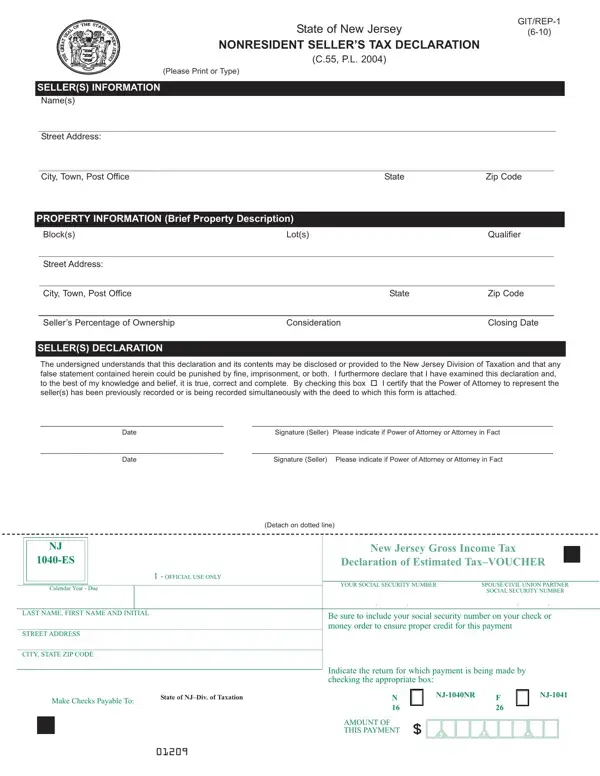
Form NJ-1040-ES at a glance
What it is: NJ-1040-ES is the NJ Gross Income Tax Declaration of Estimated Tax.
Tax deadline: When to File: You can pay in full on or before April 15, 2026, or in four equal installments.[2]
Page 1 of the 2026 Form NJ-1040-ES, What is Estimated Tax: estimated tax refers to paying tax on your income as it is earned throughout the year if you do not already pay tax through withholdings, or if not enough tax is withheld.[2]
Whether you are a resident or a nonresident, you are required to make estimated tax payments if you estimate that you will owe more than $400. This also is true for certain estates and trusts. (checked November 12, 2026)[2]
If you made an estimated payment(s) for the prior year but do not expect to have a New Jersey Income Tax liability for 2026, you do not need to make estimated payments.[2]
If your gross income for the entire year is at or under the filing threshold, you are not required to file a New Jersey Income Tax return and do not need to make estimated payments.[2]
Filing thresholds: $20,000 or less (filing status married/CU couple, filing joint return or head of household or qualifying widow(er)/surviving CU partner), or $10,000 or less (estates and trusts, or individuals with filing status single or married/CU partner, filing separate return). (checked November 12, 2026)[2]
A filled-in Form NJ-1040-ES example: a resident pays the first installment
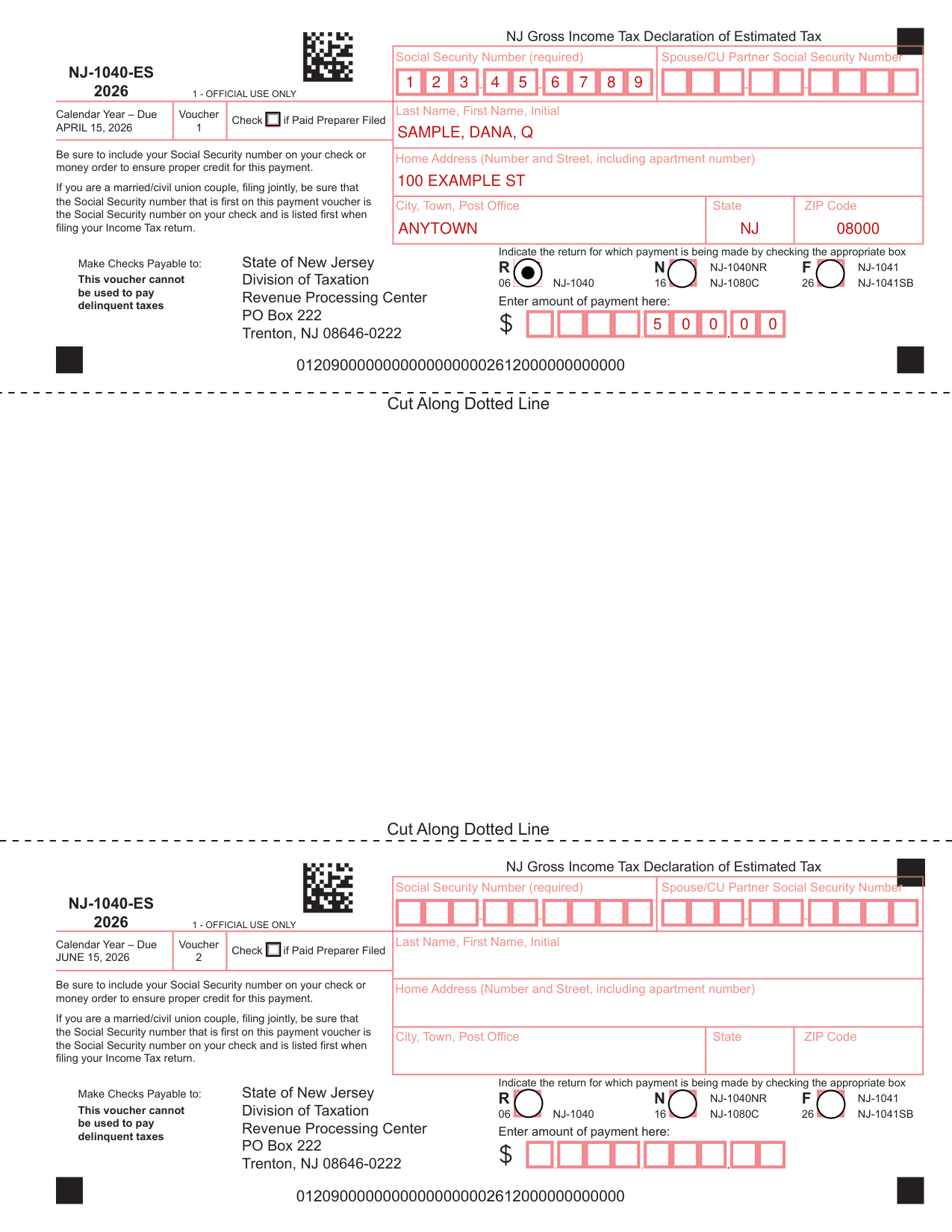
How to fill out Form NJ-1040-ES, box by box
Name, address and Social Security number
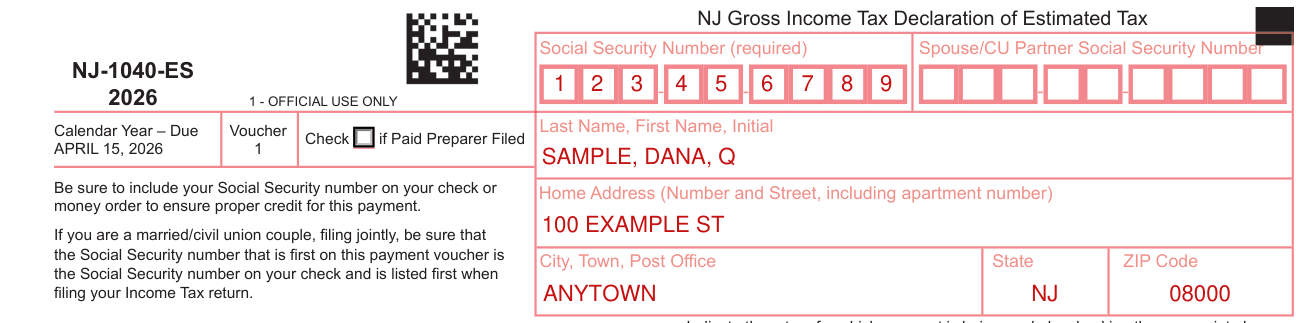
Enter your name, address, and Social Security number on the voucher (if not preprinted).
If you are filing jointly, include the name and Social Security numbers for both of you in the same order the names are listed on your New Jersey Income Tax return.
If you are a married/civil union couple, filing jointly, be sure that the Social Security number that is first on this payment voucher is the Social Security number on your check and is listed first when filing your Income Tax return.
Estates and trusts enter the federal employer identification number.
Be sure to include your Social Security number on your check or money order to ensure proper credit for this payment.[2]
The return for which payment is being made
Check the appropriate box to indicate the return for which payment is being made: Resident (Form NJ-1040), Nonresident (Form NJ-1040NR or NJ-1080C), or Fiduciary (Form NJ-1041 or NJ-1041SB).[2]
Amount of the payment

Enter the actual amount of the payment being submitted in the spaces on the voucher.[2]
More rules for Form NJ-1040-ES
If you fail to pay all or any part of your required estimated tax, underpayment of estimated tax occurs. Interest is added to the underpayment amount for that period.[2]
Interest will be assessed at the prime rate plus 3%, compounded annually.[2]
Estimated tax payments are not payments for prior year tax debts.[2]
If you have changes in income, exemptions, or deductions, you may be required to make an estimated tax payment even if payments were not previously required.[2]
Determine your expected income, then subtract your exemptions and deductions to arrive at your expected taxable income.[2]
Apply the appropriate tax rate to your expected taxable income.[2]
Subtract total anticipated credits and withholdings to arrive at your estimated tax.[2]
Use the estimated tax worksheet on page 4 as a guide for this calculation.[2]
Before you go
Completing the NJ-1040-ES Voucher: Complete the voucher only if paying by check or money order.
Do not complete the voucher if you are paying by e-check or credit card.
Make checks payable to State of New Jersey.
This voucher cannot be used to pay delinquent taxes.
Common questions about Form NJ-1040-ES
How to pay NJ 1040 ES online?
You can have your payment directly withdrawn from your bank account using the online e-check service. You need the Social Security number and date of birth of the first person listed on your New Jersey Income Tax return to make a payment. Do not send in a voucher when paying by e-check. You can use an American Express, Discover, MasterCard, or Visa credit card to make your payment. Do not send in a voucher when paying by credit card.[2]
Is there a deadline?
When to File: You can pay in full on or before April 15, 2026, or in four equal installments. If you are paying your estimated tax in four equal installments, additional payments must be made on or before June 15, 2026, September 15, 2026, and January 15, 2027.[2]
Where do I file it?
Mail your payment with the completed voucher (NJ-1040-ES) to: State of New Jersey, Division of Taxation, Revenue Processing Center, PO Box 222, Trenton NJ 08646-0222.[2]
Are there fees?
Credit Card (Processing Fees Apply).[2]
When is this form not the right one?
This voucher cannot be used to pay delinquent taxes. Do not use Form NJ-1040-ES to pay outstanding balances for prior years.[2]
Sources
[1] Form NJ-1040-ES (2026), NJ Gross Income Tax Declaration of Estimated Tax, New Jersey Division of Taxation (the Official source link on this page).
[2] 2026 Form NJ-1040-ES instructions, New Jersey Division of Taxation.