
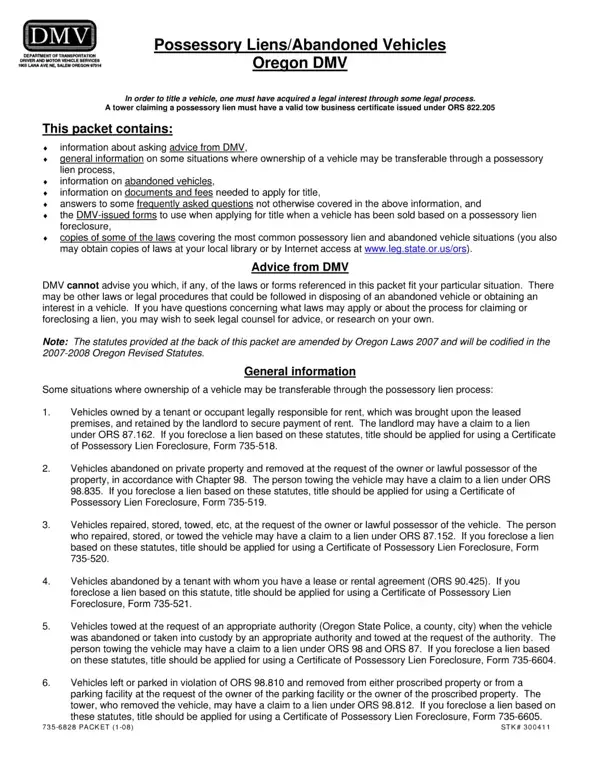

Packet 735-6828 at a glance
What it is: DMV Possessory Liens / Abandoned Vehicles, packet 735-6828 (1-26): with abandoned vehicles the vehicle title is often not available for transfer; DMV must get satisfactory proof of the applicant's legal interest in the vehicle.
Where to get it: Towers can get possessory lien certification forms online from DMV. Certification forms for the more common liens, such as possessory labor or storage liens and landlord liens, are available online from DMV.
Possessory Liens: to title any vehicle, the applicant must have obtained legal interest in the vehicle through a legal process.
Generally, the lien claimant does not apply for title; whoever buys the vehicle at a sale after the lien foreclosure usually applies for title.
For a vehicle sold through foreclosure of a lien by the tower who towed the vehicle, DMV requires a certification from the tower about the lien, its foreclosure, and the sale that followed. For a vehicle sold through foreclosure of another type of lien, DMV requires a certification from the lien claimant.
A tower claiming a possessory lien must have a valid tow business certificate issued under ORS 822.205.
What to bring and attach to Packet 735-6828
The title applicant must submit to DMV the appropriate possessory lien certification form, fully completed and signed by the lien claimant. DMV will reject your application if you submit more than one type of possessory lien certification form.
A filled-in Packet 735-6828 example: a landlord certifies a tenant's car sale
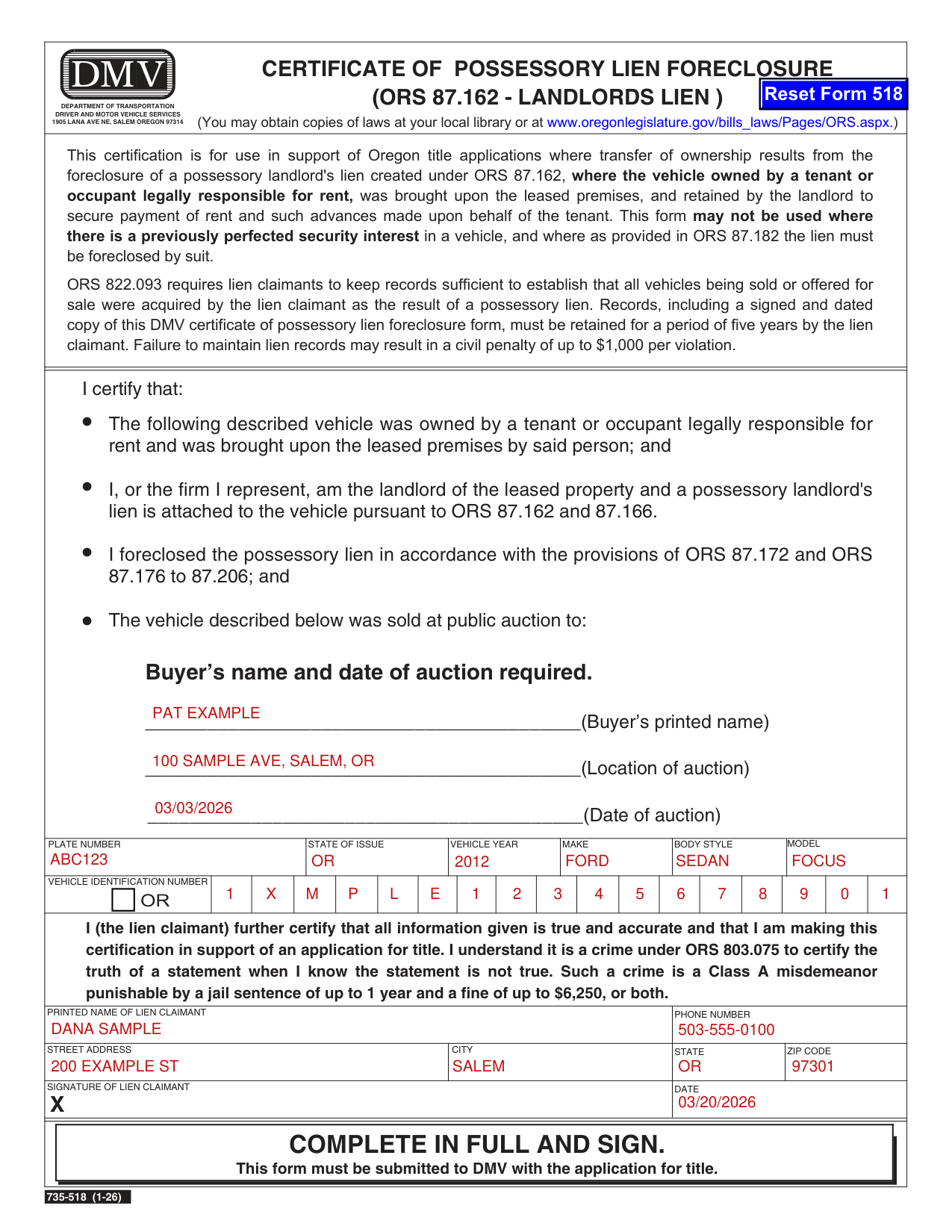
How to fill out Packet 735-6828, box by box
Vehicle sold at public auction
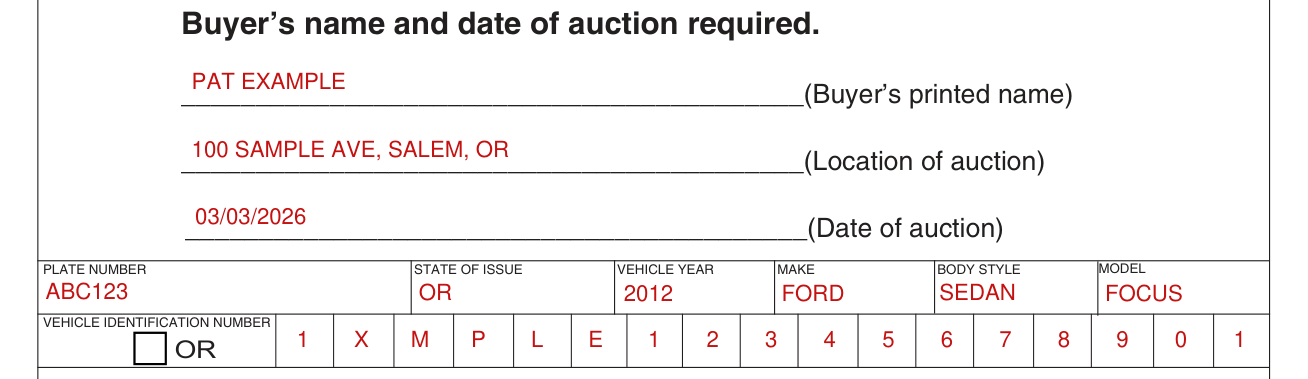
Enter the buyer's printed name and the date of auction for the vehicle sold at public auction.
Enter the plate number, state of issue, vehicle year, make, body style, model and vehicle identification number.
Printed name of lien claimant and signature

Enter the printed name of lien claimant, phone number, street address, city, state and zip code, and sign on the signature of lien claimant line.
This form may not be used where there is a previously perfected security interest in a vehicle, and where as provided in ORS 87.182 the lien must be foreclosed by suit.
More rules for Packet 735-6828
The lien claimant then gives the certification form to the buyer. The buyer, or a later buyer, can apply for title.
ORS 822.093 requires lien claimants to keep records sufficient to establish that all vehicles being sold or offered for sale were acquired by the lien claimant as the result of a possessory lien. Records, including a signed and dated copy of the DMV certificate of possessory lien foreclosure form, must be retained for a period of five years by the lien claimant.
Failure to maintain records on a vehicle may result in fines, and DMV might not process the title transaction.
Complete in full and sign. This form must be submitted to DMV with the application for title.
Which possessory lien certification form
A vehicle brought upon the leased premises and retained by the landlord
A vehicle, owned by a tenant or occupant legally responsible for rent, was brought upon the leased premises and retained by the landlord to secure payment of rent.
The landlord may have a claim to a lien under ORS 87.162.
This statute does not apply if the title record shows that there was a loan on the vehicle.
The title applicant should submit a Certificate of Possessory Lien Foreclosure, Form 735-518, if a claimant forecloses a lien based on this statute.
This certification is for use in support of Oregon title applications where transfer of ownership results from the foreclosure of a possessory landlord's lien created under ORS 87.162, where the vehicle owned by a tenant or occupant legally responsible for rent, was brought upon the leased premises, and retained by the landlord to secure payment of rent and such advances made upon behalf of the tenant.
A vehicle is abandoned on private property
A vehicle is abandoned on private property and removed at the request of the owner or lawful possessor of the property according to ORS 98.
The tower who removed the vehicle may have a claim to a lien under ORS 98.830.
Form 735-519 is the Certificate of Possessory Lien Foreclosure the title applicant should submit if a claimant forecloses a lien based on these statutes.
A vehicle is repaired, stored, or towed at the request of the owner or lawful possessor
A vehicle is repaired, stored, towed, etc. at the request of the owner or lawful possessor of the vehicle.
The person who repaired, stored, or towed the vehicle may have a claim to a lien under ORS 87.152.
Based on this statute, if a claimant forecloses a lien, the title applicant should submit a Certificate of Possessory Lien Foreclosure, Form 735-520.
Lien claimants are required to file a Surety Bond, Form 735-522B or an irrevocable letter of credit in the amount of $20,000 with DMV unless they are a franchised dealership, as defined in ORS 650.120 (5); are a manufacturer, as defined in ORS 650.120; hold a towing business certificate issued under ORS 822.205; or are a national auction company titling the vehicle according to ORS 87.152 (3) (checked October 22, 2026).
Lien claimants who file these documents with DMV must also submit an annual written certification that the bond or letter of credit is still in effect.
A vehicle is abandoned by a tenant with whom a landlord has a lease or rental agreement
A vehicle is abandoned by a tenant with whom a landlord has a lease or rental agreement.
The landlord may have a claim to a lien under ORS 90.425.
The title applicant should submit a Certificate of Possessory Lien Foreclosure, Form 735-521, if a claimant forecloses a lien based on this statute.
A vehicle is left or parked in violation of ORS 98.810
A vehicle is left or parked in violation of ORS 98.810 and removed from either proscribed property or a parking facility at the request of the owner of the proscribed property or parking facility.
The tower who removed the vehicle may have a claim to a lien under ORS 98.812.
Based on these statutes, if a claimant forecloses a lien, the title applicant should submit a Certificate of Possessory Lien Foreclosure, Form 735-6605.
Common questions about Packet 735-6828
How do I notify the DMV of my car sale in Oregon?
DMV must receive a completed and signed Notice of Sale or Transfer of Vehicle, Form 735-6890.
Who signs it?
After a lien claimant forecloses a lien, they must fully complete and sign the appropriate possessory lien certification form. The lien claimant address must be a physical address. Towers must include the valid tow plate number of the tow truck they used. Towers must use the name on their valid tow plate record for the lien claimant name on the certification form.
Is there a deadline?
A lien claimant must notify DMV within 10 days of a sale or transfer of interest of a vehicle.
Where do I file it?
The title applicant must submit to DMV an Application for Title and Registration, Form 735-226, fully completed and signed or an electronic application completed at DMV.
Are there fees?
The title applicant must submit to DMV the appropriate title fee. If the vehicle was last titled in Oregon, you must apply for title within 30 days of buying the vehicle to avoid paying late fees. If the vehicle was last titled in another state, or must be titled as an assembled, reconstructed, or replica vehicle, DMV must do a physical inspection of the vehicle identification number (VIN). The inspection fee is $9 (checked October 22, 2026).
Is there a penalty?
Failure to maintain lien records may result in a civil penalty of up to $1,000 per violation (checked October 22, 2026).
What am I certifying when I sign?
There are no special instructions for completing the form. Be sure that each section of the form is complete and that you have signed the form. Your signature certifies that you have complied with all applicable lien foreclosure laws and rules.
When is this form not the right one?
Oregon DMV will not accept a title application when the legal process to transfer vehicle ownership is based on out-of-state abandoned vehicle or foreclosure laws.
Sources
[1] DMV Possessory Liens / Abandoned Vehicles, packet 735-6828 (1-26), Oregon DMV (the Official source link on this page).