

Michigan SCAO Form PC 583 at a glance
What it is: The Account of Fiduciary, Short Form (SCAO Form PC 583) is the account a fiduciary submits to a State of Michigan probate court for a period that may not exceed 12 months.
Who signs: The fiduciary signs on the Fiduciary signature line, and an attorney signs on the Attorney signature line.
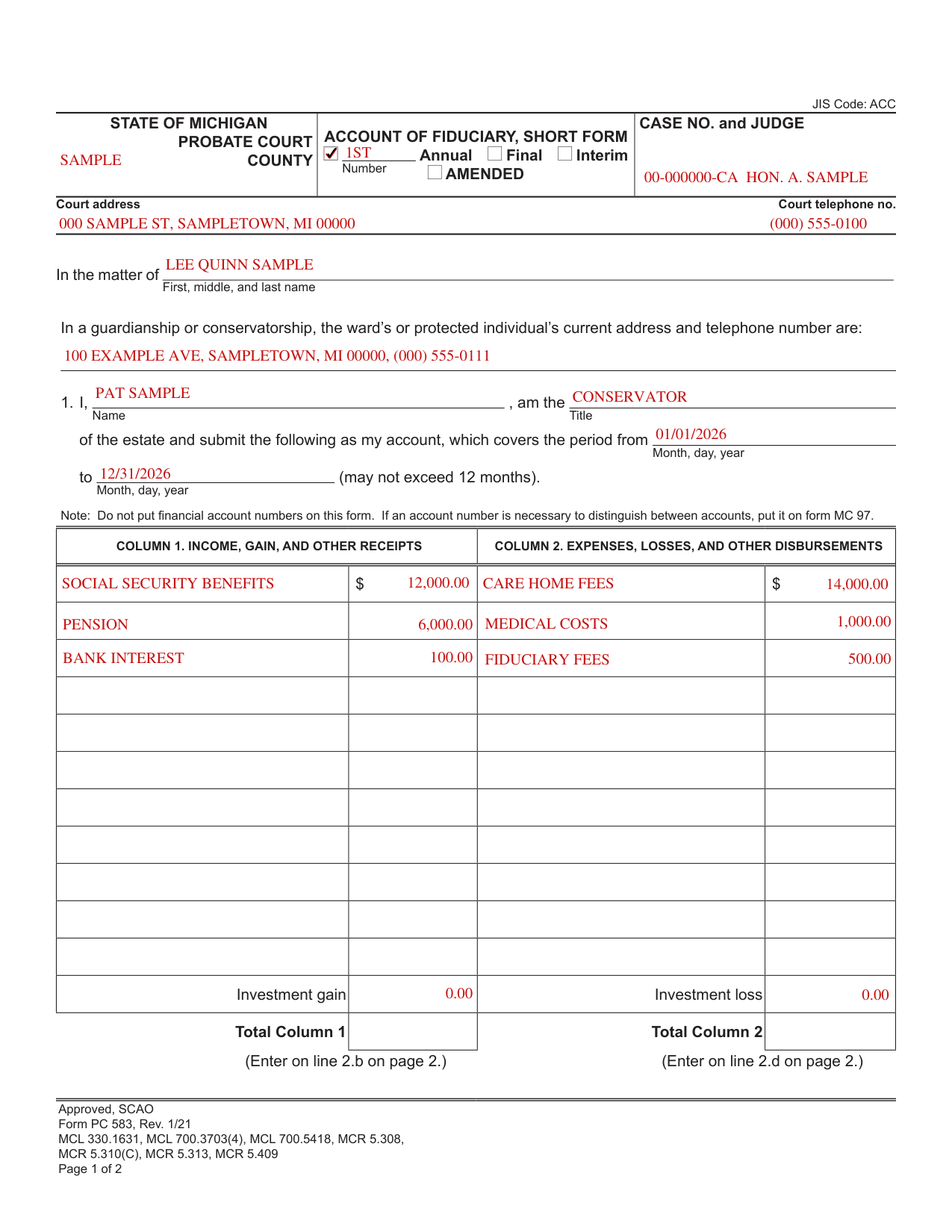
A filled-in Michigan SCAO Form PC 583 example: a conservator's first annual account
How to fill out Michigan SCAO Form PC 583, box by box
COUNTY, CASE NO. and JUDGE, In the matter of
Fill in the COUNTY, the CASE NO. and JUDGE, the Court address and the Court telephone no.
After In the matter of, enter the First, middle, and last name.
In a guardianship or conservatorship, enter the ward's or protected individual's current address and telephone number.
Annual, Final, Interim or AMENDED
Mark Annual, with its Number, Final, or Interim, and mark AMENDED if it is amended.
1. Name, Title and the period (may not exceed 12 months)
After I, write your Name and Title, and enter the period the account covers, from Month, day, year to Month, day, year; the period may not exceed 12 months.
COLUMN 1. INCOME, GAIN, AND OTHER RECEIPTS and COLUMN 2. EXPENSES, LOSSES, AND OTHER DISBURSEMENTS
List income, gain, and other receipts in Column 1, with Investment gain, and expenses, losses, and other disbursements in Column 2, with Investment loss.
Enter Total Column 1 on line 2.b on page 2, and enter Total Column 2 on line 2.d on page 2.
Do not put financial account numbers on this form; if an account number is necessary to distinguish between accounts, put it on form MC 97.
Item 2: Balance of assets on hand
On line 2.a, enter the balance on hand from the last account, or the value of the inventory if this is the first account.
On line 2.c, add line 2.a to line 2.b and enter the subtotal.
On line 2.e, subtract line 2.d from line 2.c and enter the balance of assets on hand; this line must equal the last line in item 3.
Item 3: ITEMIZED ASSETS REMAINING AT END OF ACCOUNTING PERIOD
In item 3, itemize the assets remaining at the end of the accounting period.
The Total balance on hand must equal the last line in item 2.
In guardianships and conservatorships, except as provided by MCR 5.409(C)(4), you must present to the court copies of corresponding financial institution statements or file with the court a verification of funds on deposit; either must reflect the value of all liquid assets held by a financial institution dated within 30 days after the end of the accounting period.
4. Interested persons, addresses, and their representatives
The interested persons, addresses, and their representatives are identical to those appearing on the initial application/petition, except as follows: for each person whose address changed, list the name and new address; attach a separate sheet if necessary.
5 and 6. This account is not being filed with the court
The account lists all income and other receipts and expenses and other disbursements that have come to your knowledge.
Check 6 if this account is not being filed with the court.
7 and 8. Fiduciary fees and Attorney fees
In 7, enter your fiduciary fees incurred during this accounting period, including fees that have already been approved and/or paid for this accounting period, and attach a written description of the services performed.
In 8, enter the attorney fees incurred during this accounting period, including fees that have already been approved and/or paid for this accounting period, and attach a written description of the services performed.
Fiduciary signature, Date and Attorney signature
By signing, you declare under the penalties of perjury that this account has been examined by you and that its contents are true to the best of your information, knowledge, and belief; enter the Date, the Fiduciary name (type or print), Address, City, state, zip and Telephone no.
An attorney enters the Attorney name (type or print), Bar no., Address, City, state, zip and Telephone no.
If your situation is different
If you object to the account (NOTICE TO INTERESTED PERSONS)
For accounts that must be filed with the court, you must bring to the court's attention any objection you have to the account; except in guardianships and conservatorships, the court does not normally review the account without an objection.
You have the right to review proofs of income and disbursements at a time reasonably convenient to the fiduciary and yourself.
You may object to all or part of an accounting by filing a written objection with the court before the court allows the account.
You must pay a $20.00 filing fee to the court when you file the objection, under MCR 5.310[C] (checked November 14, 2026).
You must serve the objection on the fiduciary or his/her attorney; if an objection is filed and is not otherwise resolved, the court will conduct a hearing on the objection.
Sources
[1] SCAO Form PC 583 (Rev. 1/21), Account of Fiduciary, Short Form (the Official source link on this page).
