

Form SF-3107 at a glance
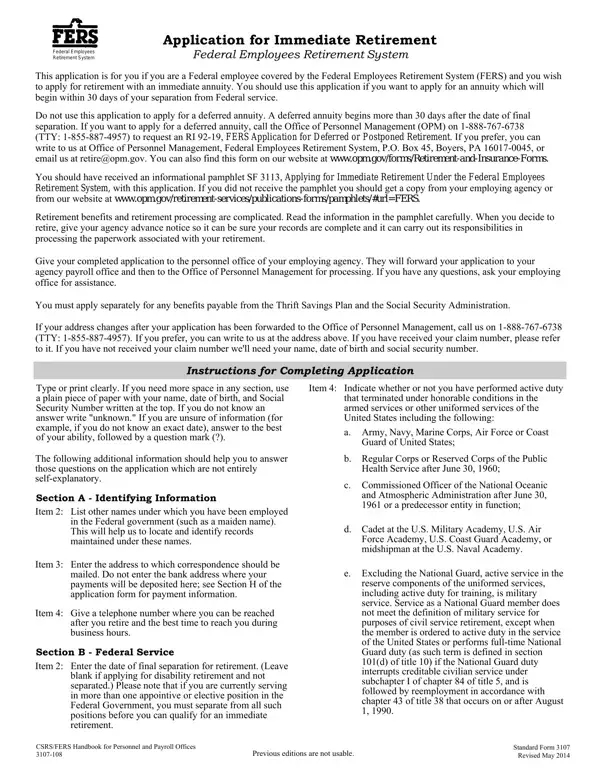
What it is: Application for Immediate Retirement is for a Federal employee covered by the Federal Employees Retirement System (FERS) who wishes to apply for retirement with an immediate annuity.
Where and when to file: Give your completed application to the personnel office of your employing agency.
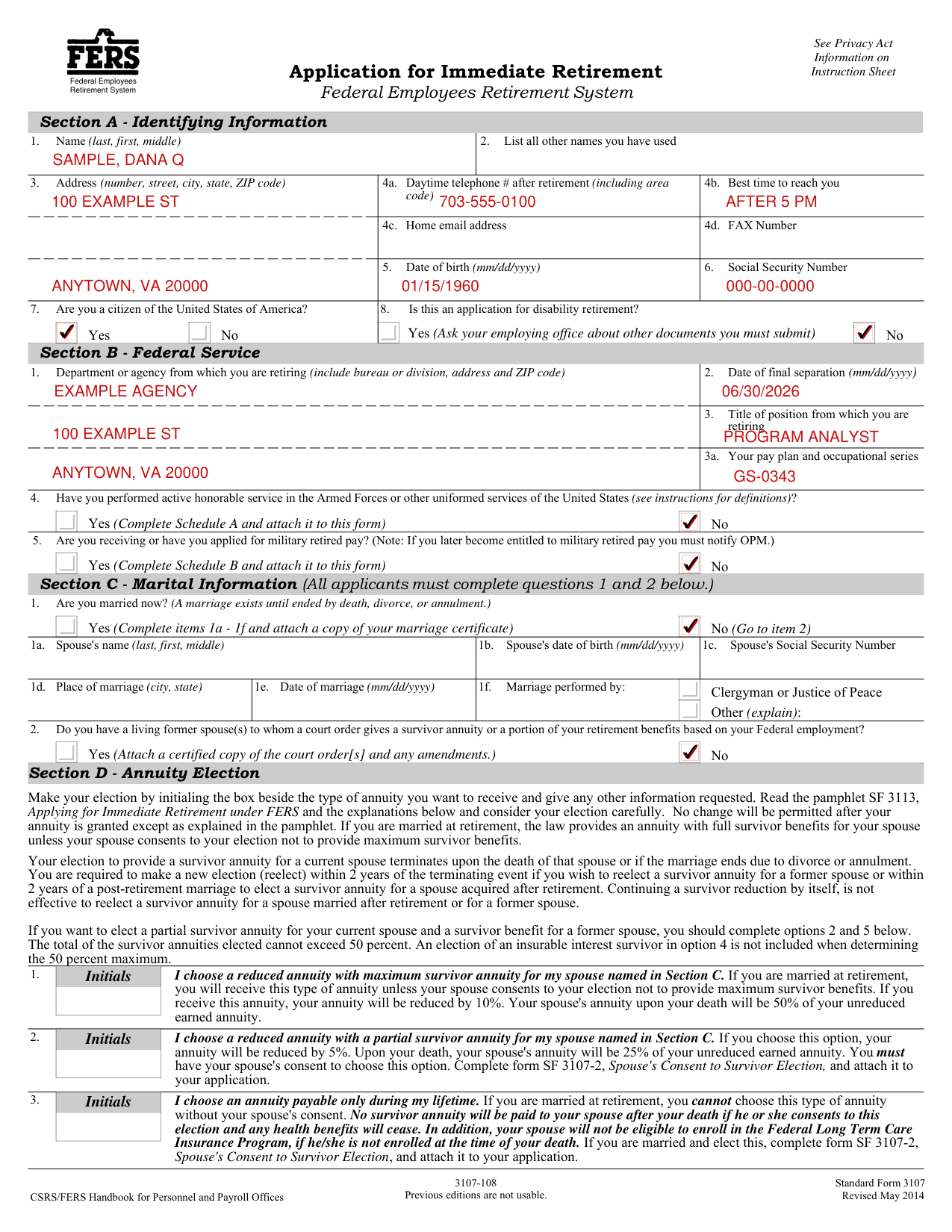
A filled-in Form SF-3107 example: a retiring employee fills in Sections A to C
How to fill out Form SF-3107, box by box
Section A - Identifying Information
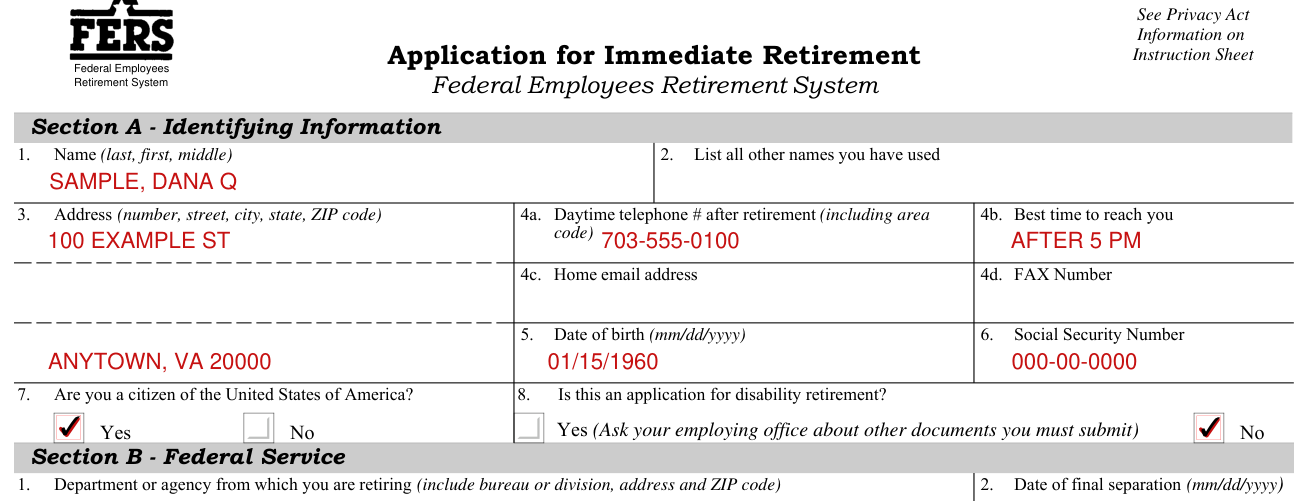
Under Section A - Identifying Information, enter your Name (last, first, middle).
Enter the address to which correspondence should be mailed. Do not enter the bank address where your payments will be deposited here; see Section H of the application form for payment information.
Give a telephone number where you can be reached after you retire and the best time to reach you during business hours.
Enter your Date of birth (mm/dd/yyyy) and your Social Security Number.
Are you a citizen of the United States of America? Yes or No. Is this an application for disability retirement? Yes (Ask your employing office about other documents you must submit) or No.
Section B - Federal Service
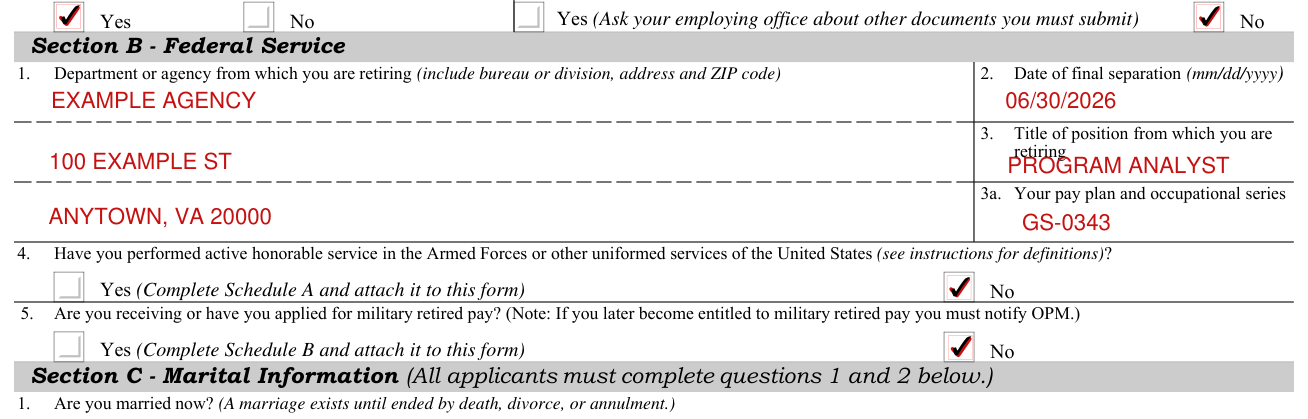
Enter the Department or agency from which you are retiring (include bureau or division, address and ZIP code).
Enter the date of final separation for retirement. (Leave blank if applying for disability retirement and not separated.) Please note that if you are currently serving in more than one appointive or elective position in the Federal Government, you must separate from all such positions before you can qualify for an immediate retirement.
Enter the Title of position from which you are retiring and your pay plan and occupational series.
Have you performed active honorable service in the Armed Forces or other uniformed services of the United States (see instructions for definitions)? Yes (Complete Schedule A and attach it to this form) or No.
Are you receiving or have you applied for military retired pay? Yes (Complete Schedule B and attach it to this form) or No. If you later become entitled to military retired pay you must notify OPM.
Section C - Marital Information
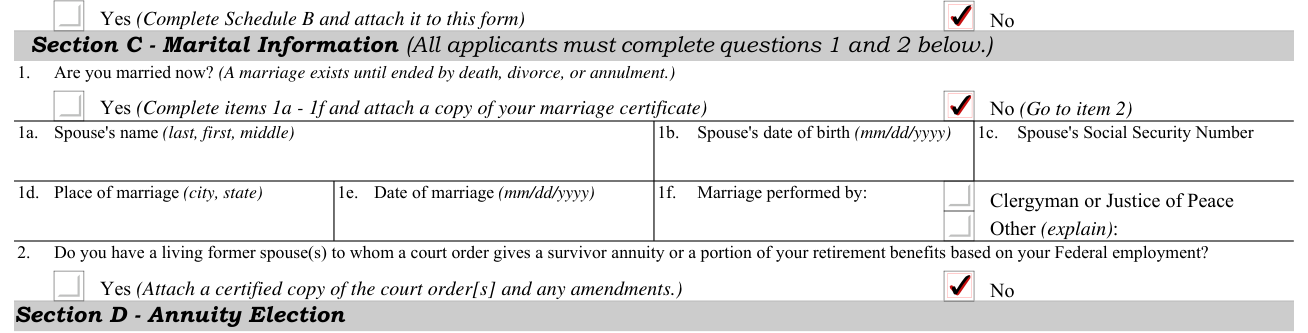
All applicants must complete questions 1 and 2. Are you married now? Yes (Complete items 1a - 1f and attach a copy of your marriage certificate) or No (Go to item 2).
Do you have a living former spouse to whom a court order gives a survivor annuity or a portion of your retirement benefits based on your Federal employment? Yes (Attach a certified copy of the court order and any amendments) or No.
More rules for Form SF-3107
In Section D - Annuity Election, make your election by initialing the box beside the type of annuity you want to receive and give any other information requested. No change will be permitted after your annuity is granted except as explained in the pamphlet.
In Section D - Annuity Election, the total of the survivor annuities elected cannot exceed 50 percent. An election of an insurable interest survivor in option 4 is not included when determining the 50 percent maximum.
In Section D - Annuity Election, box 1 is a reduced annuity with maximum survivor annuity for your spouse named in Section C. If you are married at retirement, you will receive this type of annuity unless your spouse consents to your election not to provide maximum survivor benefits. Your annuity will be reduced by 10%. Your spouse's annuity upon your death will be 50% of your unreduced earned annuity.
In Section D - Annuity Election, box 2 is a reduced annuity with a partial survivor annuity for your spouse named in Section C. Your annuity will be reduced by 5%. Upon your death, your spouse's annuity will be 25% of your unreduced earned annuity. You must have your spouse's consent to choose this option. Complete form SF 3107-2, Spouse's Consent to Survivor Election, and attach it to your application.
In Section D - Annuity Election, box 3 is an annuity payable only during your lifetime. If you are married at retirement, you cannot choose this type of annuity without your spouse's consent. No survivor annuity will be paid to your spouse after your death if he or she consents to this election and any health benefits will cease.
Common questions about Form SF-3107
Does it need a notary?
If you are married and you do not elect a reduced annuity to provide a maximum survivor annuity for your current spouse, complete Part 1 of the Spouse's Consent to Survivor Election and have your spouse complete Part 2. Part 2 must be completed in the presence of a Notary Public or other person authorized to administer oaths.
Who signs it?
Sign on the Signature (Do not print) line and enter the Date (mm/dd/yyyy).
Is there a deadline?
When you decide to retire, give your agency advance notice so it can be sure your records are complete and it can carry out its responsibilities in processing the paperwork associated with your retirement.
Where do I file it?
Give your completed application to the personnel office of your employing agency.
Is there a penalty?
Any intentionally false statement in this application or willful misrepresentation relative thereto is a violation of the law punishable by a fine of not more than $10,000 or imprisonment of not more than 5 years, or both (18 U.S.C. 1001) (checked November 2, 2026).
What am I certifying when I sign?
By signing in Section I - Applicant's Certification, you certify that all statements made in this application are true to the best of your knowledge and belief.
When is this form not the right one?
Do not use this application to apply for a deferred annuity. A deferred annuity begins more than 30 days after the date of final separation.
Sources
[1] Standard Form 3107 (Revised May 2014), Application for Immediate Retirement, Federal Employees Retirement System, U.S. Office of Personnel Management (the Official source link on this page).