
Finding the right path through the maze of visa applications can be challenging, but for those looking to study in Australia, the Form 157A is your first step. This application for a student visa is not just about allowing entry into Australia; it embodies an agreement to respect and live by Australian values—an expectation set by the Australian Government for anyone looking to temporarily call Australia home. The form requires applicants over 18 to declare their commitment to values such as freedom, respect, equality, and the rule of law, reflecting the societal fabric of Australia. Understanding and agreeing to these values is crucial, as is the compliance with various other requirements outlined in the form. These range from the financial capability to support one’s education and stay, proficiency in the English language, and the intention to adhere to the conditions of the visa. Furthermore, for students under 18, arrangements must ensure their welfare for the duration of their stay. The option to apply online brings convenience to the process, yet applicants not eligible for online submission are not left behind. With detailed instructions and requirements based on the specific student visa subclass applied for, Form 157A guides applicants through ensuring they have made appropriate arrangements for their study and stay in Australia. Additionally, the form covers crucial aspects such as working while studying, changing course types, and the necessary health requirements, among others. It is a comprehensive document that, aside from granting permission to study, ensures applicants are well-prepared and informed about their responsibilities while living in Australia.
| Question | Answer |
|---|---|
| Form Name | Student Visa 157A Form |
| Form Length | 21 pages |
| Fillable? | No |
| Fillable fields | 0 |
| Avg. time to fill out | 5 min 15 sec |
| Other names | form 157a australian immigration, student visa 157a form, visa 157a form, visa form 157a |
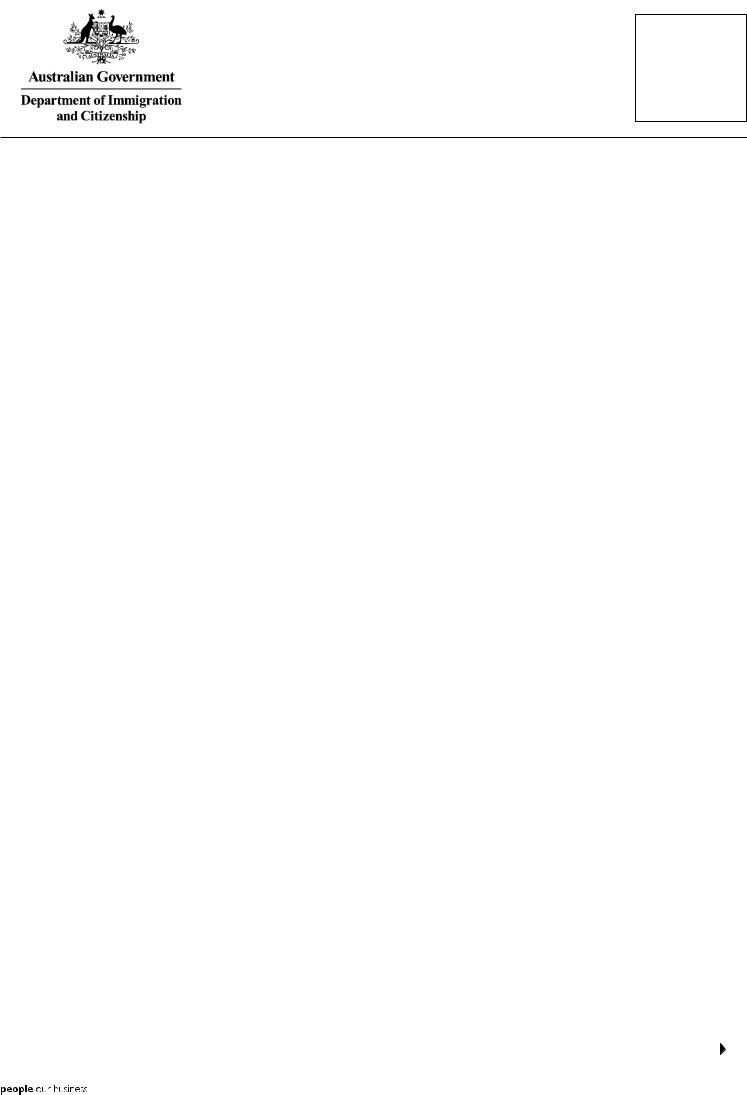
Application for a student visa
Form
157A
Life in Australia – Australian values
The Australian Government encourages people to gain an understanding of Australia, its people and their way of life, before applying for a visa to live in Australia. As part of this application every person aged 18 years or over must declare that they will respect Australian values, as outlined below and obey the laws of Australia.
Australian values include respect for the freedom and dignity of the individual, freedom of religion, commitment to the rule of law, Parliamentary democracy, equality of men and women and a spirit of egalitarianism that embraces mutual respect, tolerance, fair play and compassion for those in need and pursuit of the public good.
Australian society also values equality of opportunity for individuals, regardless of their race, religion or ethnic background.
It is also important to understand that English is the national language.
Further information is contained in the Life in Australia booklet, however, you are not required to read the booklet. The booklet is available in a wide range of languages. If you would like a copy of the booklet it can be obtained from www.immi.gov.au
About this form
Important – Please read this information carefully before you complete your application. Once you have completed your application we strongly advise that you keep a copy for your records.
Applying online
The Department of Immigration and Citizenship (the department) offers a number of convenient internet services for student visa applicants. To find out whether you are eligible to apply online for a student visa, refer to the department’s website www.immi.gov.au/e_visa/students.htm
If you wish to enter Australia or extend your stay as a student and you are not eligible to apply online, complete this form in ENGLISH using BLOCK LETTERS.
To complete this form you must first read these notes and information form 1160i Applying for a student visa. Detailed information is also available on the department’s website www.immi.gov.au/students/
Each subclass is linked to the type of course you intend to undertake in Australia as your main course of study.
You are not able to use this form to apply for a Student Guardian visa (subclass 580). Form 157G Application for a Student Guardian visa is the only valid form for a Student Guardian visa application.
If you are applying for a visa that can be granted in Australia and you are making this application in Australia, this form also serves as an application form for any class of bridging visa (classes A, C or E) for which you may be eligible to apply – see the information form 1024i Bridging visas, which is available on the department’s website www.immi.gov.au/allforms/
Please refer to information form 1160i Applying for a student visa for further information about Australia’s student visa program.
Welfare arrangements for students under 18 years of age
Students under 18 years of age need to have adequate arrangements for their welfare in Australia. If the student is applying for a student visa in Australia, these arrangements need to be in place before an application can be considered valid.
The department bears no responsibility for welfare arrangements made on a student’s behalf. It is the responsibility of the parents or legal custodians of a student under the age of 18 to ensure that the arrangements that they make on the student’s behalf provide appropriate welfare for the entirety of the student’s stay in Australia while they are under the age of 18.
If you are under 18 years of age, currently or will be studying in Australia and will be in the care of a relative for the duration of your visa or until you turn 18 years of age, form 157N Nomination of a student guardian must be completed and lodged together with this form.
Working while studying
If you already hold a student visa and now want permission to work, you and your family members can apply online www.immi.gov.au/e_visa/students.htm
To be eligible for permission to work while studying in Australia, you must first have commenced your course. More information about permission to work while studying is available on the department’s website www.immi.gov.au/students/
Who can use this form?
You should use this form if you wish to apply for a student visa and be assessed against one of the following subclasses:
•Independent ELICOS visa (subclass 570);
•Schools visa (subclass 571);
•Vocational Education and Training visa (subclass 572);
•Higher Education visa (subclass 573);
•Postgraduate Research visa (subclass 574);
•
•AusAID or Defence visa (subclass 576).
Changing course type (education sector)
Your student visa is linked to the type of course you are studying. Each student visa subclass covers specific types of course only. If you wish to change your principal course at any time to a course in a different education sector, you must first apply for a new student visa using this form (form 157A).
For information on course types and their relationship to the different student visa subclasses, refer to the department’s website www.immi.gov.au/students/
Continued on the next page
© COMMONWEALTH OF AUSTRALIA, 2008 |
157A (Design date 01/08) - Page 1 |
Applying for a student visa
To help you lodge your application and communicate with the department while your application is being processed you should read information form 1025i Making and processing visa applications, which is available from your nearest Australian Government office or the department’s website.
All student visa applicants must satisfy the criteria for grant of one of the student visa subclasses. These criteria include (but are not limited to) financial ability, English language proficiency, intention to comply with visa conditions and other relevant matters. Information on these criteria and the conditions that may be attached to your visa can be found in the information form 1160i Applying for a student visa and on the department’s website.
Note: If you are required to provide the results of an English language test, you must sit the test before you lodge your visa application. If you sit a test after you have lodged your application, the results of this test cannot be taken into account.
If you wish to study in Australia, your application will be assessed against one of 5 assessment levels for each visa subclass. Before completing this form, you must refer to information form 1219i Overseas Student Program – Assessment Levels for information on which Assessment Level applies to you. Information on assessment levels can be found on the department’s website.
In certain circumstances you may be requested to complete a supplementary information form. You will be advised by the visa processing office if this is necessary.
Your application may be decided solely on the basis of information provided in this application. Failure to answer a question may result in your application being refused if the
You must provide all of the documentation necessary to support your application (originals or certified or notarised copies) and you must declare that you have done so. Failure to do so may result in your application being refused. The documentation required may vary depending on your Assessment Level and the subclass appropriate to your course of study. Information on documentation required is available on the department’s website. A decision on your application will be made on the basis of all the information you provide, your circumstances and the legal requirements that apply. If your circumstances change in any way after you make your application you must inform the department immediately. Failure to do so can lead to cancellation of your visa (if it is granted).
Applicants who provide false or misleading information may either have their applications refused, or their visa permitting them to remain in Australia cancelled.
If you:
•are applying in Australia;
•do not already hold a student visa; and
•you are in Assessment Level 2, 3, 4 or 5
you must provide exceptional reasons for the grant of your visa in Australia.
Photographs
Applying outside Australia – enclose 4 recent
Applying in Australia – enclose one recent
Health requirements
All applicants must meet Australia’s health requirements. You and any family members included in this application may be required to undergo a chest
If applying outside Australia under Assessment Level 3, 4 or 5, you should not undertake your medical or
Members of your family unit
The term ‘members of the family unit’ covers your spouse (including a de facto spouse) and dependent children of you or your spouse, who are unmarried and have not turned
18 years of age.
Members of your family unit may apply for visas that will allow them to join you in Australia. They may apply for visas at the same time as you, or after you have arrived in Australia and commenced your course of study. If you are in Australia and your family members intend to apply to join you after you have commenced your course, you will need to complete form 919 Nomination of student dependant(s). You must send this form and other necessary documentary evidence to your family members for them to lodge at the relevant Australian Government office.
Note: If you are processed at Assessment Level 3, 4 or 5 and intend to undertake a course of 12 months or less in duration, members of the family unit are not permitted to accompany you to Australia on a student visa.
All members of your family unit must be declared on your application form, whether or not they intend to travel to Australia with you. A member who is not declared will not be eligible for entry to Australia as a family unit member, unless they were not your spouse or child at the time you lodged your application but have since become so.
A
Your spouse will have a condition placed on their visa that limits their period of study in Australia to a maximum of 3 months.
If they wish to undertake study beyond this period they must apply for a student visa in their own right.
If you are an AusAID or
157A (Design date 01/08) - Page 2 |
© COMMONWEALTH OF AUSTRALIA, 2008 |

‘No further stay’ conditions
Your visa will be subject to a number of visa conditions. Information on these conditions can be found in the information form 1160i Applying for a student visa and on the department’s website.
In certain circumstances, your visa may be subject to the ‘no further stay’ condition 8534 or 8535.
Condition 8534
If you are an Assessment Level 3, 4 or 5 student whose overall intended period of study is 10 months or less, you will usually be subject to this ‘no further stay’ condition. This means that after entering Australia, you may not be granted any other visa while you remain in Australia, other than a further student visa with permission to work or a Graduate – Skilled visa1. If you are an Assessment Level 3 student you may be exempt from the mandatory imposition of the ‘no further stay’ if you can show an additional AUD12,000 and funds to cover living and school costs for a
A ‘no further stay’ condition may also be imposed on your visa, irrespective of your Assessment Level or period of study, if the decision maker considers this appropriate.
Condition 8535
If you are sponsored by the Australian Government or the government of your home country, you may be subject to this ‘no further stay’ condition. This means that after entering Australia, you will not be entitled to be granted any other visa while you remain in Australia apart from a further student visa with permission to work or a further student visa with the consent of your sponsor1.
Visa Application Charge
Your completed application form, together with the correct Visa Application Charge, can be lodged at the nearest Australian Government office if applying outside Australia, or at the nearest office of the department if applying in Australia. You can check the Visa Application Charge with your nearest office of the department, or from form 990i Charges, which is available in the Forms section of the department’s website www.immi.gov.au/allforms/
Payment must accompany your application and is generally not refunded if the application is unsuccessful. If you have paid enrolment or tuition fees, it is your responsibility to get a refund of these fees.
Method of payment
In Australia
To make a payment, please pay by credit card, debit card, bank cheque or money order made payable to the Department of Immigration and Citizenship. Debit card and credit card are the preferred methods of payment.
Outside Australia
Before making a payment outside Australia, please check with the Australian Government office where you intend to lodge your application as to what methods of payment and currencies they can accept and to whom the payment should be made payable.
1Or to engage Australia’s protection obligation under the 1951 UN convention relating to the status of refugees.
Options for receiving written communications
You may authorise another person to receive all communications, both written and electronic, about your application with the department. You will be taken to have received any documents sent to that person as if they had been sent to you.
To do this you will need to complete Question 72 Options for receiving written communications and form 956 Appointment of a migration agent or exempt agent or other authorised recipient. For an explanation of what a migration agent or exempt agent or authorised recipient can do please read the sections below.
To change or end the appointment of your migration agent or exempt agent or authorised recipient you must promptly advise the department in writing. You can do this by using form 956 Appointment of a migration agent or exempt agent or other authorised recipient.
Authorised recipient information
An authorised recipient is someone you appoint to receive written communications about your application with the department.
All written communication about your application will be sent to your authorised recipient, unless you indicate that you wish to have health and/or character information sent directly to you.
The department will communicate with the most recently appointed authorised recipient as you may only appoint one authorised recipient at any time for a particular application.
Migration agent information
A migration agent is someone who can:
•advise you on the visa that may best suit you;
•tell you the documents you need to submit with your application;
•help you fill in the application and submit it; and
•communicate with the department on your behalf.
If you appoint a migration agent, the department will assume that your migration agent will be your authorised recipient, unless you indicate otherwise.
Your migration agent will be the person with whom the department will discuss your application and from whom it will seek further information when required.
You are not required to use a migration agent. However, if you use a migration agent, the department encourages you to use a registered migration agent. Registered agents are bound by the Migration Agents Code of Conduct, which requires them to act professionally in their clients’ lawful best interests.
Immigration assistance
A person gives immigration assistance to you if he or she uses, or claims to use, his or her knowledge or experience in migration procedure to assist you with your visa application, request for ministerial intervention, cancellation review application, sponsorship or nomination.
In Australia a person may only lawfully give immigration assistance if he or she is a registered migration agent or is exempt from being registered. Only registered migration agents may receive a fee or reward for providing immigration assistance.
If an unregistered person in Australia, who is not exempt from registration, gives you immigration assistance they are committing a criminal offence and may be prosecuted.
© COMMONWEALTH OF AUSTRALIA, 2008 |
157A (Design date 01/08) - Page 3 |

Migration agents in Australia
Migration agents in Australia must be registered with the Migration Agents Registration Authority (MARA) unless they are exempt from registration.
Migration agents outside Australia
Migration agents who operate outside Australia do not have to be registered. The department may give some overseas agents an ID number. This number does not mean that they are registered.
Note: Some Australian registered migration agents operate overseas.
Exempt agents
The following people do not have to be a registered migration agent in order to provide immigration assistance, but they must not charge a fee for their service:
•a close family member (spouse, child, adopted child, parent, brother or sister);
•a sponsor or nominator for this visa application;
•a member of parliament or their staff;
•an official whose duties include providing immigration assistance (eg. a Legal Aid provider);
•a member of a diplomatic mission, consular post or international organisation.
Further information on migration agents
Information on migration agents, including a list of registered migration agents, is available on the Migration Agents Registration Authority (MARA) website www.themara.com.au
You can also access information about migration agents on the department’s website www.immi.gov.au
Residential address
You must tell the department where you intend to live while your application is being dealt with. Failure to give a residential address will result in your application being invalid. A post office box address will not be accepted as your residential address.
Consent to communicate electronically
The department may use a range of means to communicate with you. However, electronic means such as fax or
To process your application the department may need to communicate with you about sensitive information, for example, health, police checks, financial viability and personal relationships. Electronic communications, unless adequately encrypted, are not secure and may be viewed by others or interfered with. If you agree to the department communicating with you by electronic means, the details you provide will only be used by the department for the purpose for which you have provided them, unless there is a legal obligation or necessity to use them for another purpose, or you have consented to use for another purpose. They will not be added to any mailing list.
The Australian Government accepts no responsibility for the security or integrity of any information sent to the department over the internet or by other electronic means.
About the information you give to the department
The department is authorised to collect information provided on this form under Part 2 of the Migration Act 1958. The information collected will be used for assessing your eligibility for a student visa to travel to and enter and/or remain in Australia, to monitor the conduct of migration agents, and for other purposes relating to the administration of the Migration Act.
The information collected might also be disclosed to agencies who are authorised to receive information relating to adoption, border control, business skills, citizenship, education, health assessment, health insurance, health services, law enforcement, payment of pensions and benefits, taxation, review of decisions and registration of migration agents. It will also be disclosed to any agency of the Australian Government, or of a state or territory, that is responsible for or otherwise concerned with the regulation of education providers.
Relevant information about you will be disclosed to federal, state and territory police to assist in your location and possible detention in the event that you become an unlawful
The information on this form, including the results of any tests for Human Immunodeficiency Virus (HIV), will be used to assess your health for an Australian visa. A positive HIV or other test result will not necessarily lead to a visa being denied. Your result(s) may be disclosed to the relevant Australian Government state and territory health agencies.
In addition, the relevant registered education provider(s) may be told whether or not your visa has been granted. The collection, access, storage, use and disclosure by the department of the information you provide in this form is governed by the Privacy Act 1988 and, in particular, by the 11 Information Privacy Principles. The information form 993i Safeguarding your personal information gives details of agencies to which your personal information might be disclosed. This form is available from the department’s website www.immi.gov.au/allforms/, or any office of the department or Australian mission overseas.
The department has authority under the Migration Act 1958 to collect a range of personal identifiers from
Review rights
If you apply for a student visa in Australia and you are refused the visa, you may apply for a review of the decision. You will be notified of your review rights in writing and the time limits for lodging such an appeal.
There are no review rights for decisions to refuse a student visa where the application is made outside Australia.
Home page www.immi.gov.au
General Telephone 131 881 during business hours
enquiry line in Australia to speak to an operator (recorded information available outside these hours). If you are outside Australia, please contact your nearest Australian mission.
Please keep these information pages for your reference
157A (Design date 01/08) - Page 4 |
© COMMONWEALTH OF AUSTRALIA, 2008 |
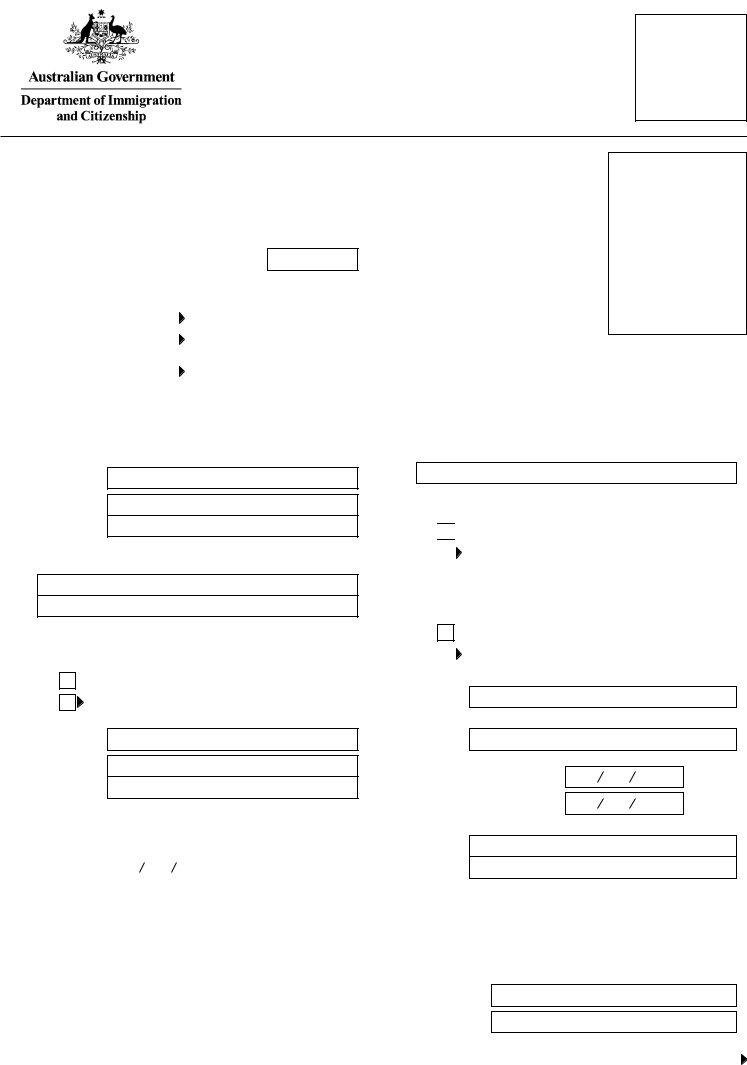
Application for a student visa
Form
157A
Part A – To be completed by all applicants
Application details
1How many people are included in this application?
2Are you applying
for yourself as a student? |
|
Complete Parts A, B and D |
|
|
|
for yourself and family? |
|
Complete Parts A, B and D |
as a member of a |
|
Complete Parts A, C and D |
student’s family unit? |
|
|
|
|
|
PHOTOGRAPH
Please attach required photographs of yourself
AND
all members of your family unit included in this application
Your personal details
3Your full name in English Family name
Given names
4Name in your own language or script (if applicable)
5Have you been known by any other names?
(including name at birth, previous married names, aliases)
Give details and provide supporting evidence eg. birth certificate/marriage certificate
Family name
Given names
6 |
Sex |
Male |
|
|
Female |
|
|
|
|
|
|
|
|
|
DAY |
MONTH |
|
YEAR |
|
|
|
||
7 |
Date of birth |
|
|
|
|
|
|
|
|
||
8 |
|
|
|
|
|
|
|
|
|
||
Place of birth |
|
|
|
|
|
|
|
||||
|
|
|
|
|
|
|
|
|
|||
|
Town/city |
|
|
|
|
|
|
|
|
||
|
|
|
|
|
|
|
|
|
|
||
|
|
|
|
|
|
|
|
|
|||
|
Country |
|
|
|
|
|
|
|
|
||
9 |
|
|
|
|
|
|
|
|
|
||
Marital status |
|
|
|
|
|
|
|
||||
|
|
|
|
|
|
Widowed |
|
||||
|
|
Married |
|
|
|
Separated |
|
|
|||
|
|
Engaged |
|
|
|
Divorced |
|
Never married |
|
||
|
|
|
|
|
|
|
|||||
|
|
|
|
|
|
|
|
|
|
||
|
|
De facto |
|
|
|
|
|
|
|
|
|
10Your present country of citizenship
11Do you hold any other citizenship? No
Yes |
|
|
Which countries? |
|
|
|
|
|
|
|
|
12Do you have a passport?
No
Yes |
|
Details from your passport |
Passport number
Country of passport
DAY MONTH YEAR
Date of issue
Date of expiry
Issuing authority/Place of issue as shown in your passport
13Details of identity card or identity number issued to you by your government (if applicable) eg. National identity card.
Note: If you are the holder of multiple identity numbers because you are a citizen of more than one country, you need to enter the identity number on the card from the country that you live in.
Identity number
Country of issue
Continued on the next page
© COMMONWEALTH OF AUSTRALIA, 2008 |
157A (Design date 01/08) - Page 5 |