
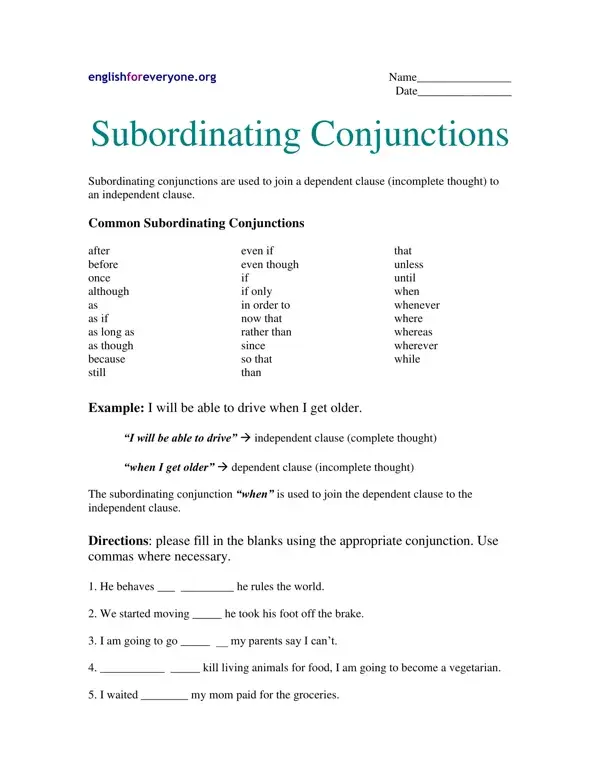
In the realm of English grammar, the role of subordinating conjunctions cannot be overstated, facilitating the connection between dependent clauses (those incomplete thoughts that cannot stand alone) and independent clauses, which are complete thoughts capable of standing on their own. These conjunctions, such as "after," "although," "because," and "while," among others, serve as bridges, rendering complex sentences not just grammatically correct but also rich in meaning. For instance, in the sentence "I will be able to drive when I get older," the subordinating conjunction "when" skillfully joins the independent clause "I will be able to drive" with the dependent clause "when I get older," exemplifying how these words weave separate strands of thought into a coherent whole. Through a diverse array of examples – from "even though" to "as long as" – subordinating conjunctions enrich English by allowing for the expression of cause and effect, contrast, condition, and time, among others. Users are encouraged to delve into exercises that not only underscore the importance of correct comma usage with these conjunctions but also challenge them to craft sentences that showcase their understanding and command of this form. This intricate interplay of clauses, made possible by subordinating conjunctions, is foundational to both understanding the complexity of English and communicating with precision and nuance.
| Question | Answer |
|---|---|
| Form Name | Subordinating Conjunctions Form |
| Form Length | 2 pages |
| Fillable? | No |
| Fillable fields | 0 |
| Avg. time to fill out | 30 sec |
| Other names | coordinating and subordinating conjunctions worksheets pdf, subordinating conjunctions worksheets with answers, subordinating conjunctions quiz pdf, coordination and subordination exercises with answers pdf |
Subordinating Conjunctions Form isn’t the one you’re looking for?