
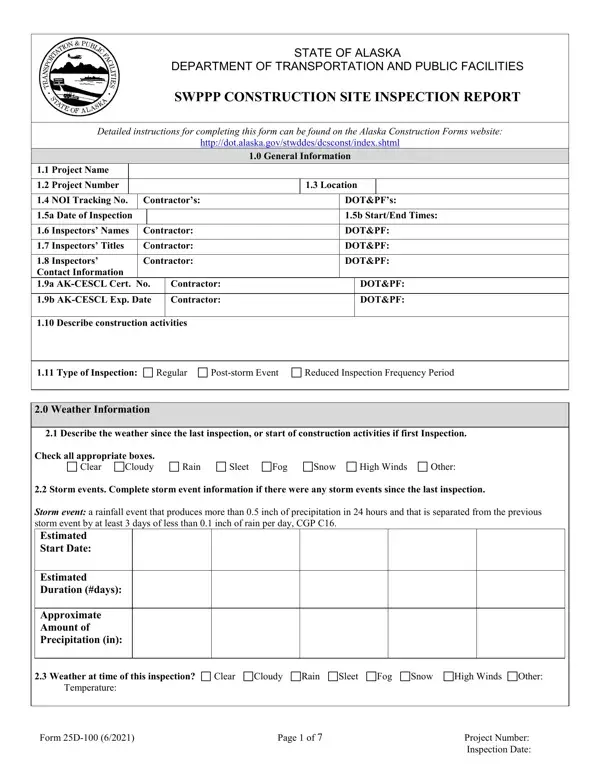

Form 25D-100 at a glance
What it is: The State of Alaska Department of Transportation and Public Facilities SWPPP Construction Site Inspection Report.
Who signs: The Contractor's Duly Authorized Representative (Title: Superintendent) and the DOT&PF's Duly Authorized Representative (Title: Project Engineer) each print the name, sign and date.
A filled-in Form 25D-100 example: a routine inspection with clear weather
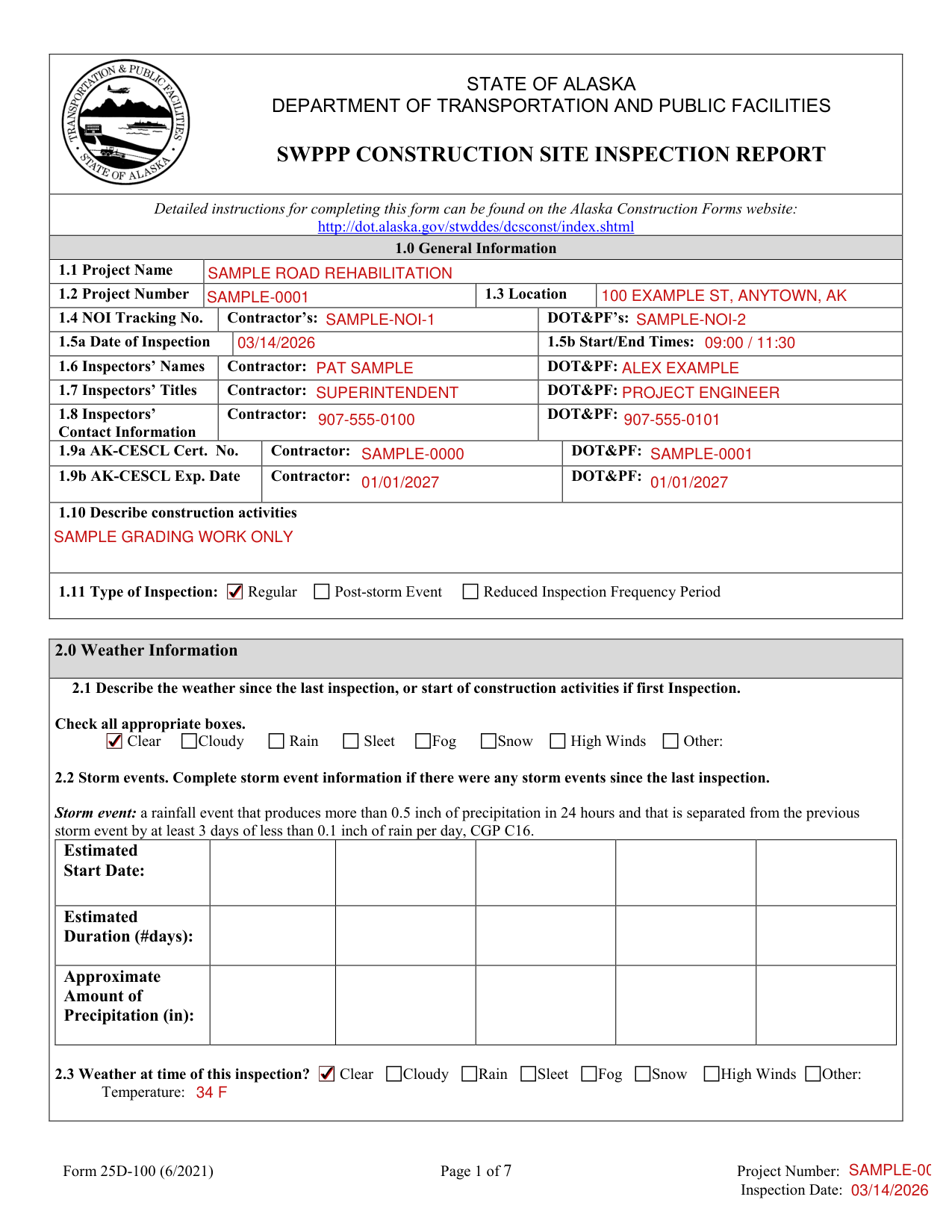
How to fill out Form 25D-100, box by box
1.0 General Information
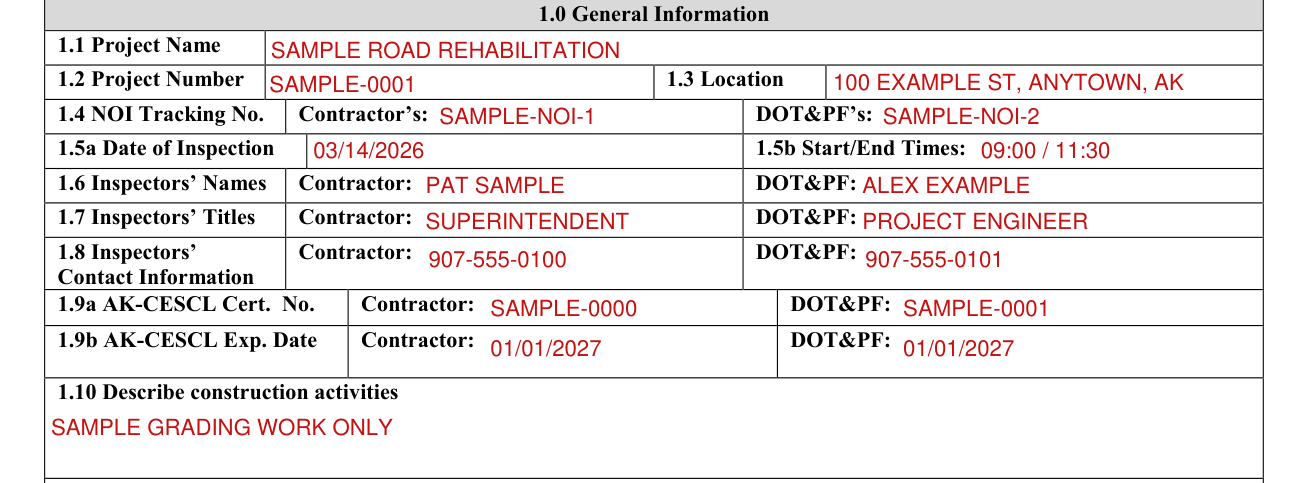
Under 1.0 General Information, enter the Project Name (1.1), the Project Number (1.2) and the Location (1.3).
In 1.4 NOI Tracking No., enter the Contractor's number and the DOT&PF's number.
Enter the Date of Inspection (1.5a) and the Start/End Times (1.5b).
For both the Contractor and the DOT&PF, enter the Inspectors' Names (1.6), Titles (1.7) and Contact Information (1.8).
For both the Contractor and the DOT&PF, enter the AK-CESCL Cert. No. (1.9a) and the AK-CESCL Exp. Date (1.9b).
Describe construction activities in 1.10.
1.11 Type of Inspection

1.11 Type of Inspection: Regular, Post-storm Event or Reduced Inspection Frequency Period.
2.0 Weather Information
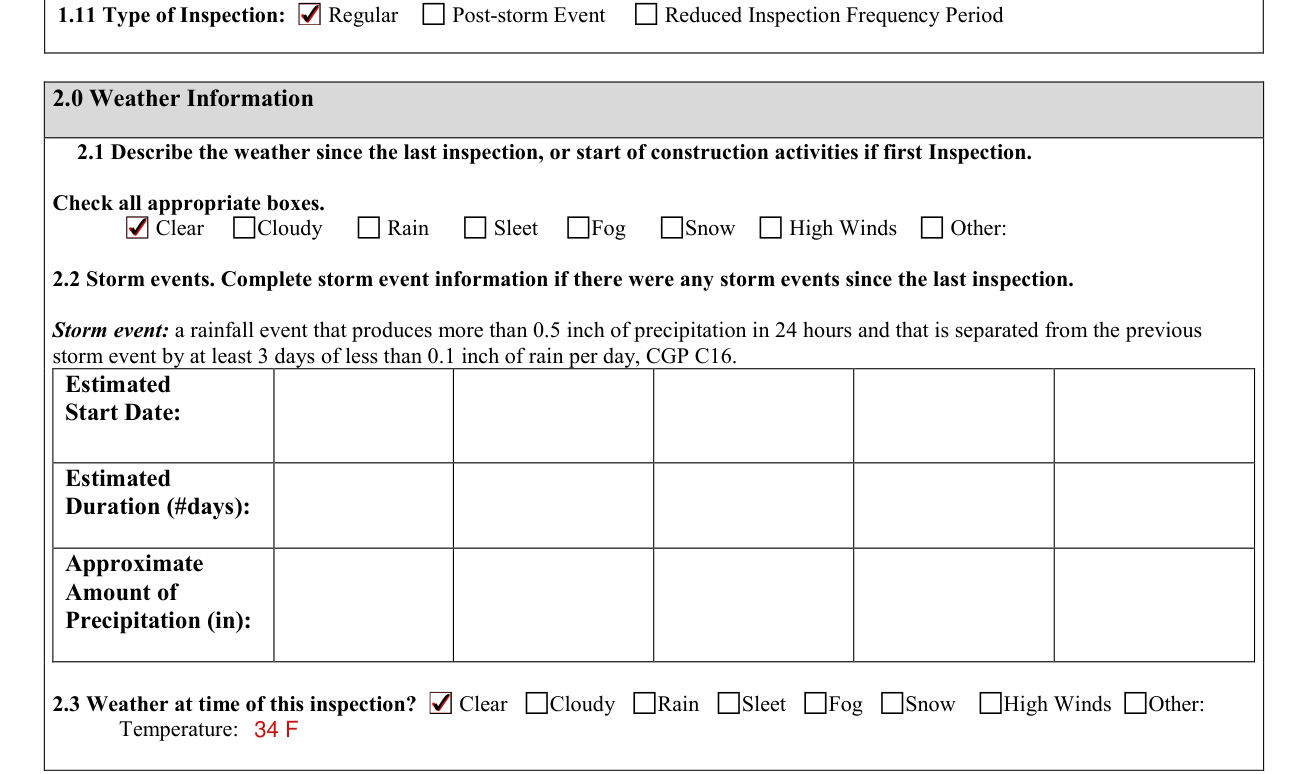
2.1 Describe the weather since the last inspection, or start of construction activities if first Inspection. Check all appropriate boxes: Clear, Cloudy, Rain, Sleet, Fog, Snow, High Winds or Other. 2.2 Storm events. Complete storm event information if there were any storm events since the last inspection. Storm event: a rainfall event that produces more than 0.5 inch of precipitation in 24 hours and that is separated from the previous storm event by at least 3 days of less than 0.1 inch of rain per day, CGP C16.
Enter the Estimated Start Date, the Estimated Duration (#days) and the Approximate Amount of Precipitation (in).
For 2.3 Weather at time of this inspection, check Clear, Cloudy, Rain, Sleet, Fog, Snow, High Winds or Other, and enter the Temperature.
3.0 Overall Site Issues
3.0 Overall Site Issues are general site issues that must be assessed during inspections.
When maintenance or some other corrective action is required, check "Yes" in the Corrective Action Required? column.
When a corrective action is required, before certifying the report, fill in the date when the corrective action can reasonably be expected to be completed. When a corrective action is NOT required, leave the "Complete by Date" blank.
Anytime you check "Yes" in the "Corrective Action Required?" column, you must fill in the "Describe Corrective Action and Location" column as well.
When a Corrective Action is required as noted in this report, you must also enter all the information for this action in the Corrective Action Log and document on the Log the actual date of completed correction.
3.1 Have stabilization measures been initiated on slopes and disturbed areas not actively being worked? 3.2 Are natural resource areas (e.g., streams, wetlands, mature trees, etc.) required by the SWPPP to be delineated in the field, identified with barriers or markings? 3.3 Are perimeter controls and sediment barriers adequately installed (keyed into substrate) and maintained?
3.4 Are storm drain inlets properly protected? 3.5 Are the construction exits preventing sediment from being tracked into the street? 3.6 Is trash/litter from work areas collected and disposed of properly?
3.7 Are washout facilities (e.g., paint, concrete) available, clearly marked, and maintained? 3.8 Are vehicle and equipment fueling, cleaning, and maintenance areas free of spills, leaks, or any other potential pollutants? 3.9 Are materials that are potential stormwater contaminants stored inside or under cover?
3.10 Are non-stormwater discharges (e.g., wash water, dewatering) properly controlled? 3.11 Has Spill Response kit been used since the last inspection? Yes No 3.12 Is the SWPPP Main Entrance Signage legible and does it contain the correct information?
3.13 Are erodible stockpiles properly covered and have a perimeter control? 3.14 Are any additional BMPs needed? Yes No 3.15 (Other)
4.0 Discharge Points
4.0 Discharge Points. 4.1 At the time of inspection, are the discharge points and receiving waters free of pollutant discharges (sediment deposits, sediment plume or oil sheen)?
4.2 Since the last inspection, are the discharge points and receiving waters free of evidence that pollutants had left the project site (for example, sediment deposits, oily residue)?
If Response is No, describe Location. If Corrective Action is required, describe Action and Location.
In 4.3 Location of Discharge Points, list the project discharge point locations and circle Yes or No under Inspected?.
5.0 Site-specific BMPs
In 5.0 Site-specific BMPs, the BMP Identifier column is a mandatory entry used to help correspond BMPs with the site map.
Number the structural and non-structural BMPs identified in your SWPPP on your site map and list them (add as many BMPs as necessary on the continuation sheets).
In the BMP column, describe and give the location of the structural and non-structural BMPs identified in your SWPPP (Include areas that are required to be inspected by the CGP, such as material storage areas that are exposed to precipitation.)
If a BMP should be installed at the time of the inspection and you marked "No" in the "BMP Installed" column, then you must check "Yes" in the "BMP Action Required?" column. If there is good reason to mark "no" in the "BMP Installed" column (such as the BMP is no longer needed and was removed) then you can mark "no" in the "BMP Action Required?" column and explain in the "Comments" column.
If a BMP needs repair, modification, replacement, maintenance or a new BMP is needed or a SWPPP amendment is needed, then a BMP Action is required.
Before certifying the report, fill in the date when the BMP Action can reasonably be expected to be completed.
Anytime you check "Yes" for "BMP Action Required," then you must also fill in the "Describe BMP Action and Location" column.
6.0 Inspection Certification
6.1 Areas of Inspection: Did you inspect all areas of the project that are required to be inspected by the CGP?
If you did not inspect any required areas, list those locations here and explain why they weren't inspected.
Under 6.2 Project Compliance, if there are incidences of non-compliance identified in this inspection report then you must summarize the incidence(s) of non-compliance.
If there is an Action Item described in the non-compliance box that does not already have a "Complete by Date" assigned elsewhere in this report, then add a Complete by Date within the box.
Check the box if there are no incidences of non-compliance with the CGP: "I certify that on the date of this inspection, this project was found to be in compliance with the terms of the applicable Construction General Permit."
CERTIFICATION STATEMENT: under penalty of law, the information submitted is, to the best of my knowledge and belief, true, accurate, and complete. There are significant penalties for submitting false information, including the possibility of fine and imprisonment for knowing violations.
More rules for Form 25D-100
Detailed instructions for completing this form can be found on the Alaska Construction Forms website: http://dot.alaska.gov/stwddes/dcsconst/index.shtml
Sources
[1] Form 25D-100 (6/2021), SWPPP Construction Site Inspection Report, State of Alaska Department of Transportation and Public Facilities (the Official source link on this page).