

United States-Chile Free Trade Agreement Certificate of Origin at a glance
What it is: This is the certificate of origin to claim preferential tariff treatment under the United States-Chile Free Trade Agreement, as provided by the National Customs Service of Chile, in Oficio Circular No. 343, Anexo 1.
Who signs: In Field 11, the party declaring origin (importer, exporter, or producer) signs.
The certificate should be completed legibly and in full by the importer, exporter or producer of the merchandise, according to the process of Oficio Circular No. 343, Anexo 1.
A filled-in United States-Chile Free Trade Agreement Certificate of Origin example: an exporter certifies one good
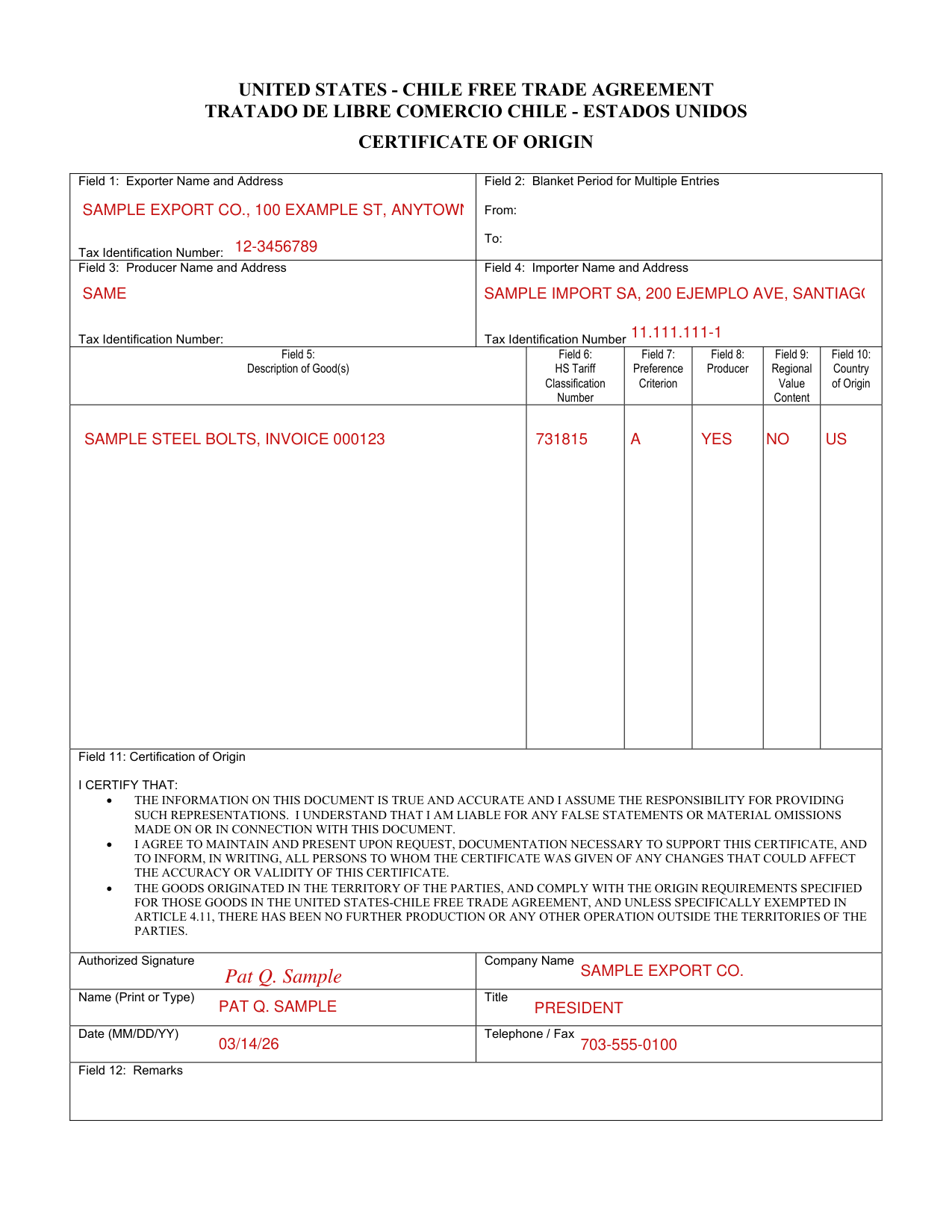
How to fill out United States-Chile Free Trade Agreement Certificate of Origin, box by box
Field 1: Exporter and Field 2: Blanket Period

Field 1: Indicate the exporter's complete name, address (including country), and tax identification number.
Complete Field 2 if the certificate covers multiple shipments of identical goods, as described in Field 5, that are imported into Chile or the United States for a specified period (the blanket period). FROM is the date upon which the certificate becomes applicable to the good covered by the blanket certificate. TO is the date upon which the blanket period expires. The importation of a good for which preferential treatment is claimed based on this certificate must occur between these dates. It is suggested that the length of the blanket period covered by the certificate should not exceed one year.
Field 3: Producer and Field 4: Importer Name and Address

Field 3: Indicate the producer's complete name, address (including country), and tax identification number. If the producer and exporter are the same person, state "SAME" in this field. If the producer is not known, state "UNKNOWN."
Field 4: Indicate the importer's complete name, address (including country), and tax identification number.
Field 5: Description of each good to Field 10: Country of Origin
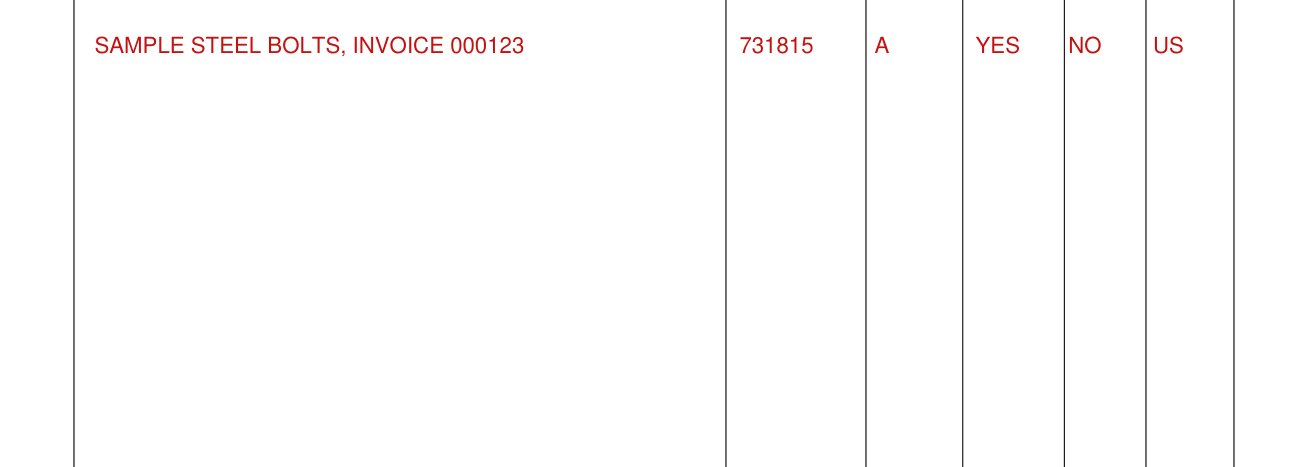
Field 5: Provide a full description of each good. The description should be sufficiently detailed such that it can be related to the invoice description and to the Harmonized System (H.S.) description of the good.
If the certificate covers only one shipment of goods, indicate the number of the commercial invoice. If the invoice number is not known, use another unique reference number, such as the waybill number, purchase order number, or any other number that can be used to identify the goods.
Field 6: For each good described in Field 5, identify the H.S. classification number to 6 digits. (Note: If the good is subject to a specific rule of origin requiring eight or ten digits, identify the good to the relevant number of digits using the H.S. tariff classification of the country into whose territory the good is imported.)
Field 7: For each good described in Field 5, state which preference criterion has been used to confer origin (A, B, or C).
As stated in Article 4.1.1 of the U.S.-Chile Free Trade Agreement, the criterion are as follows: (A) the good is wholly obtained or produced entirely in the territory of one or both of the Parties; (B) the good is produced entirely in the territory of one or both of the Parties and (i) each of the non-originating materials used in the production of the good undergoes an applicable change in tariff classification specified in Annex 4.1, or (ii) the good otherwise satisfies any applicable regional value content or other requirements specified in Annex 4.1, and the good satisfies all other applicable requirements of this Chapter; or (C) the good is produced entirely in the territory of one or both of the Parties exclusively from originating materials.
Field 8: If you are the producer of the good, state "YES" in this field. If you are not the producer of the good, state "NO" followed by a reference to Article 4.13 (2a) if the certificate is based upon a completed and signed certificate of origin provided by the producer, or Article 4.13 (2b) if the certificate of origin is based upon your knowledge of whether the good qualifies as an originating good.
Field 9: For each good described in Field 5, if the good is not subject to a Regional Value Content (RVC) requirement, state "NO." Otherwise, indicate which method was used to calculate the RVC by stating either "BUILDUP" or "BUILDDOWN."
As provided by the National Customs Service of Chile, in Oficio Circular No. 343, Anexo 1, Field 10: Identify the name of the country: State “US” for all goods originating in the United States and exported to Chile or state “CL” for all goods originating in Chile for export to the United States.
Field 11: Certification of Origin

Field 11: This field should be completed, signed and dated by the party declaring origin (importer, exporter, or producer) indicating the name, title, and company.
The signer must also certify to the suggested text. You certify that the information on this document is true and accurate and you assume the responsibility for proving such representations. You understand that you are liable for any false statements or material omissions made on or in connection with this document. You agree to maintain, and present upon request, documentation necessary to support this certificate, and to inform, in writing, all persons to whom the certificate was given of any changes that could affect the accuracy or validity of this certificate. You certify that the goods originated in the territory of one or more of the Parties, and comply with the origin requirements specified for those goods in the United States - Chile Free Trade Agreement, and unless specifically exempted in Article 4.11, there has been no further production or any other operation outside the territories of the Parties.
Field 12: Remarks

Field 12: Provide any additional or necessary remarks.
Sources
[1] United States-Chile Free Trade Agreement Certificate of Origin, the served form file (no current edition is claimed) (the Official source link on this page).
