
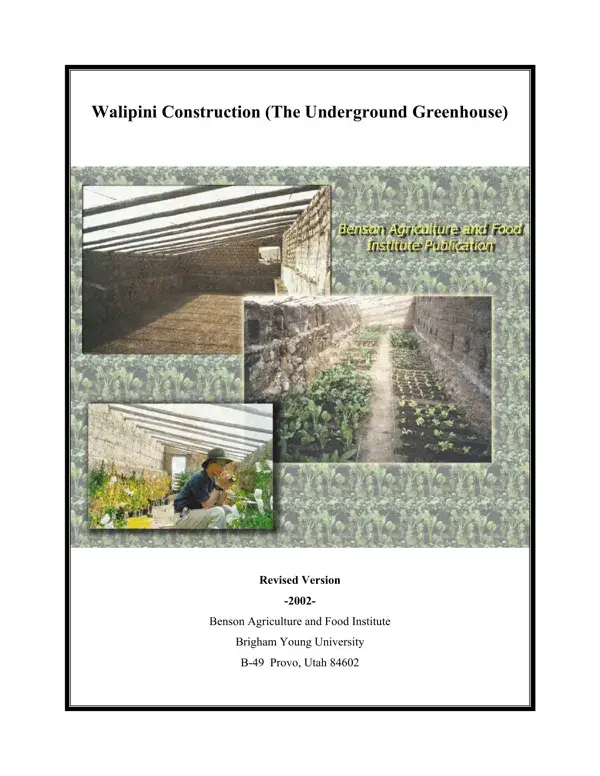
In the quest for sustainable agriculture and year-round vegetable production, innovative solutions like the Walipini present promising outcomes. Originating from the Aymara Indian language meaning “place of warmth,” the Walipini, or underground greenhouse, leverages nature’s gifts to create a warm and stable environment conducive for growing vegetables throughout the year. By positioning the growing area between 6 and 8 feet underground, the design capitalizes on the earth's natural heat and the thermal constant to maintain a favorable growing temperature with minimal energy input. The combination of earth's warmth and the strategic capture of solar radiation exemplifies a harmonious interplay between traditional knowledge and modern agricultural practices. This approach not only addresses the climatic conditions of La Paz, Bolivia, for which it was originally designed but also extends its applicability to a broad spectrum of geographic and climatic zones. This introductory manual to the Walipini form covers essential aspects ranging from the reasoning behind its underground construction, the importance of proper location to maximize solar energy, design considerations for effective heat management, to the specifics of building such a greenhouse. It promises a journey into an agricultural practice that is both environmentally considerate and economically viable.
| Question | Answer |
|---|---|
| Form Name | Walipini Form |
| Form Length | 29 pages |
| Fillable? | No |
| Fillable fields | 0 |
| Avg. time to fill out | 7 min 15 sec |
| Other names | walipini how to build, byu walipini online, walipini underground online, walipini |