

Washington 4-H Record Book, Level 2 (C0934) at a glance
What it is: The 4-H Record Book, Level 2, is for all the things you do in 4-H this year.
Who signs: The Project Commitment is an agreement between you, your project leader, and your parents about what you want to learn and how they will help you. Obtain the required signatures.
A filled-in Washington 4-H Record Book, Level 2 (C0934) example: a club member starts the record book
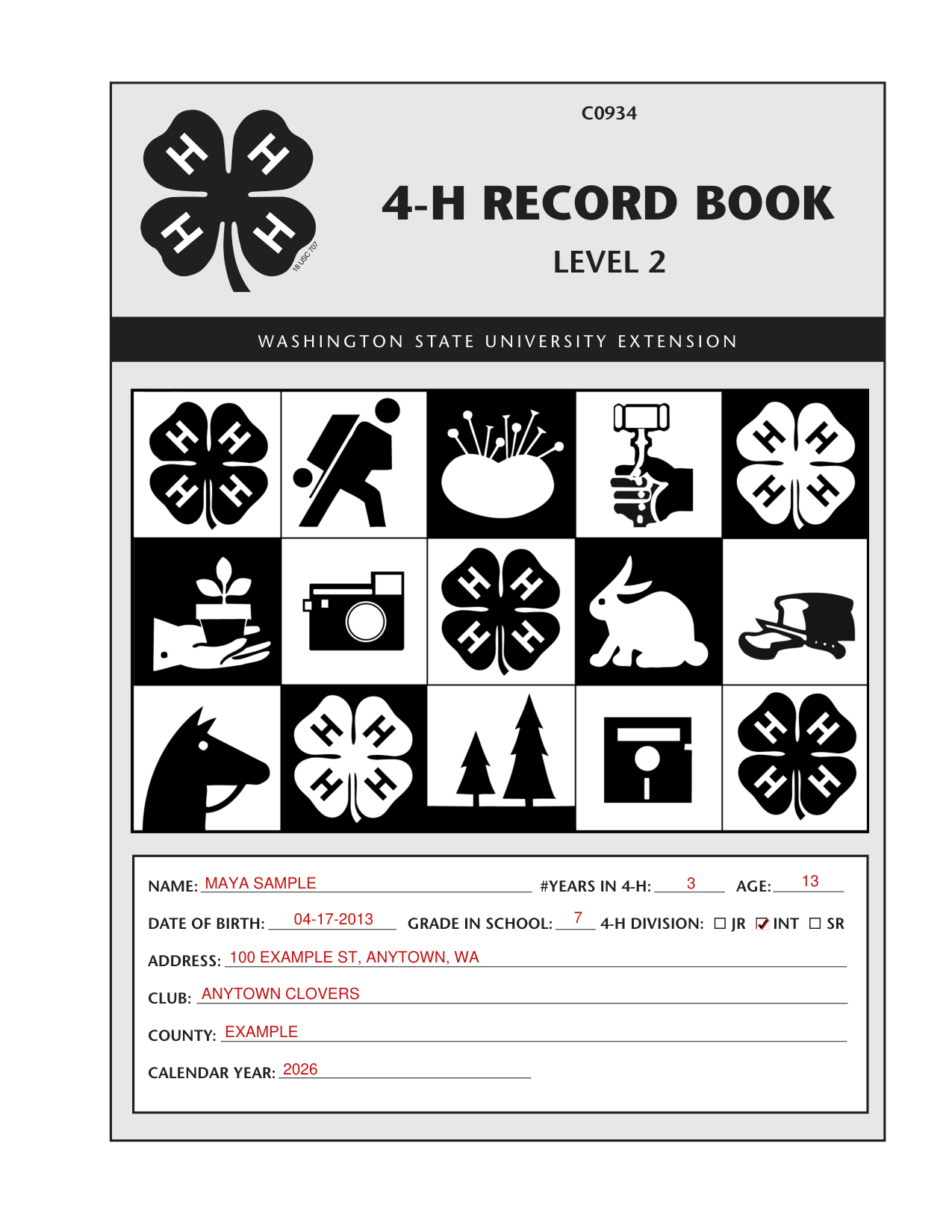
How to fill out Washington 4-H Record Book, Level 2 (C0934), box by box
Your name, club and county
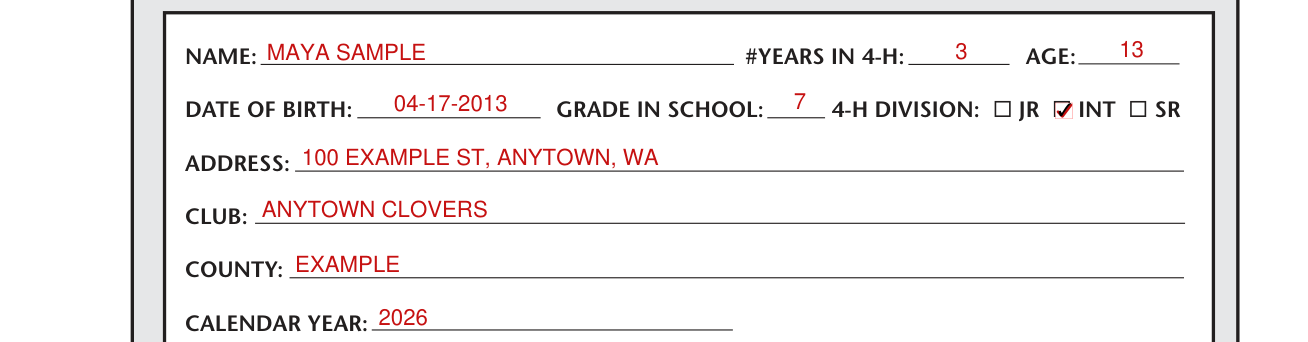
Fill in NAME, #YEARS IN 4-H, AGE, DATE OF BIRTH, GRADE IN SCHOOL, the 4-H DIVISION (JR, INT or SR), ADDRESS, CLUB, COUNTY and CALENDAR YEAR.
More rules for Washington 4-H Record Book, Level 2 (C0934)
Use a separate project commitment, project journal, project highlights, and financial summary for each of your projects.
Put it in a notebook with your other records. Separate each section with a tab. Each project should also have a tab. Keep the project commitment, project journal, project highlights, and financial summary for each project together. You may also want a scrapbook in which to keep ribbons, certificates, and programs.
Use your records to look back at your progress during the year. This will be helpful when you make plans for next year. The record book is your personal work. Keep it current as the year progresses. Do your own handwriting or typing.
There may be add sheets for projects with special planning or recording needs (breeding records, milk records, garden plan). Use the add sheets for your project as well as the project journal.
Permanent 4-H Record. Use this to record your participation in leadership, public presentations, demonstrations, judging, and other activities and contests during the years you are in 4-H.
Calendar, project pages, story and supplemental information
My 4-H Planning Calendar
Write down the events and activities you will be involved in.
Keep track of important events such as 4-H meetings, county fair, camp, and project-related activities.
On the MY 4-H PLANNING CALENDAR, place a check after each event you attend.
Project Commitment
On the Project Record page, fill in YEARS IN 4-H, PROJECT and YEARS IN THIS PROJECT.
Write what you want to learn this year under THIS IS WHAT I WANT TO LEARN THIS YEAR, then add the MEMBER'S SIGNATURE and DATE.
Obtain the LEADER'S SIGNATURE and DATE for THIS IS WHAT MY LEADER AGREED TO HELP ME LEARN.
Obtain the PARENT(S)/GUARDIAN SIGNATURE and DATE for THIS IS HOW MY PARENT(S)/GUARDIAN AGREED TO HELP ME LEARN.
Project Journal
Project Journal: complete one of these forms for each project in which you enroll.
If you need more space for the project journal, add more pages.
Date. This is a log of your actions. Keep it up to date.
What did you do or make? List, in order, the things you did or made (purchased supplies, cooked dinner, taught my dog to heel).
How much?/How many? If this column doesn't apply to what you did, leave it blank. How much did you buy? How many people did you serve?
Cost. What was the total cost of the items you purchased? If you used feed or other materials given to you by others, estimate the cost.
Income/Value. What was the amount you received for items sold, or the estimated value of items you made or raised that were used at home?
For many other things you do, such as teaching your dog to heel, there will be no cost or income.
Time. Estimate the time you spent on this action related to your project. For some activities you may want to summarize weekly or monthly hours spent.
Comments and what you learned. Briefly tell what problems you had, things you learned, and how you feel about what you did or made.
Project Highlights
Project Highlights. Look back at your project commitment. Did you learn what you planned to learn?
What problems did you have to solve? What were your main successes? What would you do differently if you did it again, knowing what you know now?
Under PROJECT HIGHLIGHTS, fill in What you learned, Problems, Successes and To do differently next time.
Financial Summary
Financial Summary. This is a summary of your project's financial value, what you spent, and what you earned during the year. It summarizes your project journal.
Do an inventory when you start your records each year and when you close your records.
Use the PROJECT FINANCIAL SUMMARY if applicable to your project: the beginning value is the materials, supplies, animals, equipment you had at the start of your project year, and the ending value is what you had at the end of your project year.
Line 3, Total Cost: add lines 1 and 2. Line 6, Total Income/Value: add lines 4 and 5. Line 7, Profit (loss): subtract line 3 from line 6.
Line 8 is the total time spent on project (project journal) in Hrs.
My 4-H Story Narrative
When you complete your 4-H program for this year, write your 4-H story. Write your story for the year in narrative form, as though you are actually talking to the reader.
Your story should have four parts and be no longer than two sides of one page: introduce yourself; write about your projects; do not repeat the project highlights; share your 4-H club experiences and how you were involved in your community and school; write about how you have changed as a result of your 4-H experience.
Supplemental Information
Supplemental Information is limited to two sides of one page. It should be related to your club, community, or school. It may contain pictures, news clippings, or letters. All items should be captioned.
Sources
[1] 4-H Record Book, Level 2 (C0934), Washington State University Extension (the Official source link on this page).