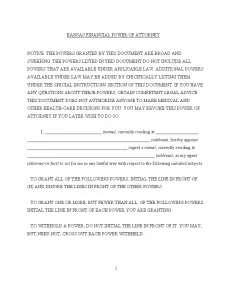
The Kansas general financial power of attorney form is a legal document enabling an individual (the “principal”) to appoint someone else (the “agent” or “attorney-in-fact”) to oversee their financial activities. This document is helpful when the principal expects to be unavailable or incapacitated and requires assistance managing their financial responsibilities.
This form grants the agent broad powers to perform actions on behalf of the principal, such as managing bank accounts, buying or selling real estate, filing taxes, and conducting other financial transactions. The powers granted through this form can take effect immediately and generally continue unless the principal revokes them or becomes incapacitated.
If the document is specified as “durable,” the powers will persist even if the principal becomes incapacitated. On our platform, you can get various Kansas power of attorney forms tailored to different needs.
Build Your Document
Answer a few simple questions to make your document in minutes
Save and Print
Save progress and finish on any device, download and print anytime
Sign and Use
Your valid, lawyer-approved document is ready
In Kansas, the laws governing the general power of attorney are detailed in the Kansas Statutes, specifically Sections 58-650 through 58-665. These statutes outline the framework within which an agent, once designated under a power of attorney, can operate on behalf of the principal. The agent is entrusted with a wide range of powers defined by the agreement, allowing them to effectively manage the principal’s affairs. Among the key provisions are:
Under Kansas Statute, Section 58-652, the principal’s signature on the document must be acknowledged in the presence of a notary public. This ensures the document’s legality and the consent to the powers granted.
| Document Name | Kansas General Power of Attorney Form |
| Other Name | Kansas Financial Power of Attorney |
| Relevant Laws | Kansas Statutes, Sections 58-650 to 58-665 |
| Avg. Time to Fill Out | 10 minutes |
| # of Fillable Fields | 41 |
| Available Formats | Adobe PDF |
The Kansas general power of attorney provides broad powers, from handling real estate transactions to managing retirement benefits. Follow this detailed guide to ensure the form is completed accurately and effectively.
1. Identify the Principal and Agent
Begin by filling out your name and address as the principal and the name and address of the person you appoint as your agent or attorney-in-fact. Ensure that the information is accurate and complete to avoid any misunderstandings.
2. Granting Powers
You will find a list of powers you can grant to your agent. These include:
You must initial next to each power you want to grant. If you wish to grant all listed powers, simply initial next to the option marked “All of the Powers Listed Above.”
3. Special Instructions
In the “Special Instructions” section, you can add any specific powers or limitations not already covered in the listed powers. This section allows you to customize the authority you are giving to your agent, tailoring it to your specific needs and circumstances.
4. Determine the Effective Date
Decide when the powers will become effective. You can choose to have the power of attorney take effect immediately or start on a specified future date. Make sure to initial the appropriate line to indicate your choice.
5. Set the Termination Date
Specify how and when the power of attorney will terminate. Options include termination upon death, revocation, or incapacitation as defined in the document. Initial the condition that applies to how you want the power to end.
6. Signatures and Witnesses
Once all sections are completed, sign the document. Your signature must be witnessed and notarized to be legally binding. Ensure that a notary public or other authorized officer is present to verify the signing.
7. Acknowledgment by Notary
The notary public will fill out the acknowledgment section, confirming your identity and understanding of the document’s significance. This step formalizes the document’s legal standing.
8. Store and Share the Document
Have the document notarized. This step authenticates the signatures and confirms that the principal signed the document willingly and without coercion.
Store the original signed and notarized document in a safe place. Provide copies to your agent and any institutions or individuals who will interact with your agent under the authority of this power of attorney.