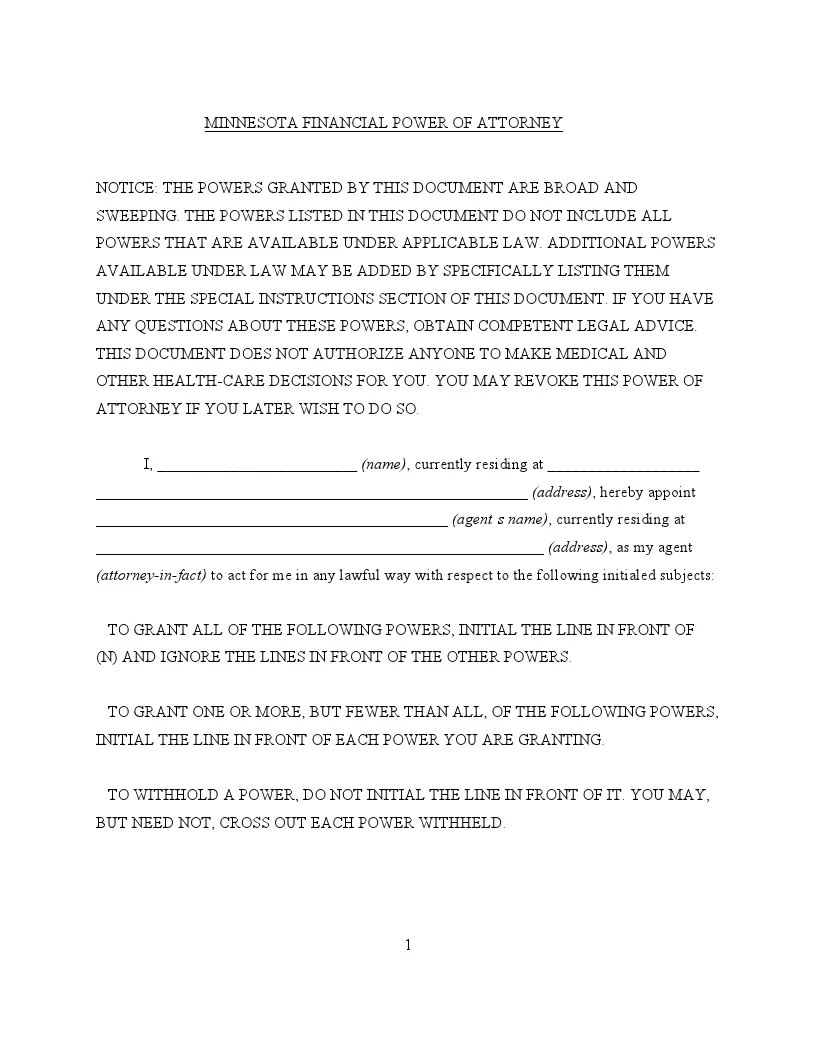
The Minnesota general financial power of attorney is a legal document that allows the principal to authorize the agent or attorney-in-fact to act on their behalf in various matters. These could include managing finances, overseeing property, and making personal and business choices. Contrary to a limited form, which restricts the agent’s authority to a specific domain, a general power of attorney provides extensive power to control most of the principal’s matters.
This type of power of attorney in Minnesota usually allows actions like opening bank accounts, property transactions, tax filing, and involvement in legal matters. However, it’s important to understand that the authority given in a general power of attorney stops if the principal is unable to make decisions unless the document is made durable. Consider other Minnesota POA forms if you need a document that will remain effective even if the principal becomes incapacitated.
Build Your Document
Answer a few simple questions to make your document in minutes
Save and Print
Save progress and finish on any device, download and print anytime
Sign and Use
Your valid, lawyer-approved document is ready
In Minnesota, the scope of the powers granted can be extensive, enabling the agent to conduct a wide range of actions on behalf of the principal as outlined in the Minnesota Statutes, Section 523.23. As per Section 523.09, a nondurable power of attorney will terminate under certain conditions, including:
The law provides a statutory form that outlines the broad and sweeping powers that can be granted to the agent, ensuring that the principal’s intentions are clearly communicated and legally enforceable. For legal validity, a notary public must acknowledge a power of attorney, whether signed directly by the principal or on their behalf, as mandated by Section 523.01.
| Document Name | Minnesota General Power of Attorney Form |
| Other Name | Minnesota Financial Power of Attorney |
| Relevant Laws | Minnesota Statutes, Sections 523.01 to 523.26 |
| Avg. Time to Fill Out | 10 minutes |
| # of Fillable Fields | 41 |
| Available Formats | Adobe PDF |
Completing a Minnesota general power of attorney form involves several steps. This guide will walk you through each part of the process to ensure your form is legally compliant.
1. Principal Information
Begin by entering the full name and address of the principal. This identifies the person who is granting the power of attorney. Ensure that this information is accurate and complete, as it is essential for the legal validity of the document.
2. Designate Attorney(s)-in-Fact
Next, fill in the names and addresses of the attorney-in-fact. If more than one attorney-in-fact is designated, decide whether they can act independently or must act jointly. Indicate this by checking the appropriate box next to the relevant statement.
3. Successor Attorney(s)-in-Fact
You may also designate a successor agent to act if the original attorney-in-fact cannot serve. Enter their names and addresses. This step is optional but recommended for continuity.
4. Expiration Date
Specify an expiration date for the power of attorney if desired. Use a specific month, day, and year. If no expiration date is provided, the POA remains effective until revoked or the principal’s death.
5. Granting Powers
Indicate the powers you grant to the attorney-in-fact by checking the boxes following each power listed in the document. Powers include real property transactions, banking transactions, business operations, and more.
6. Special Instructions and Limitations
State any limitations or special instructions for the attorney-in-fact. For example, you can specify restrictions on certain transactions or impose conditions on using granted powers. This part ensures your agent acts within the bounds of your preferences.
7. Gifting Authority
Decide whether to authorize the attorney-in-fact to make gifts to themselves or others they are legally obligated to support. If you do not wish to grant this power, check the box indicating no gift authorization. If you authorize gifting, write in the names of the authorized individuals and check the corresponding box.
8. Accounting Requirements
Choose whether the attorney-in-fact must provide an accounting of their transactions. You can require regular accountings (monthly, quarterly, or annually) or specify that an accounting is only necessary if requested by the principal or otherwise required by law. Check the box next to the preferred option and provide the necessary details.
9. Signature of Principal
The principal must sign the document in the presence of a notary public. The signature confirms the principal’s consent and understanding of the powers granted. This step is crucial for the form’s legal effectiveness.
10. Acknowledgment of Principal
The principal’s signature must be notarized. The notary public will acknowledge the signature, confirm the principal’s identity, and undertake the voluntary execution of the document.
11. Notice to Attorney(s)-in-Fact
Each attorney-in-fact must read and sign the “Important Notice to the Attorney(s)-in-Fact” section. This acknowledgment confirms that they understand their responsibilities and the scope of their authority. No notarization is required for this section.
Review the entire document to ensure all information is correct and all required sections are completed. Once all signatures and acknowledgments are obtained, the form is legally binding and can be used by the attorney-in-fact as needed.