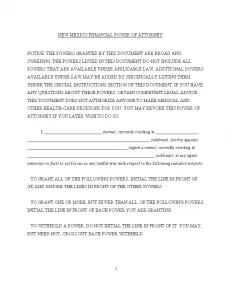
The New Mexico general financial power of attorney is a formal document through which a person, referred to as the principal, designates the agent or attorney-in-fact to oversee their financial affairs. This authorization gives the agent extensive powers to manage activities such as handling bank accounts, signing checks, and buying or selling real estate, among other financial dealings.
It should be noted that the authority conferred by this power of attorney form generally continues until the principal becomes incapacitated, at which time it would cease to be effective. In contrast, a durable version maintains validity even if the principal loses capacity. On FormsPal, you can find all New Mexico power of attorney templates and draft documents that comply with your state’s requirements.
Build Your Document
Answer a few simple questions to make your document in minutes
Save and Print
Save progress and finish on any device, download and print anytime
Sign and Use
Your valid, lawyer-approved document is ready
The laws governing the creation and use of a general power of attorney are detailed in the New Mexico Statutes Annotated, specifically under Sections 45-5B-101 to 45-5B-403. This legal framework defines a power of attorney as a written or otherwise recorded document that authorizes an agent to act on behalf of a principal. Other legal requirements include:
The general power of attorney in New Mexico is typically effective immediately upon signing unless otherwise specified.
| Document Name | New Mexico General Power of Attorney Form |
| Other Name | New Mexico Financial Power of Attorney |
| Relevant Laws | New Mexico Statutes Annotated, Sections 45-5B-101 to 45-5B-403 |
| Avg. Time to Fill Out | 10 minutes |
| # of Fillable Fields | 41 |
| Available Formats | Adobe PDF |
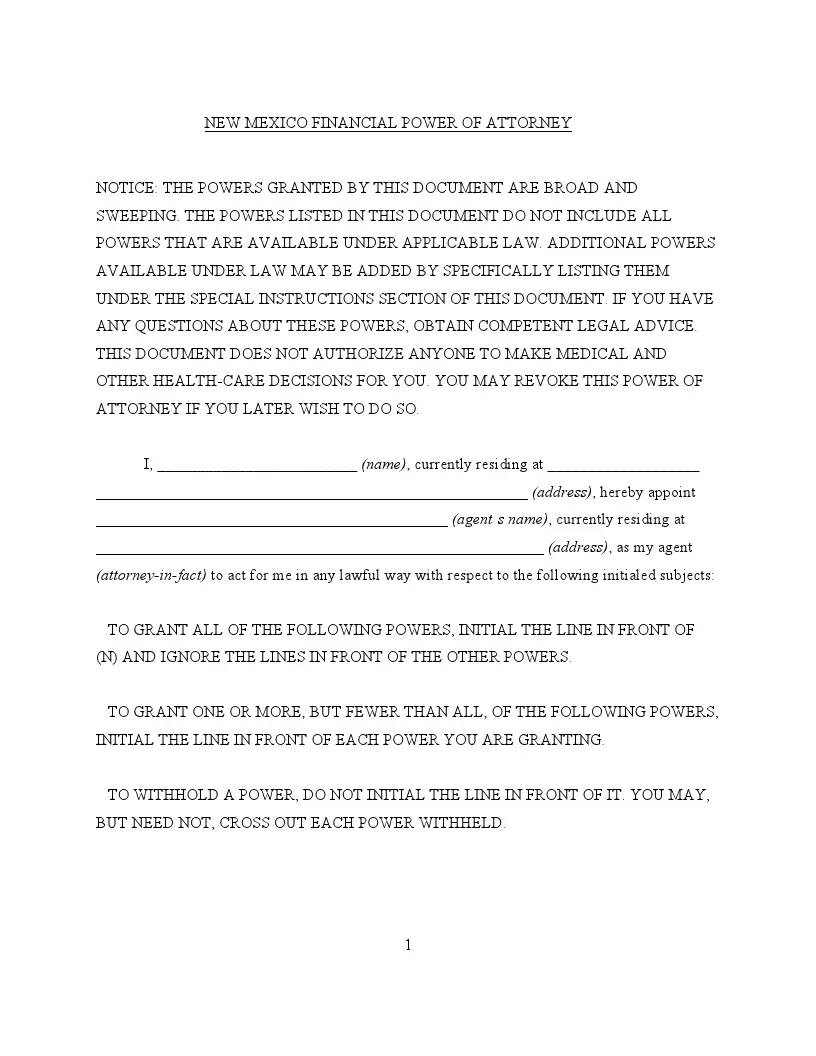
Completing a general power of attorney in New Mexico grants a designated agent the authority to handle your financial affairs. Here’s a step-by-step guide to help you accurately fill out this form.
1. Principal and Agent Information
Enter your full legal name and current residential address at the top of the form where indicated. Then, write the full legal name and address of the person you are designating as your agent. This individual will be able to act on your behalf in financial matters.
2. Granting Powers
The form lists various financial powers you can grant your agent, such as handling real estate transactions, managing financial accounts, and dealing with retirement plans. You will:
Consider carefully which powers are appropriate for your needs and circumstances to guarantee that your agent receives clear instructions.
3. Special Instructions
If you have specific conditions or additional powers not listed that you want your agent to have, detail these in the “Special Instructions” section. This is your opportunity to customize the authority you are granting.
4. Effective and Termination Dates
Choose when the POA will become effective. You can have it take effect immediately or specify a future date. Then, decide on the termination criteria for the POA. You can opt for termination upon a written revocation, a specific date, or if you are declared incapacitated. Initial next to your choice.
5. Sign and Date the Form
After reviewing the form to ensure all information is correct and reflects your wishes, sign and date the form in the presence of a notary. This step is crucial as it validates the form legally.
6. Notarization
The final step is to have the form notarized. The notary will verify your identity and witness your signature, then seal and sign the form, which finalizes its legal standing.