
A Kansas power of attorney form for a minor child is a written document in which a parent names another person to act for the child. Kansas has no general statute for this document when a parent asks a relative or friend to care for a child. Kan. Stat. Ann. § 38-2403 covers only a placement through a host family program: a parent may place a child into a program set up under that section by executing a power of attorney that delegates to a host family any of the powers regarding the care and custody of the child.[1] This guide shows which rules apply to that program and what is common practice otherwise.
Last Updated: October 2026. This guide is reviewed and updated regularly to reflect current Kansas law. If you notice an error or outdated information, please contact us.

Build Your Document
Answer a few simple questions to make your document in minutes
Save and Print
Save progress and finish on any device, download and print anytime
Sign and Use
Your valid, lawyer-approved document is ready
In a Kansas minor child power of attorney, a parent, court-appointed guardian, or court-appointed conservator names another person to act for the child. That person is called the agent or the attorney-in-fact. The terms below appear on the FormsPal template and in the rest of this guide.
Before you start the form, gather these details so you can fill it out in one sitting.
A parent can use a power of attorney template like this one to delegate powers over a child to another person. The rules below come from Kan. Stat. Ann. § 38-2403 and apply only to a host family program, which a child placement agency, or a Kansas charitable organization working under an agreement with one, may set up to provide temporary care of children by placing a child with a host family.[1] They cover how long the document lasts, who must agree, which powers stay with the parent, and how to end it.
Outside a host family program, no Kansas statute sets how long this document lasts or how it must be signed. The steps in this guide for those points are common practice, not legal requirements: pick a set end date, sign before a notary, and give copies to the child's school and doctors. People often use this document when they expect to be away from their child for a while. For a broader overview of healthcare, financial, and minor child authorizations, see all Kansas POA forms.
| Document Name | Kansas Minor Child Power of Attorney Form |
| Other Name | Kansas Parental Power of Attorney |
| Relevant Laws | Kansas Statute, Section 38-2403 (host family program placements only) |
| Duration | The end date you write on the form. For a host family program placement: up to one year, renewable for one additional year, or for a parent on active duty service, the term of active duty service plus 30 days.[1] |
| Avg. Time to Fill Out | 10 minutes |
| # of Fillable Fields | 44 |
| Available Formats | Adobe PDF |
You hand some of your powers over your child to the agent. In a host family program placement, Kan. Stat. Ann. § 38-2403 lets a parent delegate to the host family any of the powers regarding the care and custody of the child, except a short list of powers that stay with the parent.[1] The agent acts for you in those matters while the document is in effect.
Kansas does have a statute for one medical decision: a parent may delegate in writing the authority to consent to the child's immunization to a grandparent, an adult brother or sister, an adult aunt or uncle, a stepparent, or another adult who has care and control of the child.[3] If the agent may need to consent to vaccines while you are away, it is common to name that power in writing. Keep a copy of the signed document with you when you speak to the school or doctor, so you can show who may act for your child.
The FormsPal template runs three pages. Work through the steps below in order. Each step names the part of the form it covers and the page it is on, so you can check your entries against the printed form as you go.
The screenshots under each step show the FormsPal Kansas minor child power of attorney template filled with sample entries in blue, so you can see where each answer goes. The names, addresses, dates and amounts are examples only.
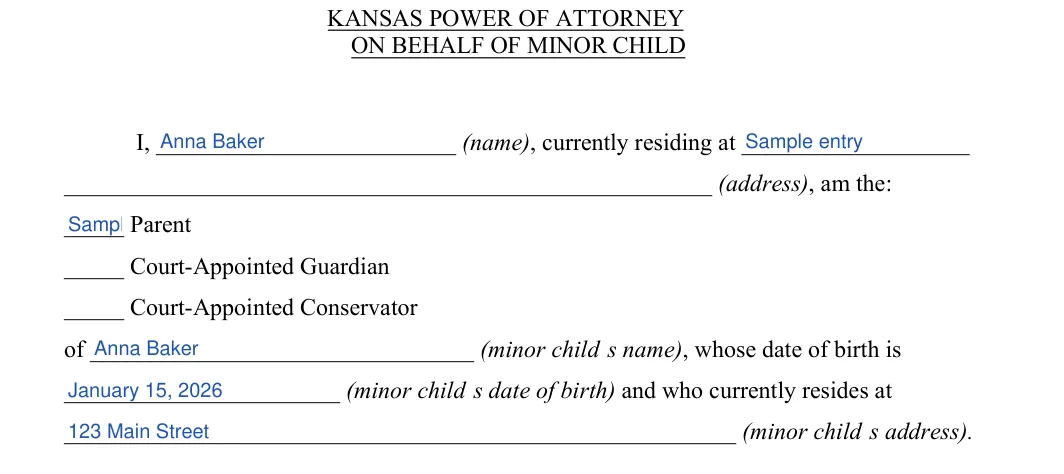
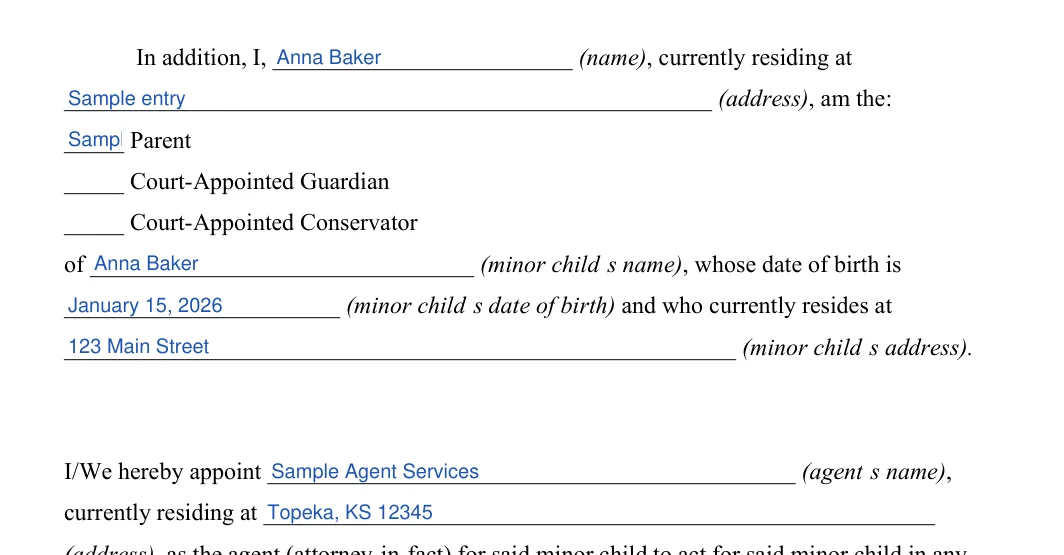
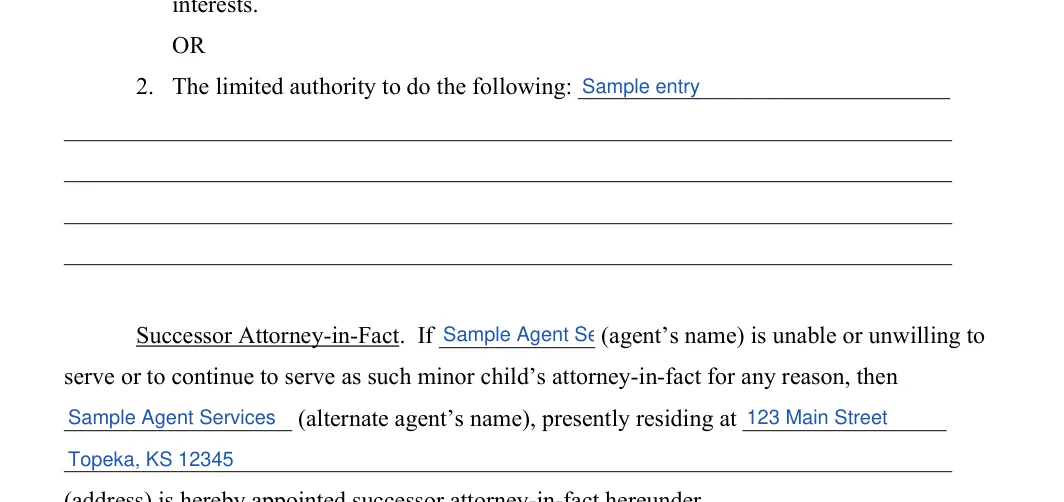

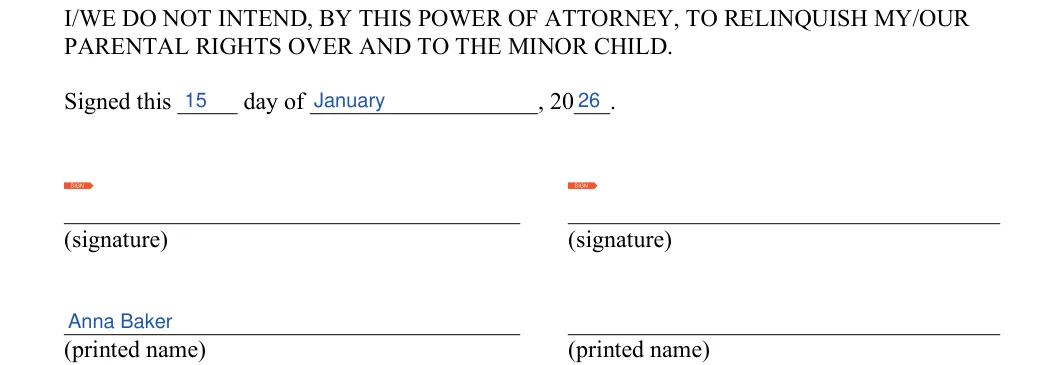
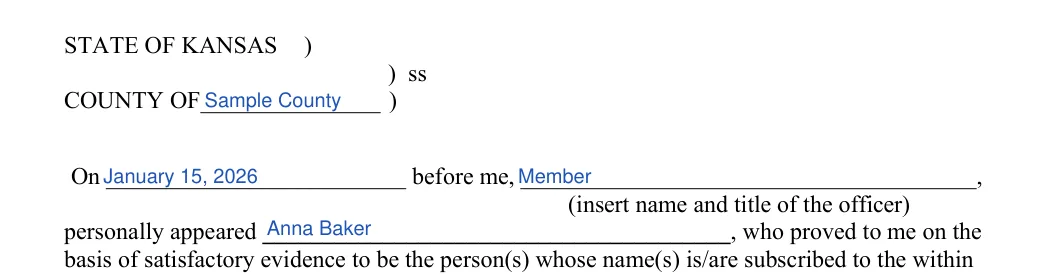

The table below uses made-up names and addresses to show how entries on pages 1 and 2 fit together. Replace every entry with your own details.
| Part of the form | Sample entry |
|---|---|
| Parent | Anna Baker, 123 Main Street, Wichita KS 67202 |
| Child | Emma Baker, born 01/01/2015 |
| Agent (attorney-in-fact) | Ben Carter, 456 Oak Avenue, Wichita KS 67202 |
| Powers | Option 2, limited: pick up the child from school and consent to routine care |
| Effective and end dates | 06/01/2027 until 05/31/2028, which is one year |
After you complete the form, review it with the agent, sign it, and get copies to the people who need them. The steps below cover creating the document, signing it, sharing copies, and ending it later.
The answers below cover duration, revocation, the powers a parent keeps, whose consent is needed, and the form to follow. Each rule below comes from Kan. Stat. Ann. § 38-2403, which covers only placements through a host family program, and the source is cited after it. Read the answers together with the requirements section above before you sign.
It depends on how you use it. Outside a host family program, no Kansas statute sets a limit, and the form asks you for an end date. A power of attorney for a host family program placement under Kan. Stat. Ann. § 38-2403 cannot exceed one year in duration, but it may be renewed for one additional year. A serving parent on active duty service may sign one for longer than one year, and its duration cannot exceed the term of active duty service plus 30 days.[1]
Yes. For a host family program placement, a parent who executes a power of attorney under Kan. Stat. Ann. § 38-2403 has the authority to revoke or withdraw it at any time.[1] Outside a program, it is common practice to revoke it in writing and tell the agent, the school, and the doctor.
In a host family program placement, a parent cannot delegate these powers to the host family.[1]
Other powers regarding the care and custody of the child can be delegated to the host family. Outside a program, no Kansas statute lists the powers a parent keeps. Option 2 on the form lets you hand over only the powers you write in.
For a host family program placement, yes. The placement is not allowed without the consent of all individuals who have legal custody of the child.[1] Outside a program, no Kansas statute sets this rule, but the form has room for a second parent, guardian, or conservator to join and sign.
A power of attorney for a host family program placement is deemed sufficient if it is in substantial compliance with the form set forth by the judicial council.[1] The FormsPal template is a general form, not that judicial council form.
General information, not legal or tax advice.
