
A Minnesota minor child power of attorney is a written document that lets a parent, legal custodian or nonprofessional guardian delegate powers over a child to another person for up to one year.[1.2] Minnesota law does not let that person consent to the child's marriage or adoption.[1.1] This power of attorney MN form is also called a Delegation of Parental Authority (DOPA). Parents use a child power of attorney form when illness, deployment or travel keeps them away.
Last Updated: October 2026. This guide is reviewed and updated regularly to reflect current Minnesota law. If you notice an error or outdated information, please contact us.

Build Your Document
Answer a few simple questions to make your document in minutes
Save and Print
Save progress and finish on any device, download and print anytime
Sign and Use
Your valid, lawyer-approved document is ready
Under Section 524.5-211 of the Minn. Stat., a parent, legal custodian or nonprofessional guardian of a minor may delegate powers over the child to another person. The delegation must be made by a properly executed power of attorney.[1.2]
It can last for a period not exceeding one year. The delegated powers can cover the child's care, custody or property, but not the power to consent to marriage or adoption of a minor person subject to guardianship.[1.1]
A parent, legal custodian, or nonprofessional guardian of a minor or incapacitated person, by a properly executed power of attorney, may delegate to another person, for a period not exceeding one year, any powers regarding care, custody, or property of the minor or person subject to guardianship, except the power to consent to marriage or adoption of a minor person subject to guardianship.
A parent who signs this delegation must mail or give a copy of the document to any other parent of the child within 30 days of signing it, unless an exception applies, for example when the other parent does not have parenting time or has supervised parenting time.[1.3]
This table summarizes the FormsPal template, including its other name, the statute behind it and how long the delegation can last. You can fill out the template online, or download the Adobe PDF, print it and complete it by hand.
| Document Name | Minnesota Minor Child Power of Attorney Form |
| Other Name | Delegation of Parental Authority (DOPA) |
| Relevant Laws | Minnesota Statutes, Section 524.5-211 |
| Duration | Up to one year[1.1] |
| Avg. Time to Fill Out | 10 minutes |
| # of Fillable Fields | 44 |
| Available Formats | Adobe PDF |
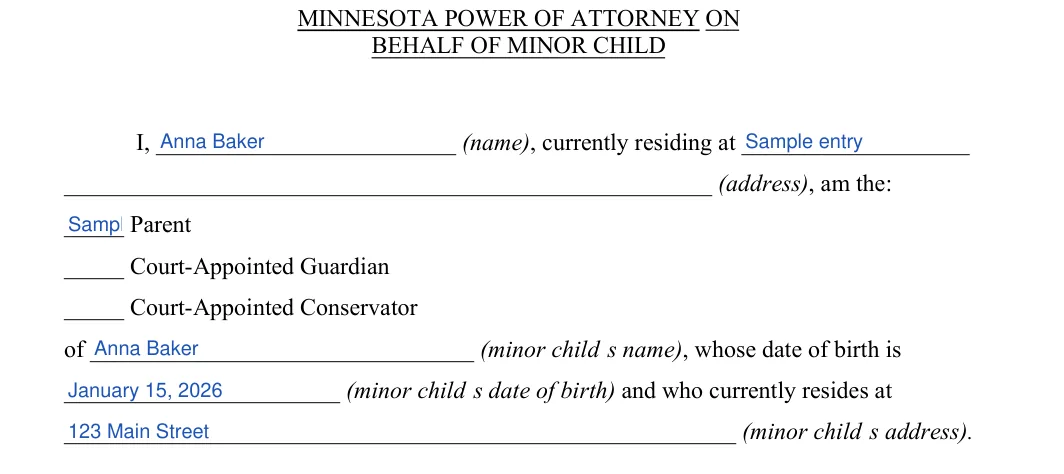
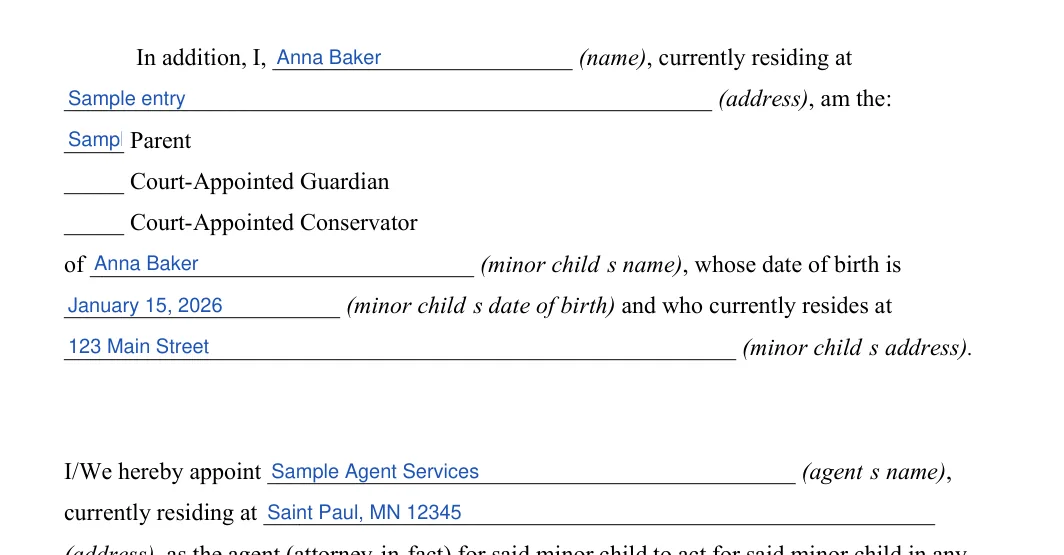
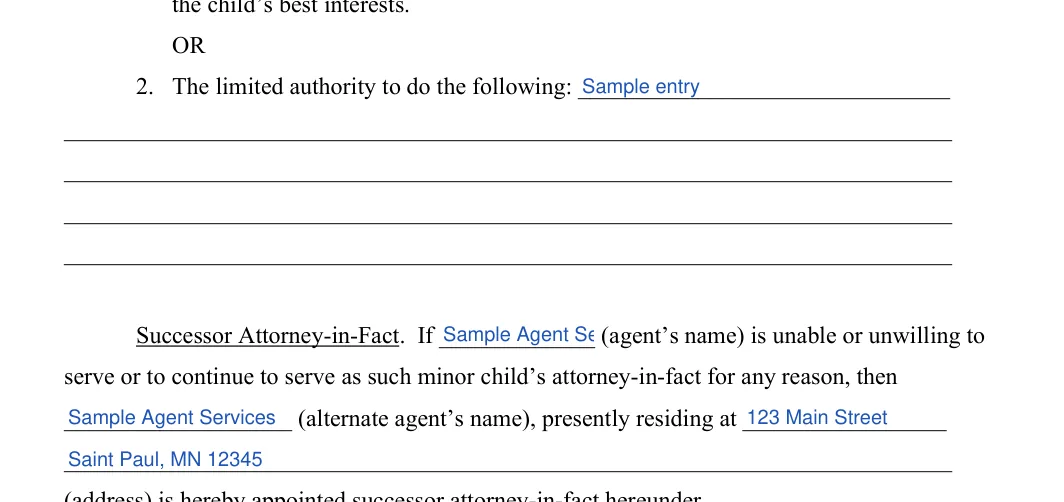
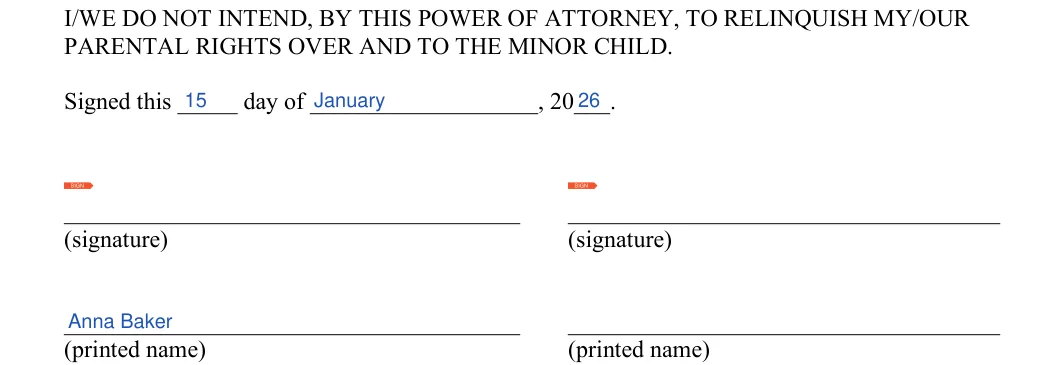
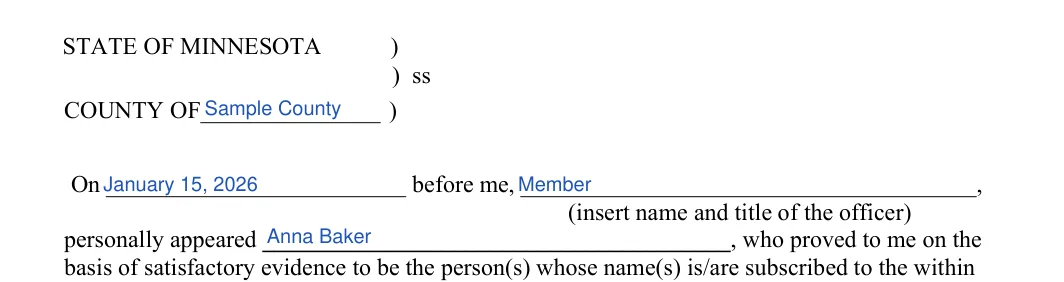
The FormsPal template runs three pages. Fill in the lines from top to bottom, using the same names and dates that appear in the child's records. Pages 1 and 2 hold the parent statement, the agent, the effective dates and the signature lines, and page 3 is a notary acknowledgment. The steps below follow the form in order.
The screenshots under each step show the FormsPal Minnesota minor child power of attorney template filled with sample entries in blue, so you can see where each answer goes. The names, addresses, dates and amounts are examples only.


Once the form is filled out, a few practical steps turn it into a document the agent can use. These steps come from common practice, not from the Minnesota statute. Check with the school, clinic or office that will receive the document about anything else it asks for.
If you need other state-specific documents, see the Minnesota medical power of attorney form or the Minnesota motor vehicle power of attorney form, or check out all Minnesota POA forms. Looking at a neighboring state? See the Wisconsin minor child form or the Iowa minor child form.
Minnesota law lets a parent, legal custodian or nonprofessional guardian of a minor delegate any powers regarding the care, custody or property of the child to another person for a period not exceeding one year.[1.1]
A power of attorney can cover any powers regarding the care, custody or property of the child. The exception is the power to consent to marriage or adoption of a minor person subject to guardianship.[1.1]
Yes. The delegation must be made by a properly executed power of attorney, and the principal must sign it. The principal is the parent, legal custodian or nonprofessional guardian who delegates the powers.[1.2]
General information, not legal or tax advice.
