Utah Minor Child Power of Attorney Form

A Utah minor child power of attorney is a legal paper that lets a parent or guardian hand some authority over a child's care, custody, or property to another adult, called the agent. The delegation can last up to six months.[1] The FormsPal template also states that the signer does not intend to give up parental rights. This guide explains the statute, the template, and every step of filling it out.

Last Updated: October 2026. This guide is reviewed and updated regularly to reflect current Utah law. If you notice an error or outdated information, please contact us.

Utah minor child power of attorney form preview

Create a high-quality Utah Minor Child Power of Attorney Form online now!

Build Your Document

Answer a few simple questions to make your document in minutes

Save and Print

Save progress and finish on any device, download and print anytime

Sign and Use

Your valid, lawyer-approved document is ready

... or download your Utah Minor Child Power of Attorney as a  PDF file

What Utah Code § 75-5-103 Says

Utah allows a parent or guardian of a minor to delegate some of their authority over the child to another person through a properly executed power of attorney. The delegation cannot last longer than six months. Two kinds of consent stay with the parent or guardian, namely consent to marriage and consent to the adoption of a minor ward.[1]

The rule comes from Utah Code § 75-5-103, and the statute says:

A parent or a guardian of a minor or incapacitated person, by a properly-executed power of attorney, may delegate to another person, for a period not exceeding six months, any of the parent's or guardian's powers regarding care, custody, or property of the minor child or ward

Utah Code § 75-5-103

In plain words, the section sets four rules:[1]

  • Who signs: the person delegating the authority signs the power of attorney.
  • What can be delegated: powers regarding the child's care, custody, or property.
  • How long: no more than six months.
  • What cannot be delegated: consent to the child's marriage or to the adoption of a minor ward.

Also, Utah Code § 75-5-104 clarifies that the existence of a minor child power of attorney does not affect the court's ability to appoint a guardian ad litem.[2]

Parents who need a different kind of authority can compare FormsPal's Utah power of attorney forms. The Utah limited power of attorney form covers a narrower task, and the Utah medical power of attorney form covers health care decisions.

For money matters, FormsPal also has the Utah general financial power of attorney form and the Utah durable power of attorney form.

What the Form Covers

The FormsPal template gives you two options for setting the scope of the authority, and you choose one on page 2. Whichever option you pick, the person you name acts for the child only within the authority granted and only for the dates you enter.

  • Option 1, all authority that can be delegated. The form gives examples such as consent to medical treatment, decisions about schooling and school activities, support, care, housing, and nourishment for the child, and any act that protects the child and serves the child's best interests.
  • Option 2, limited authority. You write the specific powers on the lines provided, and that person is limited to what you wrote.

If you want that person to handle only one task, such as medical decisions during a trip, Option 2 lets you spell out the task in your own words.

When Families Use It

In practice, families often use a power of attorney like this one when a child will stay with a relative or another trusted adult who provides care for a period of time. Common examples are illness, military service, and extended travel. These are common uses and not legal requirements, so the right choice depends on your situation. For legal questions or issues that the form does not address, ask an attorney.

Form Details at a Glance

This fillable power of attorney PDF has 44 fields and takes about 10 minutes to complete. The table below lists its other name, the statute behind it, how long the delegation can last, and the file format. For other situations, see the FormsPal POA form and the other Utah power of attorney forms.

Document Name Utah Minor Child Power of Attorney Form
Other Name Utah Parental Power of Attorney
Relevant Laws Utah Code, Section 75-5-103
Duration Up to six months[1]
Avg. Time to Fill Out 10 minutes
# of Fillable Fields 44
Available Formats Adobe PDF

Key Terms on the Form

Several words on the template are easy to confuse, so it helps to know how each one is used before you fill anything in. The list below describes each term the way the template and the statute use it.

  • Principal: the parent or guardian who delegates authority and signs the power of attorney.
  • Agent: the adult the form appoints to act for the child, also called the attorney-in-fact.
  • Successor: the person you name on page 2 to step in if the first agent cannot serve.
  • Conservator: one of the three roles the signer can mark on page 1, next to parent and court-appointed guardian.
  • Delegation: handing authority over the child to another person for a set period of no more than six months.[1]
  • Acknowledgment: the notary section on page 3, where the officer records who appeared and on what date.

What to Have Ready Before You Start

Gathering the details before you begin makes the paperwork quicker to complete, because every entry on the list below goes onto pages 1 and 2, while the notary completes page 3 when you sign.

  • Your full name and address, and whether you are the parent, court-appointed guardian, or court-appointed conservator.
  • The child's full name, date of birth, and address.
  • The name and address of a second parent, guardian, or conservator, if there is one.
  • The name and address of the person who will act for the child, and of a successor if you want one.
  • The start date and end date of the delegation, which must fit within six months.

Questions to Settle Before You Sign

A power of attorney works best when everyone involved knows what it covers. Talk through the points below with the other adult, and with the child's other parent if there is one, before you enter anything on the template.

  • Which decisions the agent will need to make, such as medical care, schooling, or daily care.
  • Whether Option 1 or Option 2 fits better, and what to write on the lines if you pick Option 2.
  • The start date and the end date, and whether six months is long enough for your situation.
  • Who the successor will be, in case the first agent cannot serve.
  • Whether a second parent, guardian, or conservator needs to sign too.
  • Whether you will have the signature notarized. The template includes the page 3 acknowledgment, and FormsPal has a separate Utah notary acknowledgment page.

How to Fill Out the Power of Attorney Step by Step

The FormsPal template has three form pages and seven parts to complete: the parent or guardian and the child, the agent, the powers, the dates, the signature, and the notary's acknowledgment. Work through the steps below in order.

The screenshots under each step show the FormsPal Utah minor child power of attorney template filled with sample entries in blue, so you can see where each answer goes. The names, addresses, dates and amounts are examples only.
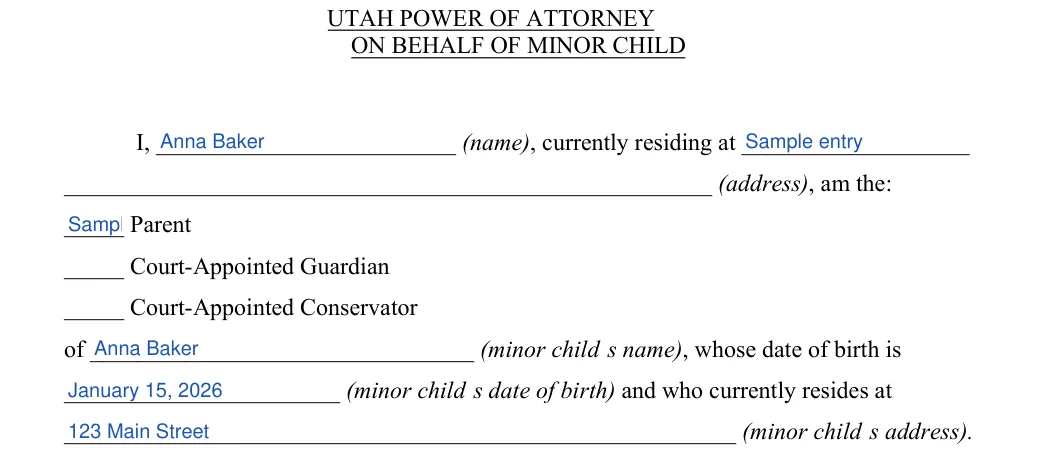
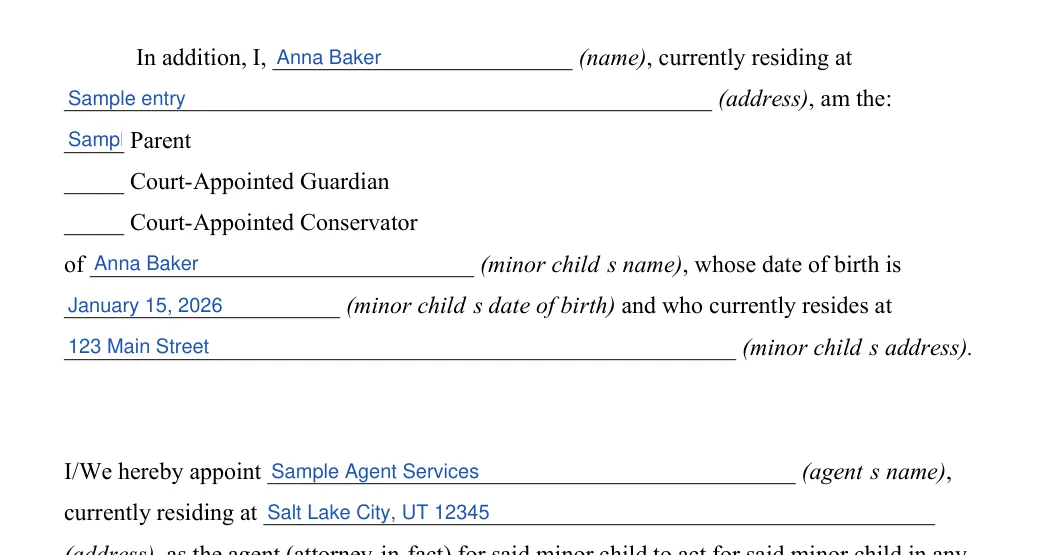
  1. Identify yourself and the child (page 1). Enter your name and address, then initial whether you are the Parent, Court-Appointed Guardian, or Court-Appointed Conservator. Add the child's name, date of birth, and address.
    Utah minor child power of attorney: ON BEHALF OF MINOR CHILD, filled with sample entries
    Step 1: sample entries, not a real document.
  2. Add a second parent and name the agent (page 1). If there is more than one parent, guardian, or conservator, complete the "In addition" statement with their details. Otherwise you can skip that statement. Then enter the name and address of the agent, also called the attorney-in-fact, who acts for the child.
    Utah minor child power of attorney: Name, Currently residing at and more, filled with sample entries
    Step 2: sample entries, not a real document.
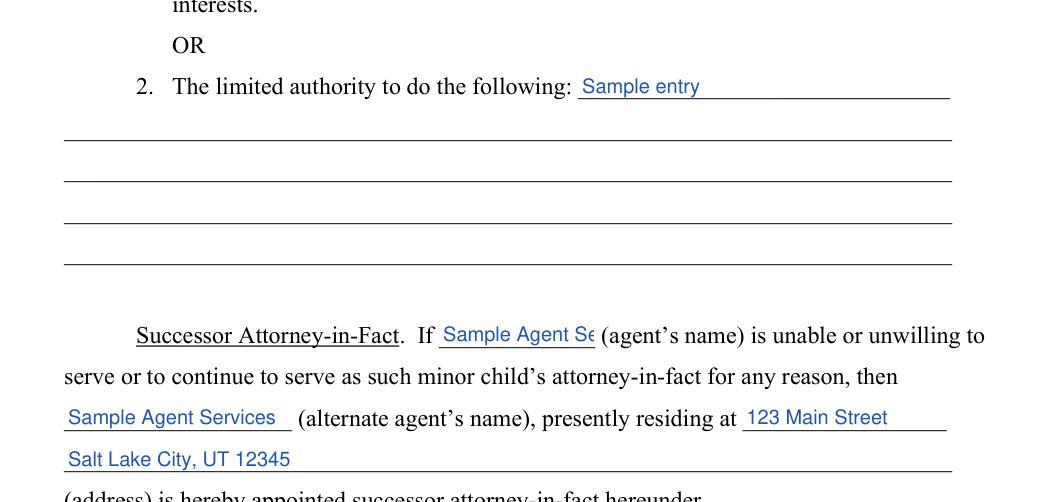
  3. Choose the powers and a successor (page 2). Option 1 gives that person all authority that can be delegated under the statute, with examples such as medical treatment and schooling. Option 2 limits the authority to what you write on the lines. You can also name a successor in case the first person cannot serve.
    Utah minor child power of attorney: Agent's name, Alternate agent’s name and more, filled with sample entries
    Step 3: sample entries, not a real document.
  4. Set the effective date (page 2). Enter the date the power of attorney starts and the date it continues until. The delegation can last no more than six months, so choose an end date within that limit.[1]
    Utah minor child power of attorney: EFFECTIVE DATE, filled with sample entries
    Step 4: sample entries, not a real document.
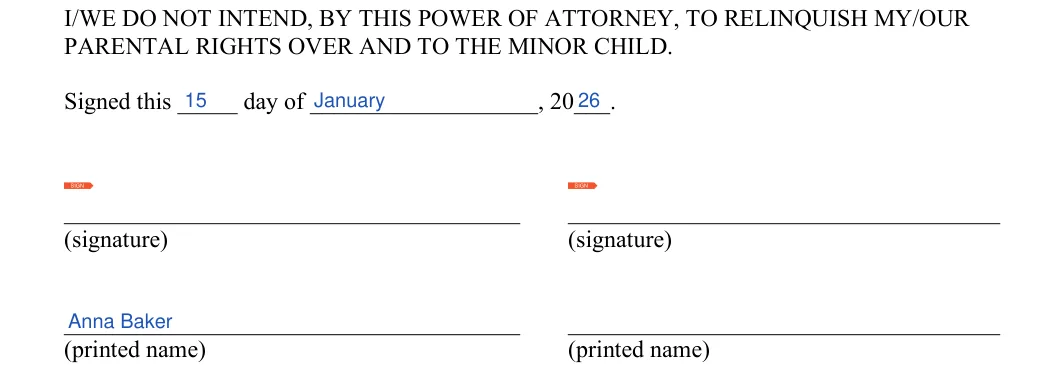
  5. Date and sign the form (page 2). Fill in the day, month, and year on the "Signed this" line, then sign and print your name. The second set of lines is for a second parent, guardian, or conservator. The statute calls for a properly executed power of attorney, so the signature of the person delegating is required.[1]
    Utah minor child power of attorney: PARENTAL RIGHTS OVER AND TO THE MINOR CHILD, filled with sample entries
    Step 5: sample entries, not a real document.
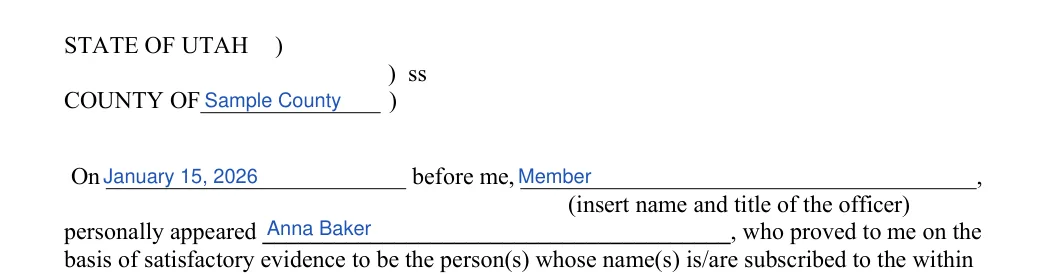
  6. Fill in the acknowledgment details (page 3). Page 3 holds a notary acknowledgment, and notarizing a signature is common practice for a form like this. Enter the county, the date, the name and title of the officer, and the name of the person who appeared.
    Utah minor child power of attorney: STATE OF UTAH, filled with sample entries
    Step 6: sample entries, not a real document.
  7. Leave the officer's signature and seal (page 3). The signature line below the acknowledgment paragraph and the seal area are for the notary or officer to complete. Check that both are filled in before you use the form.
    Utah minor child power of attorney: Signature, filled with sample entries
    Step 7: sample entries, not a real document.

Tip: Fill in the successor lines on page 2. If the first person cannot serve, the form already names who steps in.

Mistakes to Avoid When Completing the Form

Check the following points before you sign, so the power of attorney stays within the limits of the statute and every line is complete. Each point comes from the six-month limit, the excluded consents, or the layout of the template.

  • Choosing an end date more than six months after the start date.[1]
  • Trying to delegate consent to marriage or to the adoption of a minor ward.[1]
  • Leaving out the second parent, guardian, or conservator when the "In addition" statement applies.
  • Leaving the child's name, date of birth, or address incomplete.
  • Filling in the officer's signature or seal on page 3 yourself.
Template Preview
Create a high-quality Utah Minor Child Power of Attorney Form online now!

Frequently Asked Questions

How long can a power of attorney for a child last?

Under Utah Code § 75-5-103, a parent or guardian may delegate their powers for a period not exceeding six months.[1] That limit applies to the whole delegation, so the power of attorney cannot stay in effect longer than six months.

What authority can a parent not delegate?

A parent or guardian cannot delegate the power to consent to marriage or to the adoption of a minor ward.[1] The other powers regarding the child's care, custody, or property can be delegated, so these two consents stay with the person who signs.

Who signs a power of attorney for a child?

The statute refers to a properly executed power of attorney, and the principal must sign it.[1] In this setting the principal is the person who delegates authority over the child.

General information, not legal or tax advice.

Sources

  1. Utah Code § 75-5-103.
  2. Utah Code § 75-5-104. Accessed October 15, 2026.
Published: Jul 5, 2024
Mara Erlach
Mara Erlach
Writer & Attorney
Mara has been practicing estate planning and trust law in California since 2003, taking pride in helping clients of all backgrounds and asset profiles form a complete and customized estate plan. Her specialties are: estate planning, wills and trusts, trust and probate administration.