A Virginia minor child power of attorney is a written document that delegates a parent's powers over a child's custody, care, and property to another person. The rules come from Va. Code Ann. § 20-166, which calls for a properly executed power of attorney under § 20-167.[1] The PDF you can download on this page is the statutory form from Va. Code Ann. § 20-167, reproduced word for word.[2] You can also create a separate FormsPal document online with Create My Document.
Create a personalized Virginia Minor Child Power of Attorney Form online now!
Build Your Document
Answer a few simple questions to make your document in minutes
Save and Print
Save progress and finish on any device, download and print anytime
Sign and Use
Your valid, lawyer-approved document is ready
Download the Virginia Minor Child Power of Attorney:PDForWord (.docx)orOpenDocument (.odt)
What Is a Virginia Minor Child Power of Attorney
A Virginia minor child power of attorney lets a parent or legal custodian hand some powers over the child to another person, called the agent or the attorney-in-fact. The statutory form says the power of attorney does not change or modify any parental or legal rights, obligations, or authority established by an existing court order, or deprive a parent or legal custodian of any parental or legal rights, obligations, or authority regarding the custody, visitation, or support of the child.[2] The terms below appear on the statutory form and in the rest of this guide.
Parent or legal custodian: the person who signs the form to delegate powers over the child. The form is written as "I/We" for one or more signers.[2]
Attorney-in-fact: the person you designate to act for your child, also called the agent in this guide. The attorney-in-fact accepts the designation and signs paragraph 5.[2]
Licensed child-placing agency: paragraph 6 is an approval signed by a representative of a licensed child-placing agency, for an arrangement that involves one.[2]
Notary public: the statutory form prints no notary block.[2] Step 10 below explains how the notary's certificate is added.
Virginia Power of Attorney Requirements for a Minor Child
The state sets a few rules for a minor child power of attorney. They cover how long the delegation can last, who has to sign it, and what makes it invalid under state law.[1] Check each rule below before you sign, and read the warning about invalid purposes that follows the list.
Duration: a parent or legal custodian may delegate these powers for a period not to exceed 180 days.[1]
Signers: the power of attorney must be signed by all persons with authority to make decisions concerning the child under Chapter 6.1 (§ 20-124.1 et seq.) and by the person to whom powers are delegated.[1]
Joint custody: if both parents of the child are exercising joint custody, both parents must execute the power of attorney.[1]
Except as federal law permits, a power of attorney is invalid if it is executed for the primary purpose of enrolling the child in a school for the sole purpose of participating in the academic or interscholastic athletics programs provided by that school, or for any other unlawful purpose.[1]
You may also see this document called a Virginia temporary guardianship form, and FormsPal lists that as another name for it. The statutory form is a power of attorney that the parent or legal custodian signs and the attorney-in-fact accepts in writing.[2]
Parents often use this document when they will be away from their child for a while, for example during travel, illness, or military deployment. To compare other documents, see all Virginia POA templates, or browse all power of attorney forms.
Minor Child Power of Attorney Form Details
Document Name
Virginia Minor Child Power of Attorney Form
Other Name
Virginia Parental Power of Attorney
State Form Name
Power of Attorney to Delegate Parental or Legal Custodial Powers (Va. Code Ann. § 20-167)
Up to 180 days. A service member on active duty: the term of active duty service plus 30 days.[1]
Avg. Time to Fill Out
10 minutes
Form Length
2 pages
# of Fillable Fields
19
Available Formats
Adobe PDF
What a Virginia Minor Child Power of Attorney Lets the Agent Do
The agent acts for you in the matters you delegate. A parent or legal custodian may delegate any of the powers regarding the custody, care, and property of the child, except three powers that stay with the parent.[1] The statutory form gives you two ways to choose the powers, in two paragraphs that are both numbered 3 and joined by OR.[2]
The first paragraph 3 delegates all of your power and authority regarding the care, custody, and property of each child named, including discharge of a newborn infant from the hospital of birth, the initial physical placement of a child with the prospective adoptive parent under Title 63.2 of the Code of Virginia, the right to enroll the child in school, the right to inspect and obtain copies of education records and other records concerning the child, the right to attend school activities and other functions concerning the child, and the right to give or withhold any consent or waiver with respect to school activities, medical and dental treatment, and any other activity, function, or treatment that may concern the child.[2]
The second paragraph 3 delegates only the specific powers and responsibilities you write on the lines.[2]
Either way, the power to consent to marriage or adoption of the child, the performance or inducement of an abortion on or for the child, and the termination of parental rights to the child cannot be delegated.[1]
Both versions of paragraph 3 end with your certification that you are not executing the power of attorney for any unlawful purpose or for the primary purpose of enrolling the child in a school for the sole purpose of participating in the academic or interscholastic athletics programs provided by that school.[2]
Keep a copy of the signed document handy when you speak to the school or doctor, so you can show who may act for your child.
Renewing, Extending, or Ending a Virginia Minor Child Power of Attorney
A Virginia minor child power of attorney is temporary, so plan for the end date before you sign. If the delegation lasts longer than 180 days, a new power of attorney must be executed. Any person who has signed the form can revoke it.[1] The list below covers renewal, military service, revocation, and notice to the local department of social services.
Renewal: if the delegation of authority lasts longer than 180 days, a new power of attorney must be executed.[1]
Service members: a parent or legal custodian who is a service member may delegate these powers for a period longer than 180 days while on active duty service if that active duty is longer than 180 days. The period may not exceed the term of active duty service plus 30 days.[1]
Revocation: any person who has signed the form has the authority to revoke or withdraw the power of attorney at any time unless a court order supersedes that authority.[1]
Notice: a licensed child-placing agency must file notice of the arrangement authorized by the power of attorney with the local department of social services in the jurisdiction where the parents or legal guardian reside, within seven days of its execution.[1]
If you also need documents for your own affairs, FormsPal has these Virginia templates.
Filling Out the Minor Child Power of Attorney Form
The PDF on this page is the statutory form from Va. Code Ann. § 20-167, reproduced word for word.[2] It has two pages and prints paragraphs 1 to 6, with two versions of paragraph 3 and two versions of paragraph 4 joined by OR. You can type your entries in the PDF's fillable fields or with the FormsPal PDF editor, or print it and write by hand. Sign by hand. The ten steps below follow the form in order and use its own paragraph numbers and labels.
The screenshots under each step show the Virginia statutory form for a power of attorney to delegate parental or legal custodial powers with sample entries in blue, so you can see where each answer goes. The names, addresses, dates and phone numbers are examples only.
Paragraph 1 (page 1). Write each minor child's full name and date of birth. The form has lines for up to three children. With paragraph 1 you certify that you are the parent or legal custodian of each child you list.Step 1: sample entries, not a real form.
Paragraph 2 (page 1). Write your name, or the names of all parents or legal custodians who sign, after "I/We". Then write the full name, address, and phone number of the attorney-in-fact you designate on the lines below.Step 2: sample entries, not a real form.
Paragraph 3 (page 1). The first paragraph 3 is printed in full and needs no entry. It delegates all of your power and authority regarding the care, custody, and property of each child named. It also states that the power of attorney does not change an existing court order, and by signing you certify that you are not executing it for any unlawful purpose or for the primary purpose of enrolling the child in a school for the sole purpose of participating in its academic or interscholastic athletics programs.[2]
OR Paragraph 3 (pages 1 and 2). To delegate only some powers, write the specific powers and responsibilities on the lines of the second paragraph 3 instead. It ends with the same court-order statement and certification. Either way, the delegation does not include the power or authority to consent to marriage or adoption of the child, the performance or inducement of an abortion on or for the child, or the termination of parental rights to the child.[2]Step 4: sample entries, not a real form.
Paragraph 4 (page 2). Write the beginning and ending dates. The form says the power of attorney is effective for a period not to exceed 180 days, and that you reserve the right to revoke this authority at any time.[2]Step 5: sample entries, not a real form.
OR Paragraph 4 (page 2). Use the second paragraph 4 instead only if you are a service member, as defined by § 20-166, who is on, or is scheduled to be on, active duty for a period that is set to last longer than 180 days. It is effective for a period not to exceed the period of active duty plus 30 days. Write the beginning and ending dates.[2]
Signature(s) of parent/legal custodian (page 2). Sign and date the line. The power of attorney must be signed by all persons with authority to make decisions concerning the child under Chapter 6.1, and if both parents are exercising joint custody, both parents must execute it.[1]Step 7: sample entries, not a real form.
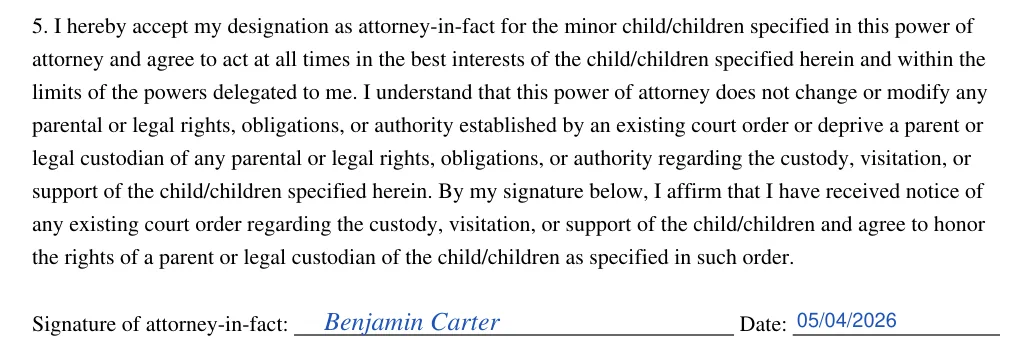
Paragraph 5 (page 2). The attorney-in-fact signs and dates the Signature of attorney-in-fact line. By signing, the attorney-in-fact accepts the designation, agrees to act at all times in the best interests of the child and within the limits of the powers delegated, and affirms having received notice of any existing court order regarding the custody, visitation, or support of the child.[2]Step 8: sample entries, not a real form.
Paragraph 6 (page 2). Complete paragraph 6 only when a licensed child-placing agency is involved. The agency's representative writes their name and the agency's name, then signs and dates the approval of the designation.[2]
Notary certificate (not printed on the form). The statutory form prints no notary block.[2] Have the signatures acknowledged before a notary public, and ask the notary to attach a Virginia acknowledgment certificate to the form. The signing rules are explained below the steps.
How the statutory form is signed. The parent or legal custodian signs and dates the line after paragraph 4, and the attorney-in-fact signs and dates the paragraph 5 acceptance. A representative of a licensed child-placing agency signs paragraph 6 only when an agency is involved. The form prints no notary block and no lines for witnesses.[2] Under Va. Code Ann. § 20-167(B), a power of attorney is legally sufficient if the wording of the form complies substantially with subsection A, the form is properly completed, and the signatures of the parties are acknowledged or verified before a notary public.[2] So have a notary attach a Virginia acknowledgment certificate to the signed form. FormsPal also has a notary acknowledgement template.
The FormsPal template from Create My Document. Under Va. Code Ann. § 20-167(A), a power of attorney to delegate parental or legal authority executed under the chapter must be substantially in the form that the statute sets out.[2] The FormsPal template is a general form, not the statutory form, and it does not follow the statutory form's wording.
Check the form before you sign.
Read the finished form once from start to finish and compare it against this list.
Children: each child's full name and date of birth are complete.
Attorney-in-fact: the full name, address, and phone number are entered in paragraph 2.
Powers: you rely on the first paragraph 3, or you wrote the specific powers in the second paragraph 3.
Dates: the beginning and ending dates are filled in, and the period does not exceed 180 days unless the military service rule applies.[1]
Signatures: every person with authority to make decisions for the child signs, and so does the agent.[1]
Notary: a notary public has attached a Virginia acknowledgment certificate for the signatures, because the statutory form has no notary block (step 10).
Create a personalized Virginia Minor Child Power of Attorney Form online now!
Frequently Asked Questions
The answers below cover duration, renewal, revocation, the powers a parent keeps, who signs, and who files notice. Each answer is short and stands on its own, and the source is cited after it.
How long can a Virginia minor child power of attorney last?
A parent or legal custodian may delegate these powers for a period not to exceed 180 days. A service member on active duty may delegate for longer if the active duty is longer than 180 days. The period may not exceed the term of active duty service plus 30 days.[1]
Do I need a new power of attorney after 180 days in Virginia?
If the delegation of authority lasts longer than 180 days, a new power of attorney must be executed.[1]
Who can revoke a Virginia minor child power of attorney?
Any person who has signed the form has the authority to revoke or withdraw the power of attorney at any time unless a court order supersedes that authority.[1]
Which powers can a parent not delegate in Virginia?
A parent or legal custodian cannot delegate these powers.[1]
Consent to marriage or adoption of the child.
The performance or inducement of an abortion on or for the child.
The termination of parental rights to the child.
The other powers regarding the custody, care, and property of the child can be delegated.
Who has to sign a Virginia minor child power of attorney?
It must be signed by all persons with authority to make decisions concerning the child under Chapter 6.1 (§ 20-124.1 et seq.) and by the person to whom powers are delegated. If both parents of the child are exercising joint custody, both parents must execute the power of attorney.[1]
Does anyone have to file notice of a Virginia minor child power of attorney?
A licensed child-placing agency must file notice of the arrangement authorized by the power of attorney with the local department of social services in the jurisdiction where the parents or legal guardian reside, within seven days of its execution.[1]
Mara has been practicing estate planning and trust law in California since 2003, taking pride in helping clients of all backgrounds and asset profiles form a complete and customized estate plan. Her specialties are: estate planning, wills and trusts, trust and probate administration.