A West Virginia minor child power of attorney is a form that lets a parent place a child in another adult's care. The parent, guardian or legal custodian picks that adult, called the agent or attorney-in-fact. When a qualified nonprofit organization helps arrange the care, Article 8 of Chapter 49 of the West Virginia Code limits the delegation to one year, and the agent serves without pay.[1]
Last Updated: October 2026. This guide is reviewed and updated regularly to reflect current West Virginia law. If you notice an error or outdated information, please contact us.
Create a high-quality West Virginia Minor Child Power of Attorney online now!
Build Your Document
Answer a few simple questions to make your document in minutes
Save and Print
Save progress and finish on any device, download and print anytime
Sign and Use
Your valid, lawyer-approved document is ready
... or download your West Virginia Minor Child Power of Attorney as a PDF file
Under Article 8, the parent can revoke it at any time, and it does not end parental rights.[1] Below are the Article 8 rules in W. Va. Code § 49-8-3 and the steps to fill out the free WV power of attorney form on this page, the statutory form in W. Va. Code § 49-8-4.[3]
What Is a West Virginia Minor Child Power of Attorney?
West Virginia lets a parent, guardian or legal custodian delegate the care and custody of a child through a power of attorney. Article 8 of Chapter 49 of the West Virginia Code (§§ 49-8-1 to 49-8-7) covers one situation: a parent, guardian or legal custodian who arranges the child's temporary care and custody with the assistance of a qualified nonprofit organization.[1] The same law says it does not restrict the right of parents, guardians or legal custodians to provide for a child's care by power of attorney in other contexts, or to temporarily delegate care and custody under other West Virginia law.[1] West Virginia has no other general statute for a parent who asks a relative or friend directly. Many parents in that situation use the same statutory form wording and sign it before a notary public. That is common practice, not a legal requirement. Under Article 8, the delegation cannot last longer than one year, and some powers can never be delegated. These Article 8 rules are in section 49-8-3, and the list below puts them in plain words.[1]
A parent, guardian or legal custodian of a child may, by a properly executed power of attorney, delegate to a person, for a period not to exceed one year, the care and custody of the child.
Length: the delegation cannot last longer than one year.[1]
Powers that stay with the parent: a parent, guardian or legal custodian may not delegate the power to consent to the marriage or adoption of the child, the performance or inducement of an abortion on or for the child, or the termination of parental rights to the child.[1] The delegation also does not change or modify any parental or legal rights, obligations or authority established by an existing court order.[1]
Pay: the designee exercises parental or legal authority on a continuous basis without compensation for as long as the power of attorney lasts, unless the parent revokes it.[1]
Revocation: the parent, guardian or legal custodian may revoke or withdraw the power of attorney at any time.[1]
Return of the child: when the power of attorney terminates, expires or is revoked, the child must be returned to the custody of the parent, guardian or legal custodian within forty-eight hours.[1]
West Virginia Code § 49-8-1 explains why this option exists. The Legislature found that an alternative to guardianship or to the Department of Human Services taking custody of the child should be available, and that a parent or legal custodian may benefit from charitable organizations in the community that provide safe, temporary care for children.[2]
West Virginia law also has narrower options for related needs. A caregiver who is at least 18 and is related to the child by blood, marriage or adoption, or has lived with the child for the past six months or more, can consent to the child's health care with a notarized affidavit.[4][5] You sign the affidavit to consent, it is valid for one year unless the child no longer lives with the caregiver, and it does not give the caregiver legal custody.[6] If you are a deploying parent and no other parent has custodial responsibility, or a court order bars the other parent's contact with the child, you can delegate all or part of custodial responsibility to an adult nonparent by power of attorney for the period of deployment.[7] If a court order on custody or child support is in effect, that power of attorney must be filed with the court that entered it.[8] A circuit or family court can also appoint a temporary guardian for a child, for up to six months unless the court extends it.[9]
Rules for the Person Who Receives the Powers
The statute and its statutory form call the person who receives the powers the designee.[3] This page also calls that person the agent. For a delegation under Article 8, section 49-8-3 sets a background check, training, an address rule and a reporting duty around that person. A qualified nonprofit organization carries out the check and the training.[1]
Background check: the qualified nonprofit organization must conduct a criminal history and federal and state background check on the person to whom powers are delegated before the power of attorney is executed.[1]
Who pays: the check is paid for by the qualified nonprofit organization, the parent, guardian or legal custodian, or the parent's designee.[1]
Training: the qualified nonprofit organization must train the designee in the rights, duties and limitations of providing care for a child under this section, including the prevention and reporting of suspected child abuse or neglect.[1]
Address: the designee may not move from the address listed on the parental rights form without written approval of the parent, guardian or legal custodian.[1]
Reporting: any person who accepts care and custody of a child under Article 8 is deemed a person mandated to report suspected abuse and neglect.[1]
Tip: Enter the agent's current address with care. Under Article 8, the designee may not move from the address on the form without the parent's written approval.
West Virginia Minor Child Power of Attorney Form Details
The free WV power of attorney form on this page is the statutory form from W. Va. Code § 49-8-4, reproduced word for word.[3] It has two pages and 26 fillable fields and takes about 10 minutes to complete. The table lists its other name, the statute behind it, how long it can last and the file format. FormsPal also has a general power of attorney page and more West Virginia POA forms.
Document Name
West Virginia Minor Child Power of Attorney Form
Other Name
West Virginia Parental Power of Attorney
State Form Name
Statutory Form for Power of Attorney to Delegate Parental or Legal Custodian Powers (W. Va. Code § 49-8-4)
The statutory form has two pages: six numbered paragraphs and an acknowledgment for a notary public.[3] You choose the scope of the designee's authority in paragraph (3) or paragraph (4).
Paragraph (3) delegates all of your power and authority regarding the care, custody and property of each child named, including the right to enroll the child in school, to inspect and obtain copies of education records and other records concerning the child, to attend school activities and other functions concerning the child, and to give or withhold any consent or waiver with respect to school activities, medical and dental treatment, and any other activity, function or treatment that may concern the child.[3]
Paragraph (4) delegates only the specific powers and responsibilities you write in. The form says that in the event paragraph four is completed, paragraph three does not apply.[3]
Both paragraphs say the delegation does not include the power or authority to consent to marriage or adoption of the child, the performance or inducement of an abortion on or for the child, or the termination of parental rights to the child.[3]
Paragraph (6) is the designee's acceptance, and the acknowledgment names both the parent or legal custodian and the designee.[3] The form has no paragraph for a successor or alternate designee.
Filling Out West Virginia Minor Child POA Form
The PDF on this page is the statutory form from W. Va. Code § 49-8-4, reproduced word for word.[3] It has two pages: paragraphs (1) to (6), then an acknowledgment for a notary public. You can type your entries in the PDF's fillable fields or with the FormsPal PDF editor, or print it and write by hand. Sign by hand. The eight steps below follow the form in order and use its own paragraph numbers and labels.
Article 8 of chapter 49, where this form appears, applies to delegations arranged with the assistance of a qualified nonprofit organization.[1] That organization keeps a copy of each power of attorney for three years after it ends.[3]
The screenshots under each step show the West Virginia statutory form for a power of attorney to delegate parental or legal custodian powers with sample entries in blue, so you can see where each answer goes. The names, addresses, dates and phone numbers are examples only.
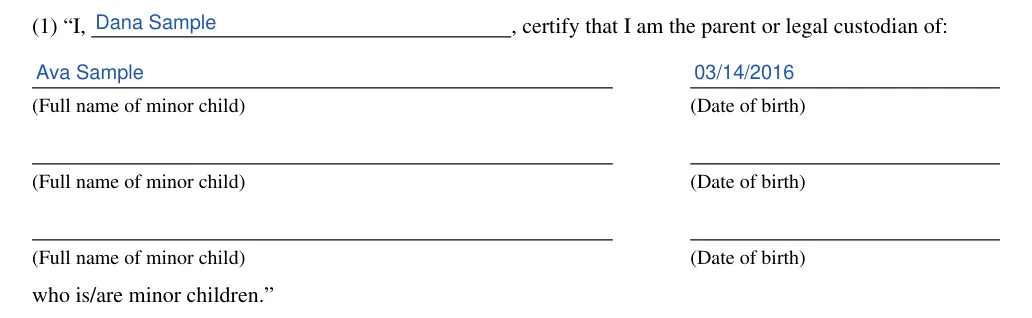
Paragraph (1) (page 1). Write your name on the line after "I," and write each minor child's full name and date of birth. The form has lines for up to three children.Step 1: sample entries, not a real form.
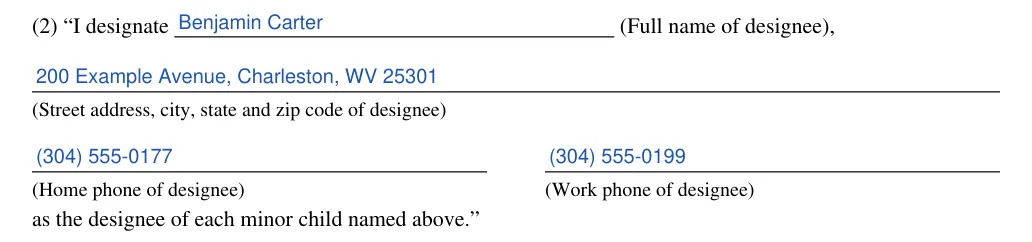
Paragraph (2) (page 1). Write the full name of the designee, their street address, city, state and zip code, and their home and work phone numbers.Step 2: sample entries, not a real form.
Paragraph (3) (page 1). Paragraph (3) is printed in full and needs no entry. It delegates all of your power and authority regarding the care, custody and property of each child named above.
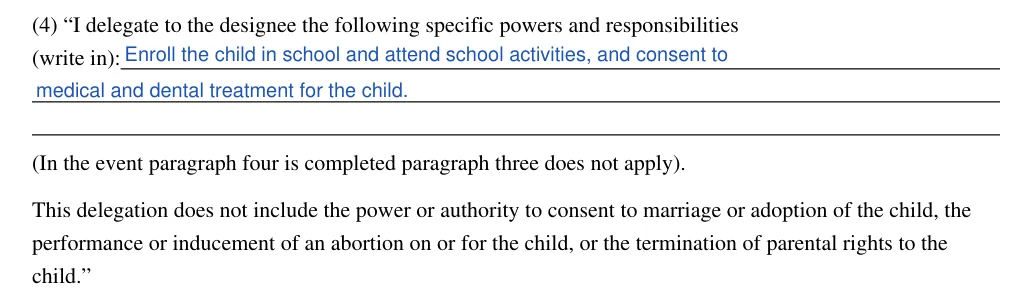
Paragraph (4) (page 1). To delegate only some powers, write the specific powers and responsibilities on the lines. The form says that in the event paragraph four is completed, paragraph three does not apply. Either way, the delegation does not include the power or authority to consent to marriage or adoption of the child, the performance or inducement of an abortion on or for the child, or the termination of parental rights to the child.[3]Step 4: sample entries, not a real form.
Paragraph (5) (page 2). Write the beginning and ending dates. The form says the power of attorney is effective for a period not to exceed one year, and that you reserve the right to revoke this authority at any time.[3]Step 5: sample entries, not a real form.
By: (Parent/Legal Custodian signature) (page 2). Sign on the By line. You and the designee then appear before the notary public who completes the acknowledgment (step 8).Step 6: sample entries, not a real form.
Paragraph (6) (page 2). The designee signs on the By line marked (Designee signature), under the sentence "I hereby accept my designation as designee for the minor child/children specified in this power of attorney."[3]Step 7: sample entries, not a real form.
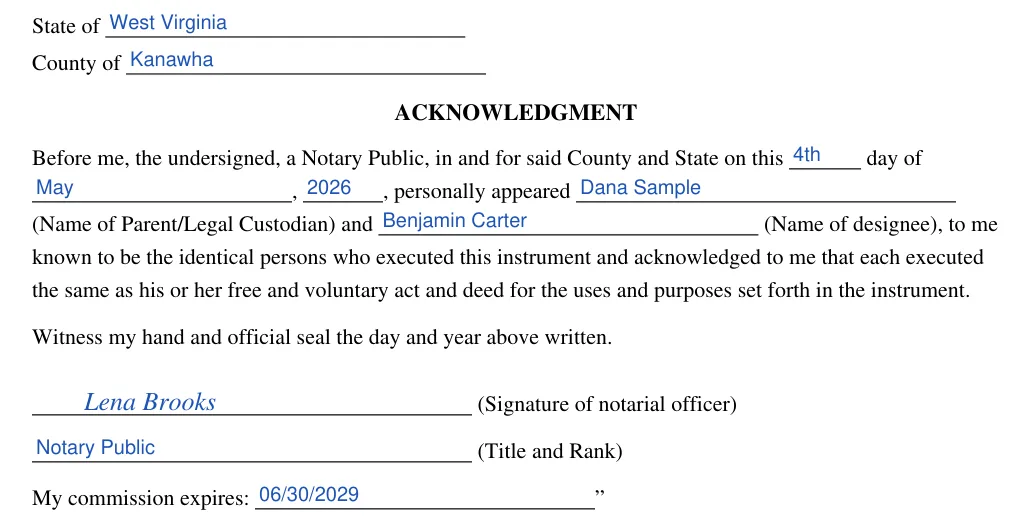
State of, County of and ACKNOWLEDGMENT (page 2). This part is for the notary public. The notary fills in the state and county, the date, and the names of the parent or legal custodian and the designee, who personally appear and acknowledge that each executed the instrument as his or her free and voluntary act and deed. The notary then signs and fills in the title and rank and the date the commission expires.[3]Step 8: sample entries, not a real form.
How to Sign and Use the West Virginia Minor Child Power of Attorney
The steps below are about using the finished form, not filling it in. Most of them are common practice and not legal requirements, except the signing rules in the second and third steps and the revocation rule in the last step.
Download and check the finished form. Read every entry once, especially the child's name, the agent's address and both dates.
The statutory form. You sign on the By line under paragraph (5), and the designee signs the paragraph (6) acceptance. The form ends with one notary acknowledgment, in which a notary public certifies that the parent or legal custodian and the designee personally appeared and acknowledged that each executed the instrument. The form has no lines for witnesses.[3] Under W. Va. Code § 49-8-4(b), a power of attorney is legally sufficient under Article 8 if the wording of the form substantially complies with the section, the form is properly completed, and the signatures of the parties are acknowledged.[3]
The FormsPal template from Create My Document. Section 49-8-4(b) ties legal sufficiency under Article 8 to wording that substantially complies with the statutory form.[3] The FormsPal template is a general form, not the statutory form, and it does not follow the statutory form's wording.
Store the original. Keep the signed original in a safe place and make copies.
Share copies. Give a copy to the agent. Many people also give copies to the child's school and doctor so the agent can show it when needed.
Revoke it if plans change. Under Article 8, the parent, guardian or legal custodian may revoke the power of attorney at any time.[1] Many people put the revocation in writing and give a copy to the agent.
Create a high-quality West Virginia Minor Child Power of Attorney online now!
Frequently Asked Questions
These answers come from W. Va. Code § 49-8-3, the Article 8 rules that apply when a qualified nonprofit organization helps arrange the child's care. They cover how long it can last, what cannot be delegated, who can revoke it, whether the designee is paid, and when the child must come back.[1]
How long can a minor child power of attorney last in West Virginia?
Under Article 8, a parent, guardian or legal custodian can delegate the care and custody of a child for a period not to exceed one year.[1]
What powers can a parent not delegate in West Virginia?
Under Article 8, three powers cannot be delegated:[1]
Consent to the marriage or adoption of the child.
The performance or inducement of an abortion on or for the child.
The termination of parental rights to the child.
Can a parent revoke a minor child power of attorney in West Virginia?
Yes. Under Article 8, the parent, guardian or legal custodian of the child may revoke or withdraw the power of attorney at any time.[1]
Does the agent get paid for caring for the child?
No. Under Article 8, the designee exercises parental or legal authority on a continuous basis without compensation for the duration of the power of attorney.[1]
How soon must the child come back when the power of attorney ends?
Under Article 8, upon the termination, expiration or revocation of the power of attorney, the child must be returned to the custody of the parent, guardian or legal custodian within 48 hours.[1]
Must the person who cares for the child report suspected abuse?
Yes. Any person who accepts care and custody of a child under Article 8 is deemed a person mandated to report suspected abuse and neglect.[1]
Mara has been practicing estate planning and trust law in California since 2003, taking pride in helping clients of all backgrounds and asset profiles form a complete and customized estate plan. Her specialties are: estate planning, wills and trusts, trust and probate administration.