A Wisconsin minor child power of attorney is a written document. In it, a parent with legal custody delegates some or all of their powers over a child to an agent, also called an attorney-in-fact. Wisconsin law allows this when every parent with legal custody signs it.[1] Parents use it to delegate parental powers while they travel, recover from an illness or serve in the military. The PDF you can download on this page is the Wisconsin court form GF-223, Power of Attorney Delegating Parental Power.[2] You can also create a separate document online with FormsPal.
Last Updated: October 2026. This guide is reviewed and updated regularly to reflect current Wisconsin law. If you notice an error or outdated information, please contact us.
Create a personalized Wisconsin Minor Child Power of Attorney Form online now!
Build Your Document
Answer a few simple questions to make your document in minutes
Save and Print
Save progress and finish on any device, download and print anytime
Sign and Use
Your valid, lawyer-approved document is ready
... or download your Wisconsin Minor Child Power of Attorney Form as a PDF file
Wisconsin Minor Child Power of Attorney Requirements
A Wisconsin power of attorney for a child follows Wis. Stat. § 48.979. Under that statute, a parent who has legal custody of a child may delegate powers over the child to an agent through a power of attorney.[1] The rules below cover who signs, how long the delegation lasts, and how a parent can cancel it.
Who signs: the power of attorney must be properly executed (signed) by all parents who have legal custody of the child.[1]
How long it lasts: the delegation may remain in effect for no longer than one year. It may last longer if it is to a relative of the child or the court approves it.[1] If no termination date is given, the statute's form says the power of attorney remains in effect for one year after the effective date.[1]
How to cancel it: a parent who delegated powers may revoke the delegation at any time by executing a written revocation and notifying the agent in writing.[1] A written revocation invalidates the delegation, except for acts already taken in reliance on it.[1]
FormsPal lists this document under a second name, the Wisconsin temporary guardianship form. GF-223 calls the person you appoint the agent, and states that the delegation does not deprive a custodial or noncustodial parent of any of his or her powers regarding the care and custody of the child.[2]
Form Details
Document Name
Wisconsin Minor Child Power of Attorney Form
Other Name
Wisconsin Parental Power of Attorney
State Form Name
Power of Attorney Delegating Parental Power (court form GF-223, 10/25)
Up to one year, or longer for a relative or with court approval[1]
Avg. Time to Fill Out
15 minutes
Form Length
3 pages
# of Fillable Fields
72
Available Formats
Adobe PDF
When Parents Use a Minor Child Power of Attorney
Parents delegate care of a child when the child will be with another adult for a while and that adult may need to act for the child. The form is a practical tool for temporary arrangements, such as the situations below.
A parent travels for work or serves away from home and leaves the child with a grandparent or another relative.
A parent is in the hospital or recovering from surgery and cannot handle school or medical matters.
A child stays with an aunt, uncle or family friend for a school year, a summer program or a sports season.
A family lives apart, and the child spends long stretches with a relative in another city.
The delegation runs only for the period you write on the form, so it suits a temporary plan. If you need a permanent change in who has custody of the child, talk to a family law attorney instead.
What the Agent Can and Cannot Do
The agent acts for the child only in the areas the parent delegates. Item 4 of GF-223 offers two choices. Full parental power covers the care and custody of the child. Partial parental power covers only the subjects you check: health care (all of it, or only ordinary or routine care, emergency blood transfusion, dental care or disclosure of health information), educational and vocational services, employment of the child, disclosure of other confidential information, care and custody, a motor vehicle operator's license, travel outside Wisconsin, and substitute care such as child care. A last line takes other powers or limits.[2]
Type of authority
Full parental power
Partial parental power
What the agent can do
Act on your parental power regarding the care and custody of the child, except the powers no parent can delegate
Only the subjects you check and any other powers you write in
What you fill in
Check the Full parental power box
Check Partial parental power, each subject you delegate, and write any other powers or limits on the last line or on an attached sheet
Typical use
The child will live with the agent for a stretch and needs day-to-day care
A narrower arrangement, such as health care and school matters during a trip
Wisconsin law lets a parent delegate any of their powers regarding the care and custody of the child, with four exceptions.[1] Consent to marriage or adoption, consent to an abortion, termination of parental rights and enlistment in the U.S. armed forces all stay with the parent. The FAQ section below lists the four powers in full.
What to Gather Before You Start
Have the details below ready before you open the form. Filling it out in one sitting is faster, and it helps you avoid blanks that a school office or doctor might question later.
The county for the court caption at the top of page 1, and the child's name and date of birth.
The child's full name, address and date of birth for item 1.
Your name, address, email and telephone number, and the same details for the other parent if you share joint legal custody, because both parents must then sign.[2]
The agent's name, address, telephone number, email address and relationship to the child.
Your choice between full and partial parental power, and the subjects you want to delegate.
The date the power of attorney takes effect and the date it ends.
A notary public only if you want to use item 11, the optional witnessing of signatures.[2]
Filling Out the Wisconsin Minor Child Power of Attorney Form
The PDF this page hands out is the Wisconsin court form GF-223, Power of Attorney Delegating Parental Power, revised 10/25.[2] It has three pages: a court caption, then numbered items 1 to 13, with the parents' signature blocks after item 10. FormsPal added fillable fields on top of the court's pages and left the printed form unchanged. Type your entries in the PDF's fields or with the FormsPal PDF editor, or print it and write by hand. A few fields sit just above a short printed blank, in the white space, so they do not cover the printed words. The signature lines have no field, so sign by hand. The 13 steps below follow the form in order and use its own item numbers.
The screenshots under each step show GF-223 with sample entries in blue, so you can see where each answer goes. Where a blank on the form is too short, the sample entry is shown just above it. The names, addresses, dates and phone numbers are examples only.
Court caption (page 1). In the line STATE OF WISCONSIN, CIRCUIT COURT, write the county name on the blank before COUNTY. Under IN THE INTEREST OF, write the child's name and date of birth. Check Amended only when the form amends an earlier one. The Case No. line takes a court case number. The sample is not filed with a court, so it leaves Amended and Case No. blank.Step 1: sample entries, not a real form.
Item 1 (page 1). Under "This power of attorney is for the purpose of providing for the care and custody of", write the child's name, address and date of birth.Step 2: sample entries, not a real form.
Item 2 (page 1). Write your name and address. You state that you have legal custody of the child. The form says only a parent who has legal custody may use it, and that if parents have joint legal custody, both parents must sign it.[2]Step 3: sample entries, not a real form.
Item 3 (page 1). Write the agent's name, address, telephone number, email address and relationship to the child.Step 4: sample entries, not a real form.
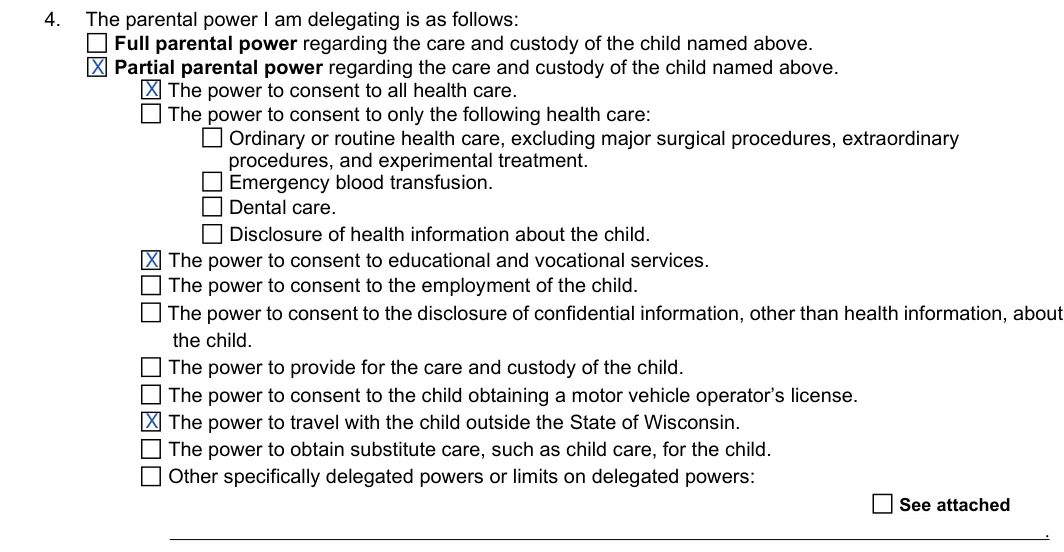
Item 4 (page 1). Check Full parental power, or check Partial parental power and then each power you delegate. Write any other powers or limits on the last line, or check See attached and attach a sheet. The sample delegates partial power over all health care, educational and vocational services, and travel outside Wisconsin.Step 5: sample entries, not a real form.
Items 5 and 6 (pages 1 and 2). Nothing to fill in. Item 5 says the delegation does not deprive a custodial or noncustodial parent of any of his or her powers. Item 6 says the form may not be used to delegate the power to consent to the marriage or adoption of the child, an abortion, the termination of parental rights or enlistment in the U.S. armed forces, or to place the child in a foster home, group home, shelter care facility or inpatient treatment facility.[2]
Item 7 (page 2). Write the date the power of attorney takes effect and the date it ends. The form says that if no termination date is given, it remains in effect for one year after the effective date, but no longer, and that a parent who has legal custody may revoke it in writing at any time.[2]Step 7: sample entries, not a real form.
Items 8, 9 and 10 (page 2). Check one only if it applies: item 8 if the child is subject to the jurisdiction of the juvenile court, item 9 if the child is an Indian child, and item 10 if the agent is not a relative of the child and the delegation would last longer than one year. Each one says what you will file with the court or ask it to do.[2] Wisconsin law requires the court's approval in the item 8 and item 10 cases.[1] The sample checks none of them.
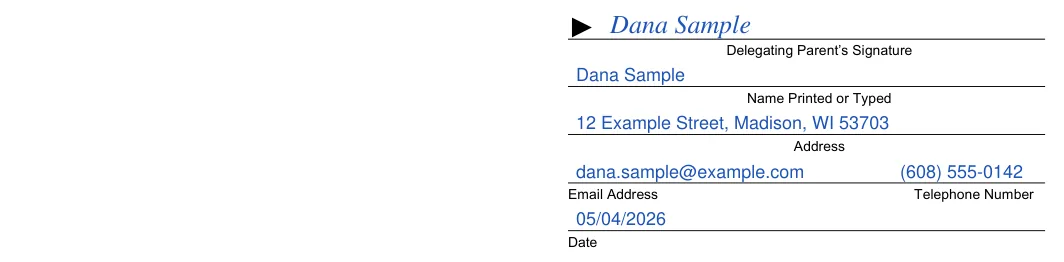
Delegating Parent's Signature (page 2). Sign on the line marked with the arrow, then fill in your printed name, address, email address, telephone number and the date.Step 9: sample entries, not a real form.
Non-Delegating Parent with Joint Legal Custody's Signature (page 2). If the other parent shares joint legal custody, they sign and fill in this block the same way.[2] Wisconsin law requires the power of attorney to be properly executed by all parents who have legal custody.[1]Step 10: sample entries, not a real form.
Item 11, Witnessing of signature(s) (optional) (pages 2 and 3). This item is optional. If you use it, check the box. A notary public fills in the state, the county, the date and the names of the parents who signed before the notary, then signs on Signature of notary and fills in My commission expires at the top of page 3.[2]Step 11: sample entries, not a real form.
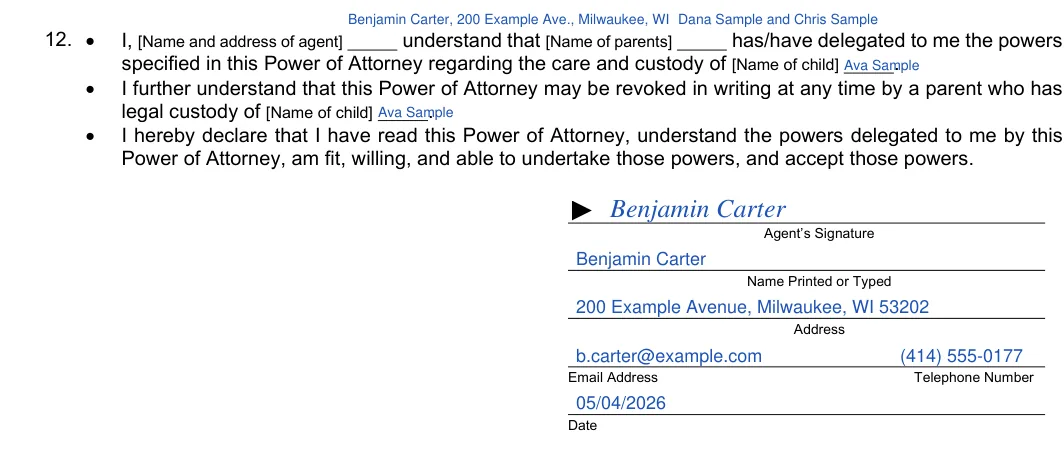
Item 12 (page 3). The agent writes their name and address, the parents' names and the child's name, then signs below the statement that they have read the power of attorney, understand the powers delegated, are fit, willing and able to undertake those powers, and accept them. The agent also fills in their printed name, address, email address, telephone number and the date.[2]Step 12: sample entries, not a real form.
Item 13 (page 3). This item is optional. Check it to write where you can be located during the term, if that differs from the addresses above, or to name another person to contact. The sample leaves it blank.
If you check Partial parental power, check each subject you want to delegate. The agent receives only the powers you check or write in.
How to Sign and Use the Wisconsin Minor Child Power of Attorney
After you fill out the form, review it with the agent, sign it, and share copies with the people who rely on it. The steps below cover signing, copies, safekeeping, and cancelling the delegation later.
Download GF-223 from this page and type your entries in its fillable fields or with the online PDF editor, or print it and fill it in by hand. The Create button on this page makes a separate FormsPal document, described at the end of this list.
Check the dates and the signers. Every parent who has legal custody of the child must sign, so confirm that each of them has a signature line.[1]
How GF-223 is signed. The delegating parent signs the first block on page 2, and a parent with joint legal custody signs the second. Item 11, Witnessing of signature(s), is marked optional: if you use it, a notary public records the date and the names of the parents who signed before the notary, then signs. The agent signs item 12 on page 3, declaring that they have read the power of attorney, understand the powers delegated and accept them.[2] Under Wis. Stat. § 48.979(2), a power of attorney complies with the statute when it substantially conforms to the statutory form, and that form labels the witnessing of signatures by a notary as optional.[1] The delegation may remain in effect for no longer than one year, unless it is to a relative of the child or the court approves it.[1]
Give the signed original to the agent and keep a copy for yourself. Share copies with the child's school, doctor or other care provider so they know who may act for your child.
Keep the original somewhere safe. To cancel the delegation, a parent may revoke it at any time by executing a written revocation and notifying the agent in writing.[1]
The FormsPal template from Create My Document. The template is a general form. It is not GF-223, and it does not follow the statutory form that a power of attorney substantially conforms to under Wis. Stat. § 48.979(2).[1] GF-223 is the Wisconsin court form for § 48.979.[2]
For a power of attorney that covers money or medical decisions, see our Wisconsin POA forms.
Common Mistakes to Avoid
Most problems with a power of attorney for a child come from small gaps on the form or from missing copies. Check the list below before you hand the signed form to the agent.
Leaving the dates blank. Item 7 asks for the date the power of attorney takes effect and the date it ends. If no termination date is given, the form says it remains in effect for one year after the effective date.[2]
Signing with only one parent when more than one parent has legal custody. The power of attorney must be signed by all of them.[1]
Leaving out the agent. The agent signs the statement in item 12 on page 3 and accepts the powers.[2]
Writing other powers too vaguely. If you use the last line of item 4, name the tasks in clear words, such as consenting to a dental visit, so the school or doctor reading it knows what is covered.
Keeping the only copy in a drawer. Give the agent a copy so they can show it when a school or doctor asks who may act for the child.
Create a personalized Wisconsin Minor Child Power of Attorney Form online now!
Frequently Asked Questions
These answers come from Wis. Stat. § 48.979, the statute that lets a parent with legal custody delegate powers over a child to an agent. They cover how long a delegation lasts, how to cancel it, and two limits on what a delegation can do.[1]
Which powers can a parent not delegate to an agent?
A parent may delegate any of their powers regarding the care and custody of the child, except these four:[1]
The power to consent to the marriage or adoption of the child.
The power to consent to the performance or inducement of an abortion on or for the child.
The termination of parental rights to the child.
The enlistment of the child in the U.S. armed forces.
How long can a Wisconsin power of attorney for a child last?
A delegation of powers to an agent may remain in effect for no longer than one year. It may last longer if the delegation is to a relative of the child or the court approves it.[1]
Can a parent cancel the delegation of powers?
Yes. A parent who delegated powers may revoke the delegation at any time by executing a written revocation and notifying the agent in writing.[1]
Can a power of attorney place a child in a foster home or treatment facility?
No. A parent who has legal custody of a child may not place the child in a foster home, group home, shelter care facility or inpatient treatment facility by means of a delegation of powers. Those placements can be made only by a court order or as otherwise authorized by statute.[1]
Can a power of attorney cover a child who is part of a court case?
Not without the court's approval. A parent may not delegate powers regarding the care and custody of a child who is subject to the court's jurisdiction in a child welfare or juvenile matter unless the court approves the delegation.[1]
Mara has been practicing estate planning and trust law in California since 2003, taking pride in helping clients of all backgrounds and asset profiles form a complete and customized estate plan. Her specialties are: estate planning, wills and trusts, trust and probate administration.