
Updated:
A contract amendment is a signed document that changes an existing contract. This form amends a real estate purchase agreement: price, loan, closing date or included items. Buyers and sellers use one when a term changes after both have signed.
Key facts
A contract amendment is a separate written agreement that changes one or more terms of a contract the parties have already signed. The amendment sits in the file next to the original contract, and the two documents are read together from the day both parties sign the change.
The amendment does not replace the purchase agreement. The original agreement keeps every term the amendment leaves untouched, and the amendment controls only the terms it rewrites.
A real estate contract amendment usually changes a single item: the price, the financing, the closing date or the list of items that stay with the house. The printable purchase agreement form holds the original terms; the amendment holds the new ones.
A purchase agreement amendment fits any change to a signed deal that both the buyer and the seller accept before closing. The most common reasons are appraisal issues, a problem with the loan, or the mortgage is not approved.
Typical changes buyers and sellers write into an amendment include:
An appraisal below the agreed price is the classic trigger for a price amendment. The amendment gives the new price, and it can also say who covers the gap between the appraised value and the old price. A large gap often reopens the negotiation before anyone writes a word.
The purchase agreement names the loan type and the down payment, so a change to either belongs in an amendment. The same goes for a lender approving a smaller loan than the buyer's pre-approval: the amendment records the new amount and any new price or closing date that follows from it.
A closing date amendment replaces the old date with the new one and leaves the rest of the timeline as written. If other dates in the agreement depend on closing, the amendment names each date that moves.
An item amendment lists what now stays with the property or leaves with the seller. For example, the seller may leave the outdoor grill in exchange for skipping a small repair, which is often easier than adjusting the purchase price.
A contract amendment suits a few specific changes to a deal that otherwise stands. When the buyer, the property or most of the terms change, the parties usually end the old agreement and sign a new purchase agreement instead.
A contract amendment changes terms after signing, while an addendum adds detail that becomes part of the original contract. An addendum is usually executed and signed together with the agreement, or added when the buyer or seller believes that something was not made clear in it.
| Contract amendment | Contract addendum | |
|---|---|---|
| Relation to the contract | A separate document kept with the original contract | Part of the original contract |
| Typical use | Changing a term, such as the price, the loan type or the closing date | Adding detail, such as the inspection, water or property tax |
| What it does to existing terms | Rewrites the terms it names | Supplements the terms without rewriting them |
An addendum in a home sale most often covers the inspection, the water supply or the property tax. An inspection addendum can hold the last date for the inspection, the delivery date of the report and any terms agreed after it. A rural sale may add a septic or well addendum covering maintenance, the water supply, the inspection contingencies and who pays for routine work.
Some other common addendum reasons are:
An addendum's effect on the main text depends on its own wording. An addendum that says it controls over a conflicting term is written to take priority; one that only adds detail leaves the main text in place. A change to an existing term is clearer as an amendment, which names the term and its new wording.
A contract amendment includes five parts: the parties, the recitals, the amendment lines, the closing clauses and the signatures with the date. The FormsPal template prints them in that order across two pages.
The parties section lists the buyer and the seller by full name and mailing address. The names match the original purchase agreement exactly, spelling included, so that anyone reading both documents sees the same people.
The recitals name the original agreement by its date and describe the property by its street address. Their purpose is to show anyone who reads the amendment which purchase agreement it changes.
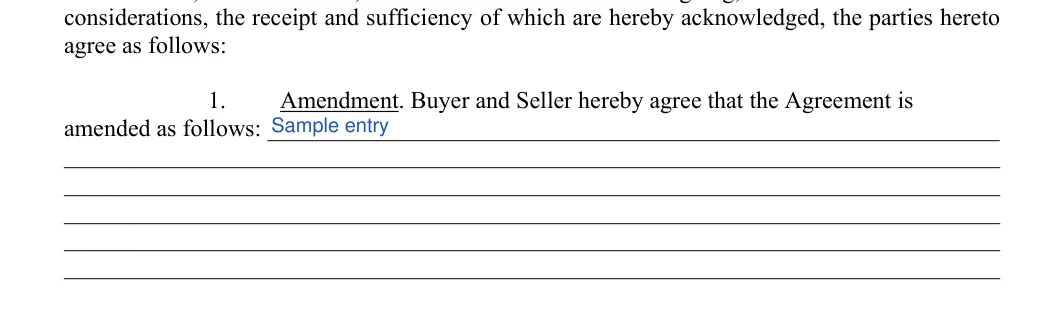
The amendment section holds the change itself, one change per sentence. Each sentence names the term, its old wording and its new wording, so nobody has to guess what the amendment replaced.
A sample line for the Amendment section might read: The closing date in the Agreement is updated from June 12, 2026 to July 1, 2026.
Sections 2 and 3 of the template are already printed. Section 2, No Other Amendments, says the rest of the original agreement stays as it is. Section 3, Miscellaneous, adds standard wording that ties the amendment to the original agreement, so you only update the lines in the blanks.
The amendment carries new signatures even though the original contract is already signed. The date at the top is the date of the amendment, not the purchase date or the closing date from the original contract.

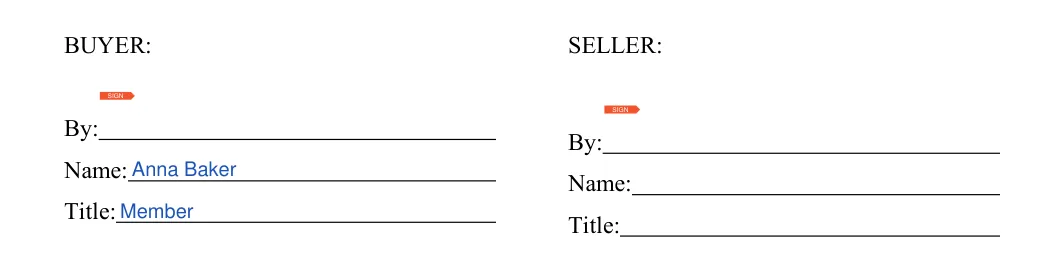
The Contract Amendment Form takes four entries: the date and parties, the recitals, the changes and the signatures. Page 1 holds the date, the parties, the recitals and six lines for the change. Page 2 holds the signature blocks for the Buyer and the Seller.
The screenshots under each step show the FormsPal Contract Amendment template filled with sample entries in blue, so you can see where each answer goes. The names, addresses, dates and amounts are examples only.
Have these details ready before you start:


A contract amendment is complete once both parties sign the same final text, so the signing order matters less than getting both signatures on the same final text. The amendment comes after negotiation, never in place of it.
When the parties cannot agree on a change, the original agreement stays as it was. If the change matters too much to drop, a lawyer can advise on the options under the agreement itself.
A handful of state statutes touch a purchase agreement change: some cover the written form of a land sale contract, and some cover changes to the seller's property disclosures. The table lists only the states our legal fact sources hold a matching rule for; it is not a full list of state law.
| State | Rule | Source |
|---|---|---|
| Alabama | A contract for the sale of land, or of any interest in it, is void unless it or a note of it is in writing and signed by the party to be charged; leases of one year or less are excepted, and so is a sale where the buyer has paid some or all of the price and been put in possession | Ala. Code § 8-9-2 |
| Massachusetts | An action on a contract for the sale of land succeeds only if the contract or a note of it is in writing and signed by the party to be charged or a person that party authorized | Mass. Gen. Laws ch. 259, § 1 |
| Alaska | If information in the seller's disclosure statement becomes inaccurate through an act or agreement after delivery, the seller is required to deliver an amendment for the disclosure statement to the buyer | Alaska Stat. § 34.70.040(a) |
| Virginia | At or before settlement, the owner is required to disclose any material change in the disclosures made about the property | Va. Code Ann. § 55.1-711 |
| Indiana | At or before settlement, the owner is required to disclose any material change in the physical condition of the property, or to certify that its condition is substantially the same as when the disclosure form was provided | Ind. Code § 32-21-5-12(a) |
Other states are left out because our sources hold no matching rule for them, not because they have none.
A written, signed amendment keeps the changed term in the same form as the original purchase agreement. In Massachusetts, Mass. Gen. Laws ch. 259, § 1 lets an action on a contract for the sale of land go forward only when the contract or a note of it is in writing and signed by the party to be charged. Rules of this kind are often called the statute of frauds.
A Virginia purchase contract amendment sits alongside a separate duty about the seller's disclosures. Under Va. Code Ann. § 55.1-711, the owner is required to disclose any material change in the disclosures at or before settlement, when such a change occurs after the disclosures were made.
A search for a "VA amendment" can also mean a home bought with a VA-backed loan; the loan's own clauses come from the lender's paperwork, not from this form.
A contract amendment fails its purpose when the change is vague or the parties cannot match it to the original agreement. These slips come up most often:
To amend a contract is to change its terms by a later agreement of the parties. The amendment names what changes, and the rest of the contract keeps its original wording.
No. A contract amendment changes only the terms it names, and the No Other Amendments clause in the FormsPal template says the rest of the original agreement stays as it is.
An amendment is a separate document that changes a contract you already have. An addendum is part of the original contract.
An addendum is also called a rider, a supplement or an attachment to the contract. A contract amendment is also called a contract modification.
Describe the change in plain words: the term, its old wording and its new wording. Common examples are a new closing date, a different loan type or down payment amount, and an item added to the sale.
It helps to have it next to you. The FormsPal Contract Amendment Form asks for the date of the original agreement and the property address, so you can copy both straight from the contract.
Page 2 has one signature block for the Buyer and one for the Seller. Each block has a By line, a Name line and a Title line.
General information, not legal or tax advice.
