
A Hunting Lease Agreement is a contract between a landowner and a hunter. It records how the hunter may use the land, for how long and at what price. Create one online with the form below, or fill out our free lease agreement form step by step.
Last Updated: October 2026. This guide is reviewed and updated regularly to reflect current law. If you notice an error or outdated information, please contact us.
Build Your Document
Answer a few simple questions to make your document in minutes
Save and Print
Save progress and finish on any device, download and print anytime
Sign and Use
Your valid, lawyer-approved document is ready
Three terms appear throughout the agreement:
If you are hunting on private property— For those who will be hunting in National forests or parks, there is no need to write a hunting lease. Instead, some permits and licenses must be secured through a different process. Hunting Lease Agreements are solely for those who are interested in hunting on private woodlands or fields.
If your name is not included in the deed — Even if you are hunting on a property your family owns, it is still important to secure a hunting lease agreement to avoid any questions or misunderstandings.
A hunting agreement can come in three types: daily, short-term and long-term. The difference mainly lies in the duration and the set-up. The right one depends on how often you or the hunters plan to use the land.
Much like a day-tour, the landowner can accommodate different hunters on a per-day basis. However, he or she must provide additional services like a reception for walk-ins or guides so that hunters can acquaint themselves easily with the hunting grounds given the time restraint.
These are the most preferred hunting leases because most hunting activities are seasonal. U.S. laws also specify an “open season” wherein hunting can be legal for certain animals.
For some avid hunters who want to hunt anytime and do not want to write a new lease every season, a long-term lease is recommended. This can last for an entire year or any duration specified in the contract.
When using FormsPal’s template, there is no need to distinguish between the three. You may simply choose any of the applicable duration listed under “Section 4: Term.”
Opening your land to hunters brings extra income, but it also brings safety and upkeep concerns. Weigh both sides before you list your property, and decide how much access you want to give hunters.
PROS
CONS
Keep in mind that safety and legal concerns are the biggest issues of hunting. Still, if you have proper documentation and permits, there is nothing to worry about.
You may find a hunting lease calculator on huntinglocator.com. It computes the number of acres, species for hunting, and other factors to determine the value. If you are adding features of amenities (e.g. option to camp), you may also compute the additional cost.
On the other hand, you may determine the price by contacting hunting lease agents who can determine the value of different lands. One great thing about hiring an agent is that he or she can also assist you in the documentation and application processes. This will give you more opportunities to lease out the place. There is, however, payment for this type of assistance, which the lessor usually pays once a lease is signed.
To find areas available for a hunting lease, you may visit any listing website that specializes in hunting. Then filter the results by your state, the species that you want to hunt, and preferred dates.
Aside from this, you may also ask local tour guides or tourism offices for the type of hunting ground you are looking for. If you are a member of a hunting club, you can also ask the veteran hunters for tips about the best areas.
Though requirements for a hunting license varies from state to state, the following are common requirements of local Department of Fish and Wildlife offices:
If you are unsure of the requirements, it is best to get more information from the state’s assigned officers. For landlords, you must check the hunter’s documents as listed above. This should be one of the top items in your to-do list, since you may be deemed responsible for the entire hunting activity.
In general, it is important to re-visit the official hunting guidelines set by your state, since they also update it from time to time. If you are going to another state for hunting, you have to make time to read through their safety education pamphlets or materials because they may have more rules than your original state.
Aside from following “open season” schedules, here are some of the general laws of hunting that are common to every state:
| Document Name | Hunting Lease Agreement Form |
| Other Name | Hunting Lease Contract |
| Avg. Time to Fill Out | 17 minutes |
| # of Fillable Fields | 97 |
| Available Formats | Adobe PDF |
The FormsPal Hunting Lease Agreement is a seven-page fillable PDF with 97 fields. Fill it in from the first page to the last, and tick or write only what fits your lease. Each step below follows the headings printed on the form.
Have these details ready before you start:
The screenshots under each step show the FormsPal Hunting Lease Agreement template filled with sample entries in blue, so you can see where each answer goes. The names, addresses, dates and amounts are examples only.
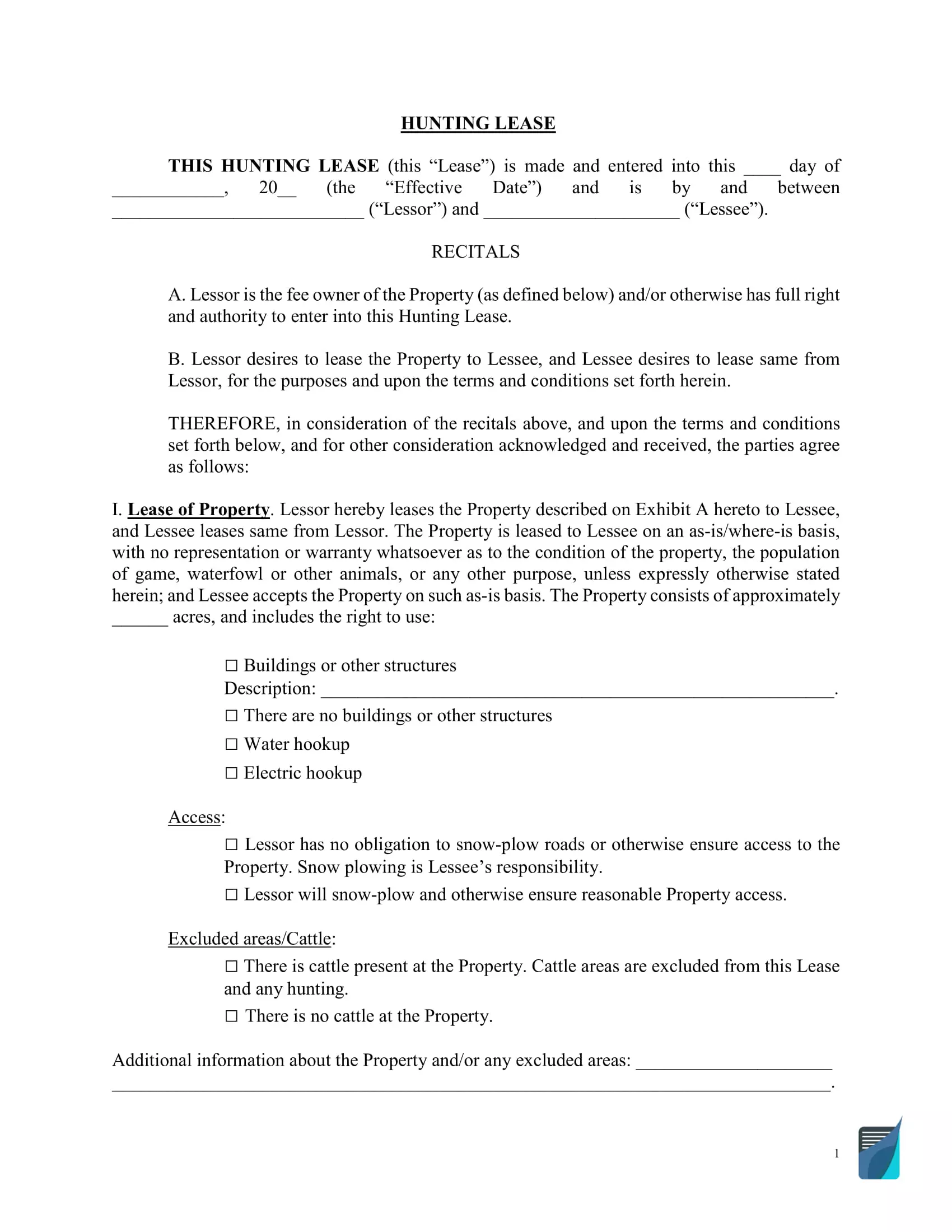
Type the day and the month of the Effective Date. Then type the last two digits of the year after the printed “20”. Next, type the Lessor’s name and the Lessee’s name in the two blanks that follow. The Lessor is the landowner and the Lessee is the hunter.


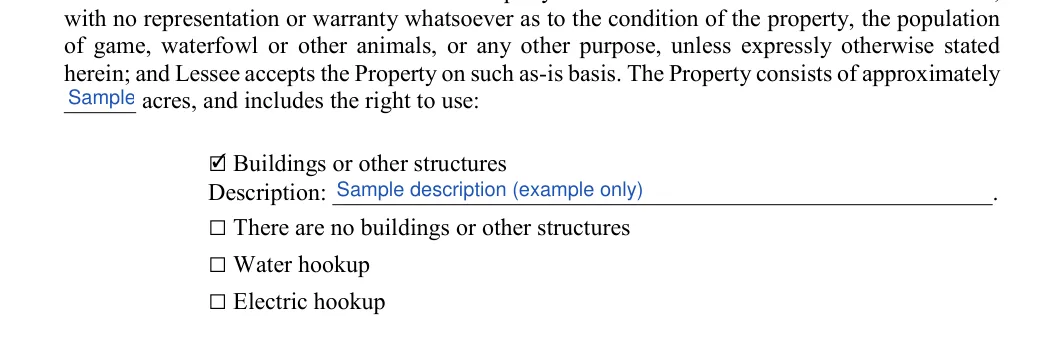
Write the approximate number of acres. Tick Buildings or other structures and describe them on the Description line, or tick There are no buildings or other structures. Tick Water hookup and Electric hookup if the property has them.

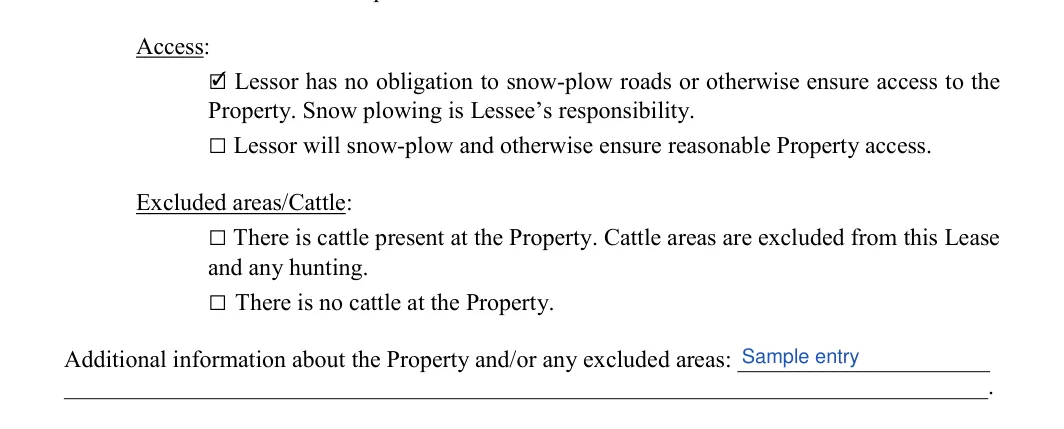
Tick one Access box: either the Lessor has no obligation to snow-plow, or the Lessor will snow-plow. Then tick one Excluded areas/Cattle box: cattle are present and excluded, or there is no cattle. Use the Additional information lines for anything else about the property or any excluded areas. The lines continue onto page 2.

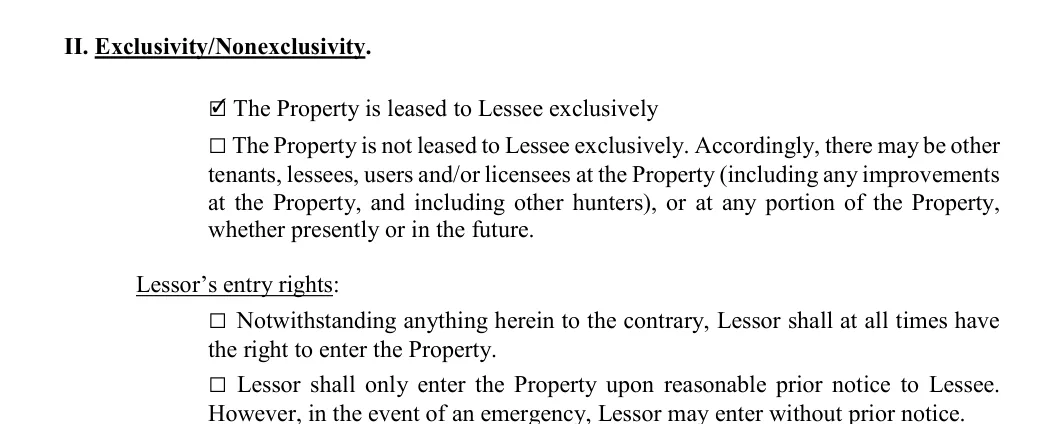
Tick whether the property is leased to the Lessee exclusively or not. Then tick one entry-rights box. The first lets the Lessor enter at all times. The second lets the Lessor enter on reasonable prior notice, with an exception for emergencies.

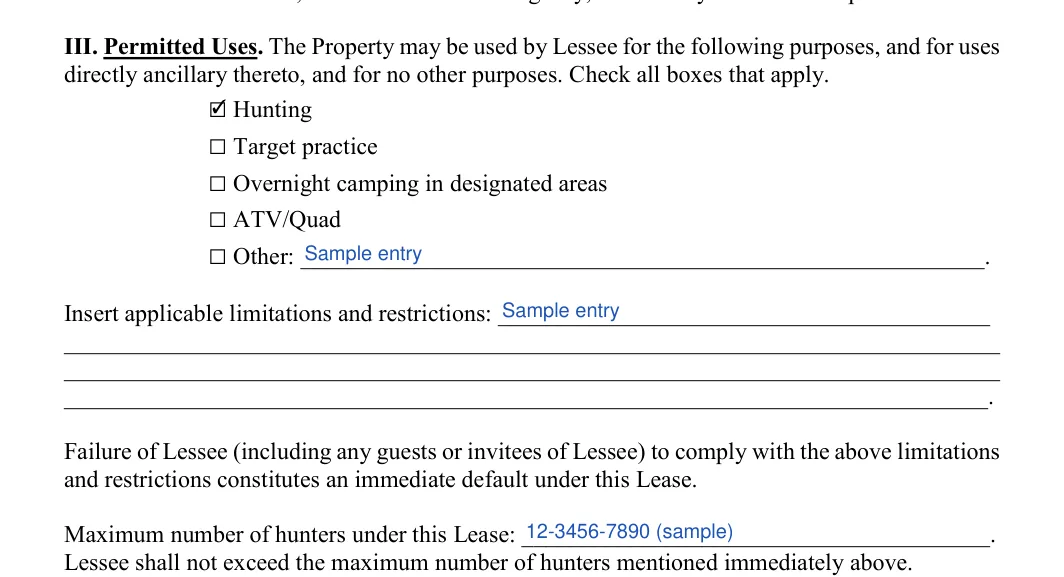
Tick every use that applies: Hunting, Target practice, Overnight camping in designated areas, ATV/Quad or Other. Describe any other use on the Other line. Then write any limitations and restrictions and the maximum number of hunters.


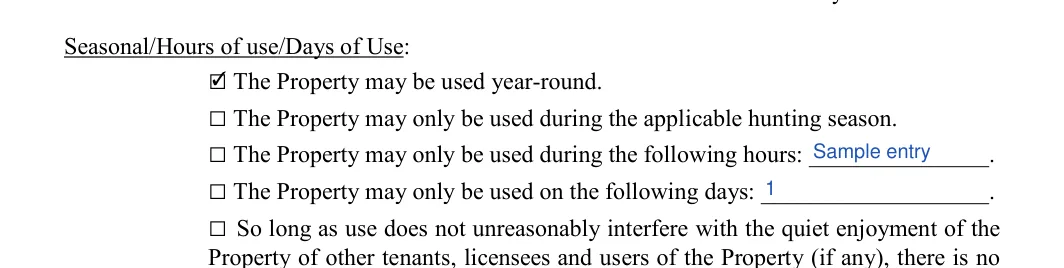
Tick the box that fits the lease: year-round use, the applicable hunting season only, specific hours or specific days. Write the hours or the days on the line next to your choice. Tick the last box if there is no limit on hours or days.

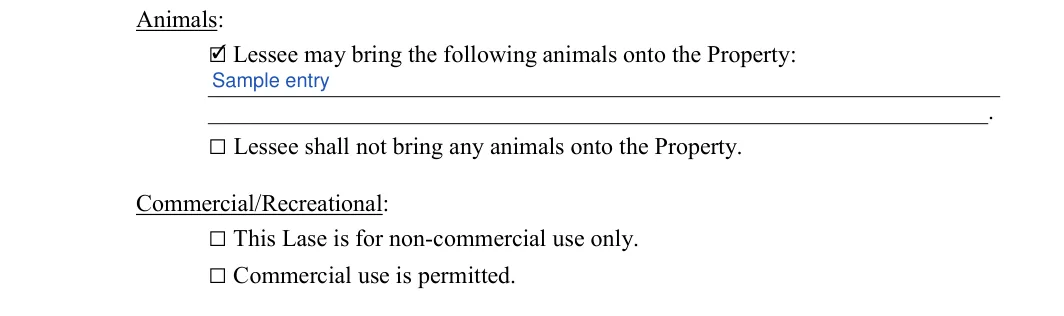
Tick whether the Lessee may bring animals onto the property. If so, list the animals on the lines provided. If not, tick the box that says no animals. Then tick whether the lease is for non-commercial use only or whether commercial use is permitted.

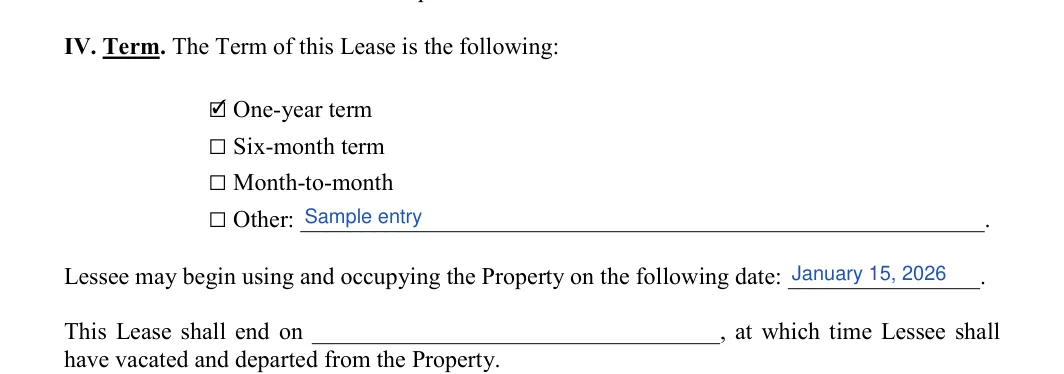
Tick one term: One-year term, Six-month term, Month-to-month or Other. If you pick Other, write the term on that line. Then enter the date the Lessee may begin using the property and the date the lease ends.

Enter the Amount, the period under Per (such as week or month) and the Due Date. Add any Additional Rent and the address where rent is payable. Tick Late Fee and write the amount, or tick No Late Fee. Last, tick the insurance box that fits: the rent either includes hunting liability insurance premiums or it does not.


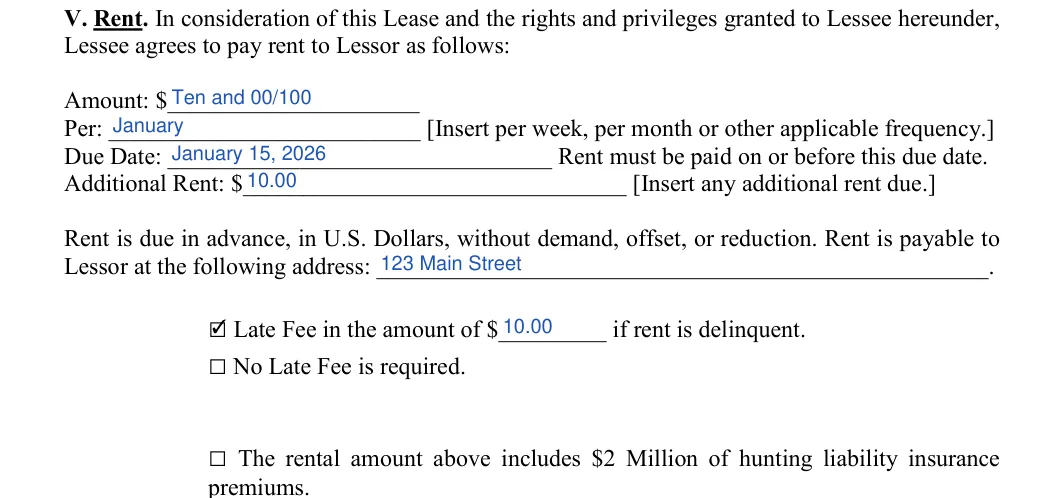
Tick the security deposit box and fill in the figure, or tick the box that says no deposit. Under Insurance, tick the box for the Lessee’s own hunting liability insurance and write the minimum amount. Otherwise, tick the box that says separate insurance is not needed because the Lessor provides it.


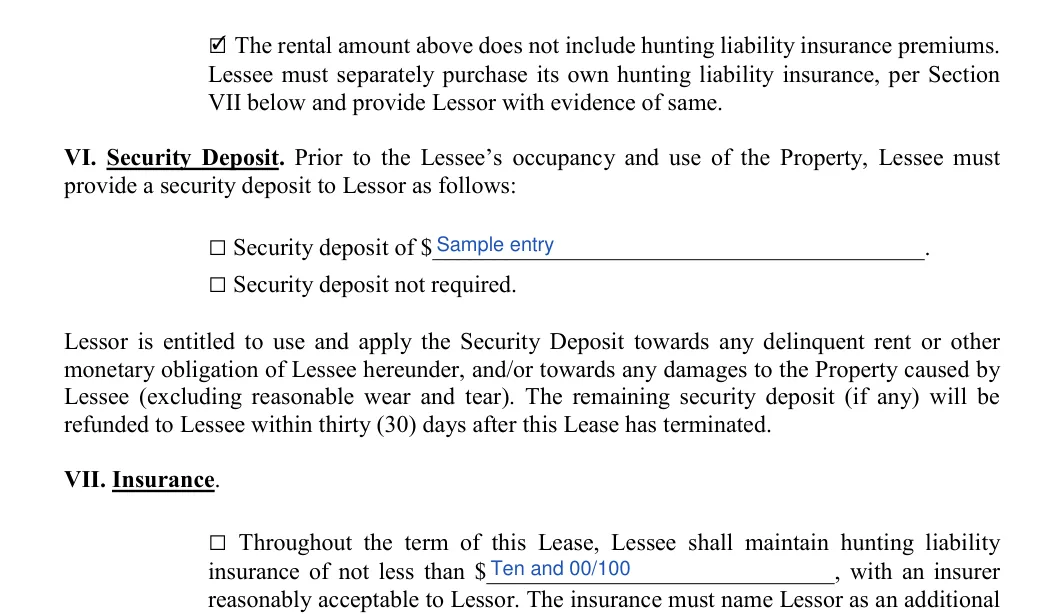
Add any other insurance requirements on the lines provided. The Compliance with Laws part has no blanks. Under Contact Information and Notices, enter the Lessor’s Name, Cell Phone Number and Email Address.
The lessor’s mobile phone must be reachable during hunting hours, in case there are any emergencies.


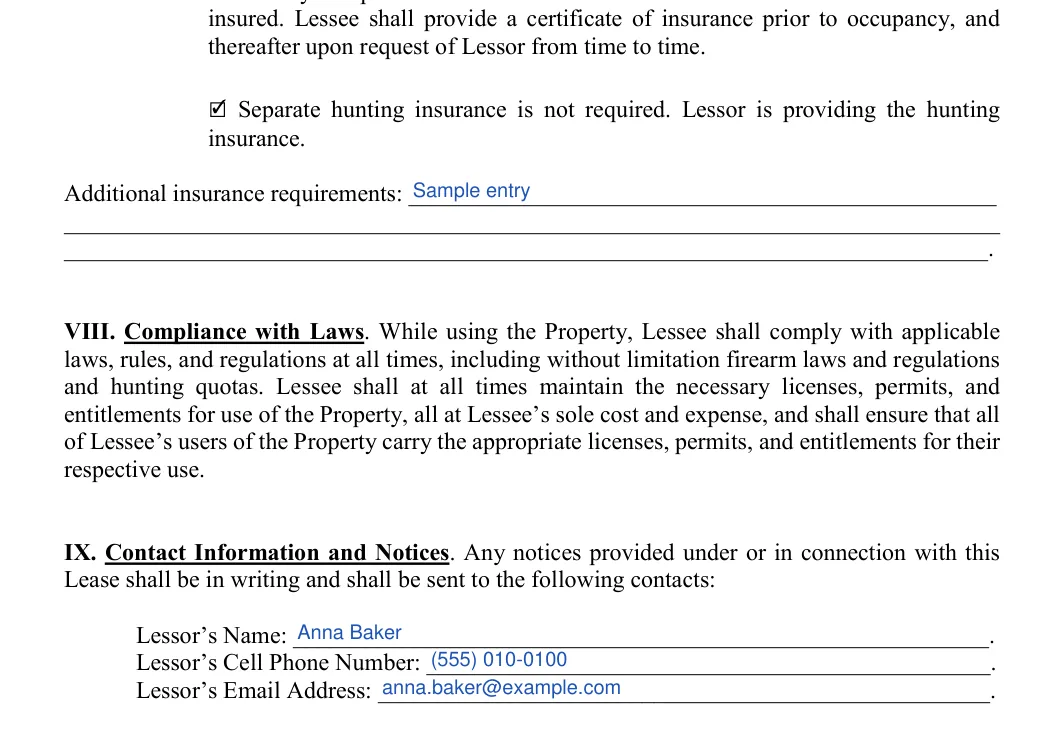
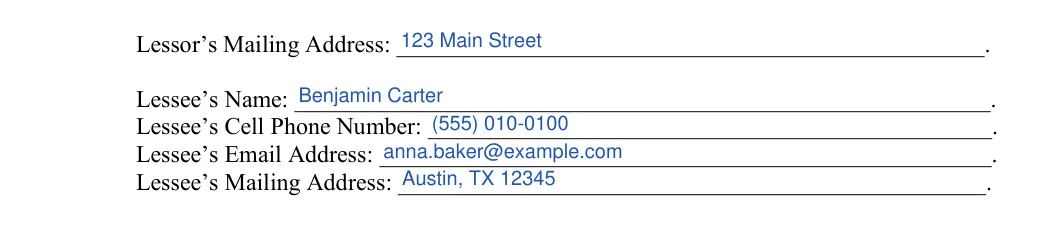
Enter the Lessor’s Mailing Address. Then enter the Lessee’s Name, Cell Phone Number, Email Address and Mailing Address. The Assumption of the Risk and Safety parts have no blanks.
Likewise, the lessee’s phone must also be with him or her during the hunt, especially if there is no guide and they get lost in the woods.


Under Assignment and Subleasing, tick whether assignment and subletting are prohibited or permitted with the Lessor’s prior approval.
If the landowner agrees to allow commercial use, this does not automatically mean that subletting or subleasing is allowed. Both parties must still agree if either box 1 (prohibited) or box 2 (permitted) will be applicable.
Then move to the Default part.
In case any violation occurs, set a date when the problem must be resolved by writing a period next to box 1. If the cure period is not an issue, simply tick box 2.


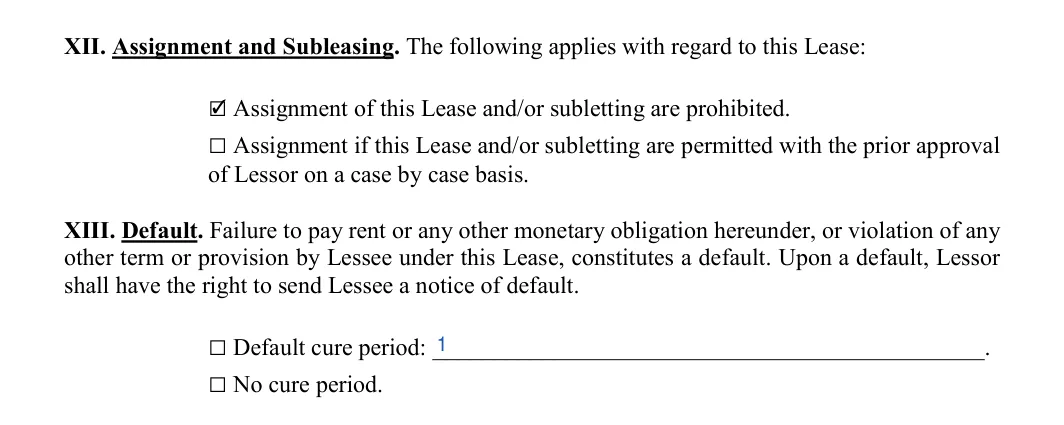
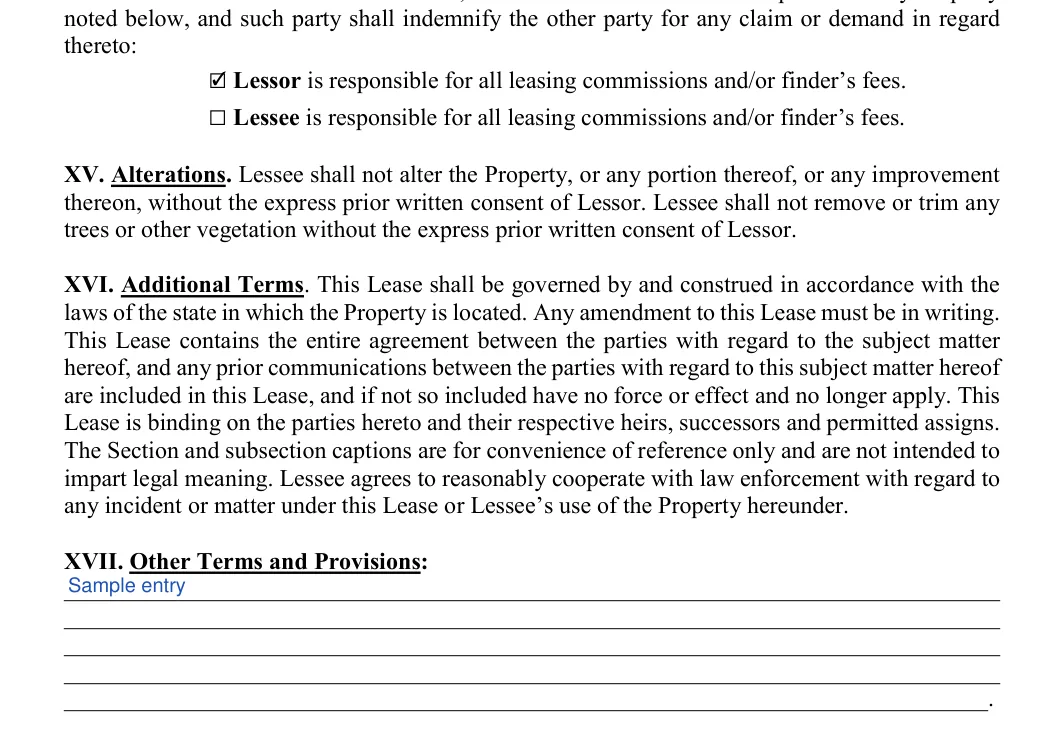
Tick whether the Lessor or the Lessee is responsible for all leasing commissions and finder’s fees. The Alterations and Additional Terms parts have no blanks. Write any added terms on the lines under Other Terms and Provisions.
If there is any additional condition, the landowner may type these out under section 17 of the document.


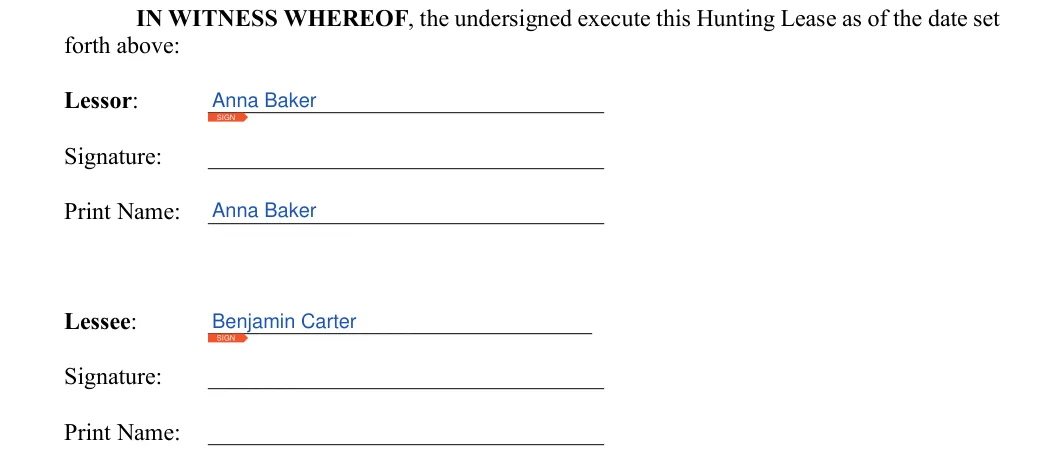
On the last page, the Lessor signs and prints a name on the Lessor lines. The Lessee does the same on the Lessee lines. Make sure that both parties have signed on all pages of the agreement. Following this step, the document must be notarized so that it can be legally binding.

After the last blank is filled in, the form is ready to review, sign and share. Go through these steps in order so that both parties end up with the same finished copy.
The landlord may provide a description or map of the land for the hunter’s use. Likewise, the hunter may also provide a copy of his or her hunting license or permit in order for the landowner’s reference. Any relevant document may be added as an attachment, like an informal “Hunter’s Rights” pamphlet or official guidelines taken from the safety education program.
When writing a hunting lease agreement, both landowners and hunters must make sure that they abide by the provisions of the agreement as well as the state guidelines. This will help alleviate dangerous situations that can cause irreversible consequences. Aside from the hunting lease, the lessee must secure a hunting license. Otherwise, the lease agreement will be halted.
Though hunting serves a recreational purpose, both parties must be careful since the negligence of state laws can lead to an unwanted situation. Of course, if each document is ready, hunters can have a good time exploring each of their leased acres of land while catching prized game.
It is a contract between a landowner, called the Lessor, and a hunter, called the Lessee. It records how the hunter may use the land, for how long and at what price.
The FormsPal template takes about 17 minutes on average. It has 97 fillable fields across seven pages.
The template has one version for every length. Under Term, tick One-year term, Six-month term, Month-to-month or Other, and enter the start and end dates.
The landowner and the hunter fill it out together, because both need to agree on the boxes and blanks. Both then sign it.
General information, not legal or tax advice.
