
An early lease termination letter is a written lease termination letter that a tenant sends to ask a landlord to end a lease before its term is over. Once sent, it gives both sides a dated record of the request. To assist you, FormsPal offers a free and fully-editable early lease termination letter template below.
Last Updated: October 2026. This guide is reviewed and updated regularly to reflect current law. If you notice an error or outdated information, please contact us.
Build Your Document
Answer a few simple questions to make your document in minutes
Save and Print
Save progress and finish on any device, download and print anytime
Sign and Use
Your valid, lawyer-approved document is ready
Though both parties may be living amicably, there are many reasons why early lease termination letters will be needed. For the tenant, it may be one of the following personal or legal reasons:
Whether the choice to end the lease is reasonable or not, the tenant still has the last say whether to write that letter or not. The landlord may only withhold the tenant’s deposit depending on the conditions stated in the lease agreement.
| STATES | MIN TERMINATION | STATE LAW |
| Alabama | Thirty (30) Days | Alabama Code, Section 35-9A-441 |
| Alaska | Thirty (30) Days | Alaska Statutes, Section 34.03.290 |
| Arizona | Thirty (30) Days | Arizona Revised Statutes, Section 33-1375 |
| Arkansas | Thirty (30) Days | Arkansas Annotated Code, Section 18-17-704 |
| California | Thirty (30) or Sixty (60) Days | California Civil Code, Section 1946.1 |
| Colorado | Depends on the lease duration* | Colorado Revised Statutes, Section 13-40-107 |
| Connecticut | Three (3) Days | Connecticut Revised Statutes, Chapter 832, Section 47a-23 |
| Delaware | Sixty (60) Days | Delaware Code, Title 25, Section 5106 |
| Florida | Fifteen (15) Days | Florida Statutes, Section 83.57 |
| Georgia | Sixty (60) Days (for Landlord), or Thirty (30) Days (for Tenant) | Georgia Code, Section 44-7-7 |
| Hawaii | Forty-five (45) Days (for Landlord), or Twenty-eight (28) Days (for Tenant) | Hawaii Revised Statutes, Section 521-71 |
| Idaho | One (1) Month | Idaho Statutes, Section 55-208 |
| Illinois | Thirty (30) Days | Illinois Compiled Statutes, Chapter 735, Section 5/9-207 |
| Indiana | One (1) Month | Indiana Code, Section 32-31-1-1 |
| Iowa | Thirty (30) Days | Iowa Code, Section 562A.34 |
| Kansas | Thirty (30) Days | Kansas Statute, Section 58-2570 |
| Kentucky | Thirty (30) Days | Kentucky Revised Statutes, Section 383.695 |
| Louisiana | Ten (10) Days | Louisiana Civil Code, Article 2728 |
| Maine | Thirty (30) Days | Maine Revised Statutes, Title 14, Section 6002 |
| Maryland | One (1) Month | Maryland Annotated Code, Section 8-402 |
| Massachusetts | Thirty (30) Days, or interval between payment periods, whichever is longer | Massachusetts General Laws, Chapter 186, Section 15B |
| Michigan | Thirty (30) Days | Michigan Compiled Laws, Section 554.134 |
| Minnesota | Three (3) Months, or interval between payment periods, whichever is less | Minnesota Statutes, Section 504B.135 |
| Mississippi | Thirty (30) Days | Mississippi Annotated Code, Section 89-8-19 |
| Missouri | One (1) Month | Missouri Revised Statutes, Section 441.060 |
| Montana | Thirty (30) Days | Montana Annotated Code, Section 70-24-441 |
| Nebraska | Thirty (30) Days | Nebraska Revised Statutes, Section 76-1437 |
| Nevada | Thirty (30) Days | Nevada Revised Statutes,Section 40.251 |
| New Hampshire | Thirty (30) Days | New Hampshire Revised Statutes, Section 540:3 |
| New Jersey | One (1) Month | New Jersey Statutes, Section 2A:18-56 |
| New Mexico | Thirty (30) Days | New Mexico Annotated Statutes, Section 47-8-37 |
| New York | One (1) Month | New York Consolidated Laws, RPP Section 232-B |
| North Carolina | Seven (7) Days | North Carolina General Statutes, Section 42-14 |
| North Dakota | One (1) Month | North Dakota Century Code, Section 47-16-07.2 |
| Ohio | Thirty (30) Days | Ohio Revised Code, Section 5321.17 |
| Oklahoma | Thirty (30) Days | Oklahoma Statutes, Section 41-111 |
| Oregon | Thirty (30) Days, or Sixty (60) Days (if tenant has been renting for more than a year) | Oregon Revised Statutes, Section 91.070 |
| Pennsylvania | Fifteen (15) Days | Pennsylvania Consolidated Statutes, Section 250.501 |
| Rhode Island | Thirty (30) Days, or Sixty (60) Days (if tenant’s age over 62 years) | Rhode Island General Laws, Section 34-18-37 |
| South Carolina | Thirty (30) Days | South Carolina Code of Laws, Section 27-40-770 |
| South Dakota | Thirty (30) Days | South Dakota Codified Laws, Section 43-32-13 |
| Tennessee | Thirty (30) Days | Tennessee Code Annotated, Section 66-28-512 |
| Texas | One (1) Month | Texas Statutes, Property Code, Section 91.001 |
| Utah | Fifteen (15) Days | Utah Code, Section 78B-6-802 |
| Vermont | Sixty (60) Days, or Ninety (90) Days (if tenant has been renting for more than a year) | Vermont Statutes, Title 9, Section 4467 |
| Virginia | Thirty (30) Days | Virginia Code, Section 55-248.37 |
| Washington | Twenty (20) Days | Washington Revised Code, Section 59.18.200 |
| West Virginia | One (1) Month | West Virginia Code, Section 37-6-5 |
| Wisconsin | Twenty-eight (28) Days | Wisconsin Statutes and Annotations, Section 704.19 |
| Wyoming | No Statute | Wyoming Statutes, Section 35-22-403 |
* If less than 1 week – 1 Day;
If 1 week or longer (but less than 1 month), or a tenancy at will – 3 Days;
If 1 month or longer (but less than 6 months) – 10 Days;
If 6 months or longer (but less than 1 year) – 1 Month;
If 1 year or longer – 3 Months.
A letter to end a lease early is most often used with a fixed-term lease. If your tenancy renews every month or every week, your starting point is the notice period for that type of tenancy. FormsPal's verified state data shows how much those periods differ, so check the rule for your location before you set a move-out date.
To find the last day of a notice period counted in days, try FormsPal's deadline calculator. For the rules in one state, open that state's lease agreement page.
These ranges are counts across the jurisdictions FormsPal covers. They do not replace your own lease or your state's rule, so check both before you pick a move-out date.
Ending a lease early takes three moves: check what your lease says about early termination, talk with your landlord about the terms, and send a written letter. Taking these steps in order can help you protect your security deposit and leave on good terms.
Step 1— Refer back to the original lease agreement.
It is always important to check old lease agreements for any guidelines regarding breaking a lease. Oftentimes, an early lease termination has its consequences wherein the landlord may forfeit your security deposit. To avoid any unwanted complications, review your contract’s early termination clause.
Step 2— Negotiate the terms before you break the lease.
You’d want to contact your landlord by phone or in person before you send your termination letter. During the meeting, calmly discuss the reasons with utmost sincerity. Hopefully, your landlord will go easy on the contract’s early termination clause and be lenient regarding the following:
Remember that tenants must use the original lease as the basis of their negotiation points. When finalized, the negotiated terms must then be indicated on the letter to properly end the lease.
Step 3— Formalize the termination letter.
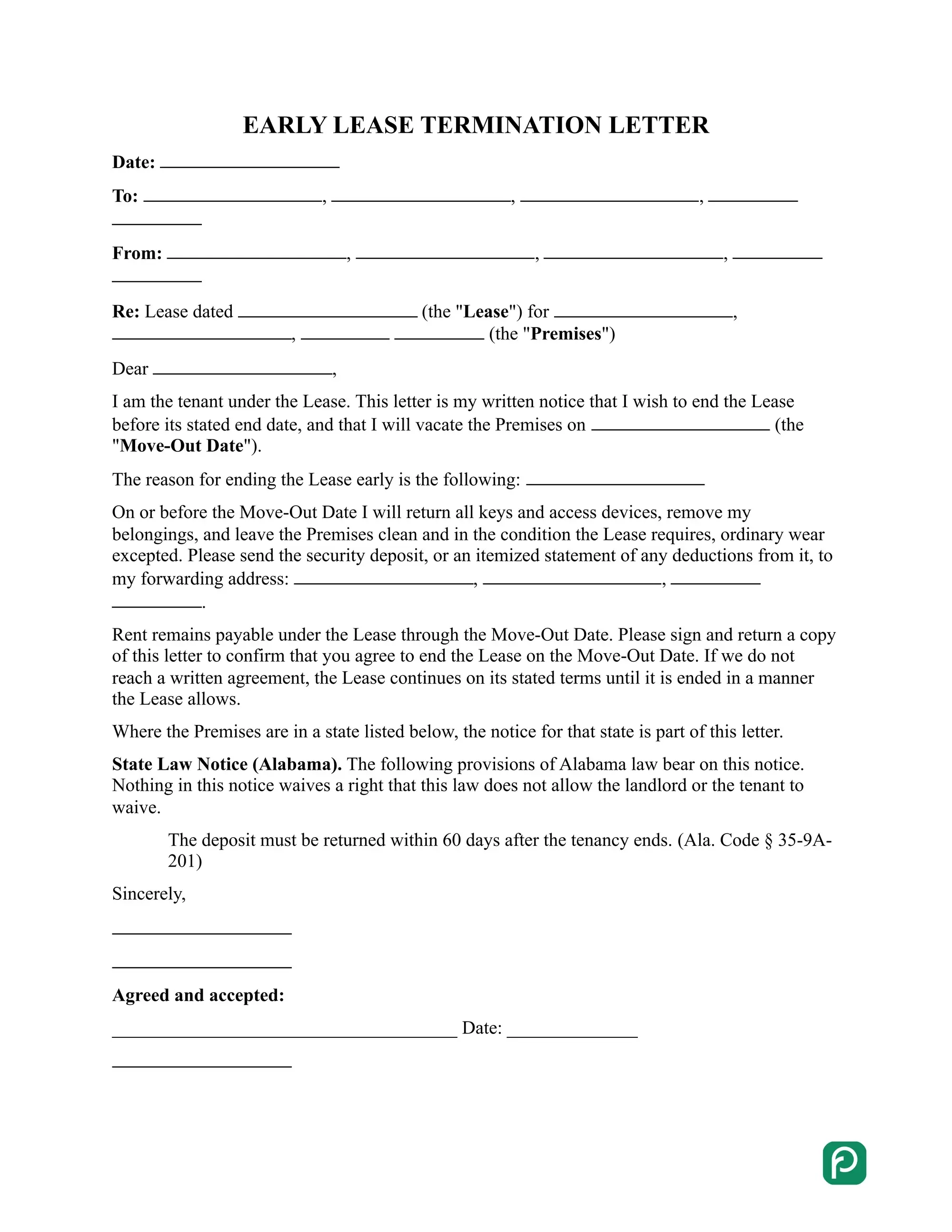
Use the template below to formalize your request for early lease termination. You may also add some of the results of your negotiation, which you may detail in writing. Once you have fully edited the template, print a copy. Make sure that you ask the landlord or his or her representative to sign a receiving copy as proof that you have submitted the notice.
Another option is sending it through certified mail, a service that uses a form that the landlord must acknowledge and sign. You may also consult state laws regarding provisions for their guidelines on sending a proper notice.

The template has four parts to complete: the heading, the subject line, the body of the letter, and the deposit instructions with your signature. Download the file first, then work through each step below in order. Fill in each blank before you print the letter.
Step 1— Download the lease termination letter template.
Choose the file that is compatible with your computer:
Step 2— Fill out the heading.

For the first part of the letter, type the following:
For blanks 3 to 4, you may add the necessary details to make the address more accurate.
Step 3— Indicate the subject of the letter.

Below the date and the addressee, fill out the first sentence, which starts with “Re:” ( a clipped version of the word “Regarding”). Write the following details in order:
Step 4— Write the body of the letter.

Step 5— Write instructions for the security deposit and sign the letter.

If you need to break the lease early, remember that you must properly inform the landlord and abide by the contract’s early lease termination clause. There are, however, many disadvantages to the early termination of lease, most of which were detailed in this article.
Should you feel that the decision to leave early weighs more than finishing the lease, you may formalize your request through an early lease termination letter. Using such will allow your landlord to better understand your reasons and may be more lenient when imposing the early termination clause.
A complete letter covers the details below, from the date and the landlord's address to your deposit instructions and signature. The steps above walk through each blank in order, so you can fill in the template without missing anything.
Yes, it usually helps. Contact your landlord by phone or in person first, and ask about the deposit, the move-out date, a buyout, subletting or a lease assignment. Then write any agreed terms into the letter so nothing in it comes as a surprise.
Hand the letter to your landlord or their representative and ask to receive a signed copy as proof. You can also send it by certified mail. Keep your own copy and any receipt, so you can show when you sent it.
If you're renting month to month, the notice period section above applies to you. In 46 of the 49 jurisdictions FormsPal's verified state data covers, the law sets a notice period for ending a month-to-month tenancy. In the 32 whose rule states it in days, it runs from 3 to 60 days.
General information, not legal or tax advice.
