
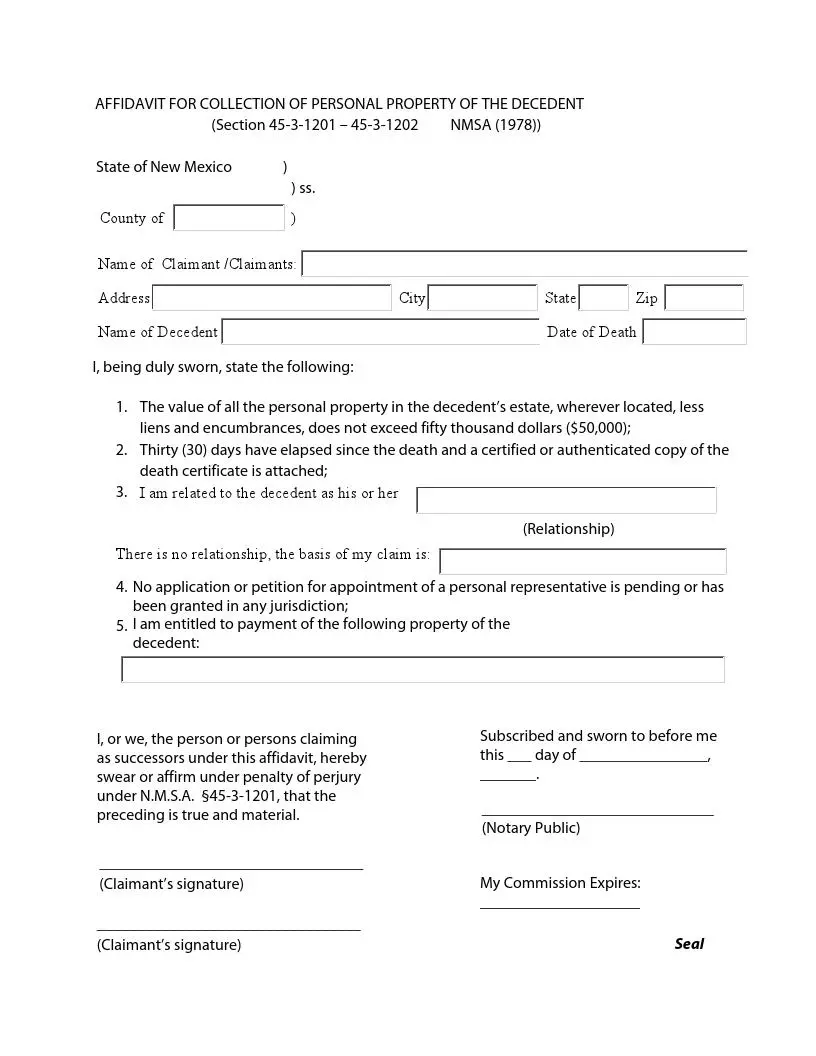
A New Mexico small estate affidavit is a sworn written statement that lets a person claiming to be the successor of someone who died collect that person's personal property. The rule is in N.M. Stat. Ann. § 45-3-1201. The entire estate must be worth no more than $50,000, and thirty days must have passed since the death.[1]
Last Updated: October 2026. This guide is reviewed and updated regularly to reflect current New Mexico law. If you notice an error or outdated information, please contact us.
Build Your Document
Answer a few simple questions to make your document in minutes
Save and Print
Save progress and finish on any device, download and print anytime
Sign and Use
Your valid, lawyer-approved document is ready
Under N.M. Stat. Ann. § 45-3-1201, thirty days after the death of a decedent, anyone who owes the decedent money or holds the decedent's tangible personal property must pay or deliver it to a person claiming to be the successor. The decedent is the person who died, and the successor is the person entitled to the property.[1]
The successor presents a sworn statement, and two numbers decide whether the claim fits:
Real estate has its own rule. The statute says:
The affidavit made pursuant to this section may not be used to perfect title to real estate.
In plain words, this procedure cannot prove ownership of a house or land, because the form covers personal property only.
Other states set their own limits. See our small estate affidavit forms for other states if you need a different state.
| Max. Estate | $50,000[1] |
| Min. Time to Wait After Death | 30 days[1] |
| Real Estate | Not usable to perfect title to real estate[1] |
| State Laws | N.M. Stat. Ann. § 45-3-1201 |

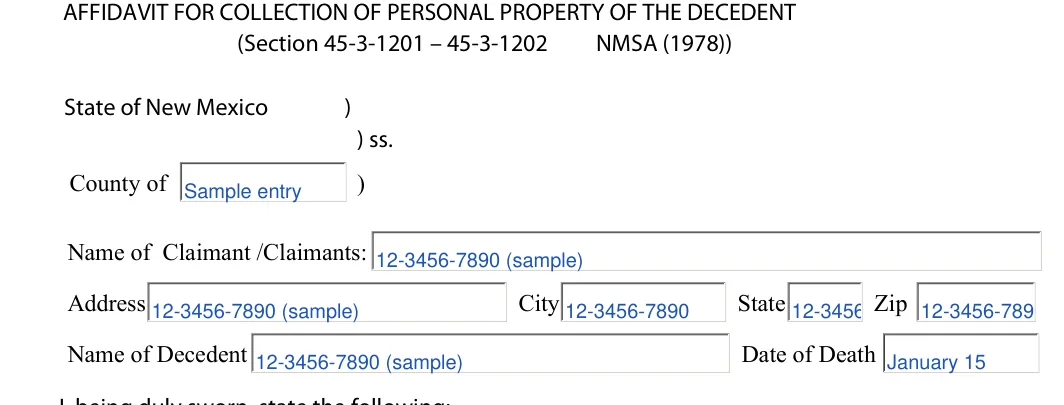
The form is a one-page document called Affidavit for Collection of Personal Property of the Decedent. Fill it out in the five steps below, in the order the form shows them, and each step names the part of the form it covers. You can create the form online with our document builder and download it as a PDF.
The screenshots under each step show the FormsPal New Mexico small estate affidavit template filled with sample entries in blue, so you can see where each answer goes. The names, addresses, dates and amounts are examples only.


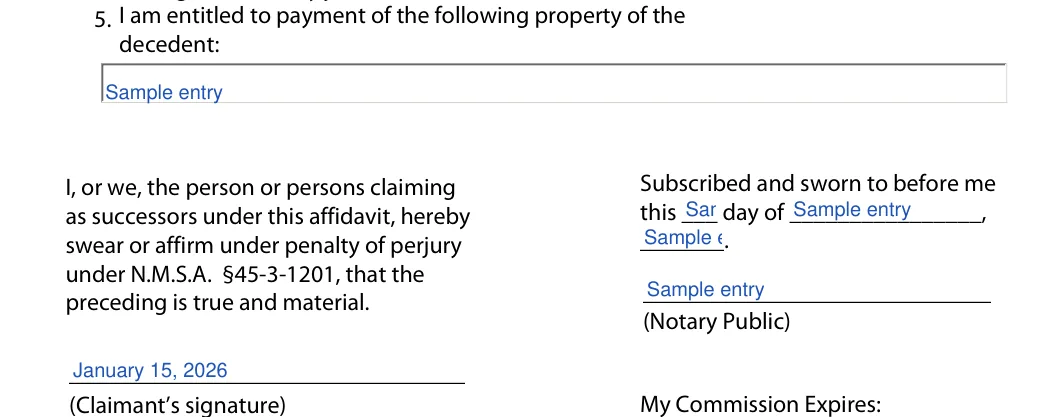

Under the statute, the successor presents the signed form to the person who owes the money or holds the property.[1]
Make a copy of the signed form before you hand it over, because the copy shows exactly what each claimant swore.
These short answers cover the procedure, the dollar amount and the limit for collecting personal property. Each answer comes from N.M. Stat. Ann. § 45-3-1201, the state statute on collecting personal property by affidavit, and states only what that statute says.[1]
The statute sets a simple procedure for personal property. The entire estate must be worth no more than $50,000, and thirty days must have passed since the death. Then a person claiming to be the successor can present an affidavit to the person holding the decedent's property. The affidavit may not be used to perfect title to real estate.[1]
The amount is $50,000, and the value of the entire estate, wherever located, less liens and encumbrances, must not exceed that figure.[1]
The limit is $50,000, and thirty days must also have elapsed since the death of the decedent before the claim is presented.[1]
General information, not legal or tax advice.
