
Updated:
A Tennessee car bill of sale is a signed receipt for a vehicle. The form names the seller, the buyer, the vehicle, its VIN, the price and the sale date. This page covers when you need one and how to fill it out.
Key facts
Build Your Document
Answer a few simple questions to make your document in minutes
Save and Print
Save progress and finish on any device, download and print anytime
Sign and Use
Your valid, lawyer-approved document is ready
| Document Name | Tennessee Vehicle Bill of Sale Form |
| Other Names | Tennessee Car Bill of Sale, Tennessee Automobile Bill of Sale, TN Auto Bill of Sale |
| Titling Agency | Tennessee Department of Revenue |
| Notarized Bill of Sale Needed? | In three title cases: no Tennessee title (Tenn. Comp. R. & Regs. 1320-8-13-.01(2)), a lost or damaged title (Tenn. Comp. R. & Regs. 1320-8-13-.04), or a title held by a lienholder (Tenn. Comp. R. & Regs. 1320-8-13-.02(1)(c)) |
| Avg. Time to Fill Out | 7 minutes |
| # of Fillable Fields | 64 |
A Tennessee bill of sale differs by what is being sold: a motor vehicle, a trailer, a boat, a firearm or other personal property. Each card below describes one type. Pick the card that matches the item in your sale.
The Tennessee motor vehicle bill of sale records the sale of a car, truck or other motor vehicle. It names the seller and the buyer, describes the vehicle and states the price. Tenn. Comp. R. & Regs. 1320-8-13-.01(2) calls for it notarized, with a sworn statement explaining why the vehicle has not been titled, in a title application for a used vehicle that has no Tennessee title, existing or pending, unless the title from the state where it was previously registered is sent instead.
| Alternative Name | Car Bill of Sale |
| Seller’s Signature | Signature line on the form; the seller who holds the title also signs an assignment on it (Tenn. Code Ann. § 55-3-118(a)) |
| Buyer’s Signature | Signature line on the form |
| Notarization | Needed for no Tennessee title (Tenn. Comp. R. & Regs. 1320-8-13-.01(2)), a lost or damaged title (Tenn. Comp. R. & Regs. 1320-8-13-.04), or a title held by a lienholder (Tenn. Comp. R. & Regs. 1320-8-13-.02(1)(c)) |
| Download | PDF Template |

This bill of sale for trailers records the sale of a trailer. Use a separate bill of sale for the vehicle that tows it.
| Alternative Name | Trailer Bill of Sale |
| Seller’s Signature | Signature line on the form |
| Buyer’s Signature | Signature line on the form |
| Notarization | Not covered on this page |
| Download | PDF Template |

Tennessee boat bill of sale records the transfer of a specific vessel from one person to another. It names the seller and the buyer, describes the boat and states the price.
| Alternative Name | Vessel Bill of Sale |
| Seller’s Signature | Signature line on the form |
| Buyer’s Signature | Signature line on the form |
| Notarization | Not covered on this page |
| Download | PDF Template |

This firearm bill of sale records the sale of a firearm. It lists the make, model, caliber and serial number, the details of both parties and the purchase price.
| Alternative Name | Gun Bill of Sale |
| Seller’s Signature | Signature line on the form |
| Buyer’s Signature | Signature line on the form |
| Notarization | Not covered on this page |
| Download | PDF Template |

The Tennessee general bill of sale records the sale of personal property or equipment. Use it when none of the other templates fits.
| Alternative Name | Generic Bill of Sale |
| Seller’s Signature | Signature line on the form |
| Buyer’s Signature | Signature line on the form |
| Notarization | Not covered on this page |
| Download | PDF Template |
A Tennessee car bill of sale names the seller, the buyer, the vehicle and the price, and it shows the sale date and how the buyer pays. The form holds these parts:
The vehicle description identifies one car by its VIN, together with its make, model, body type, year, color and odometer reading. The VIN ties the form to the certificate of title for the same car. A buyer compares the VIN on the form with the VIN on the title and on the car before paying.
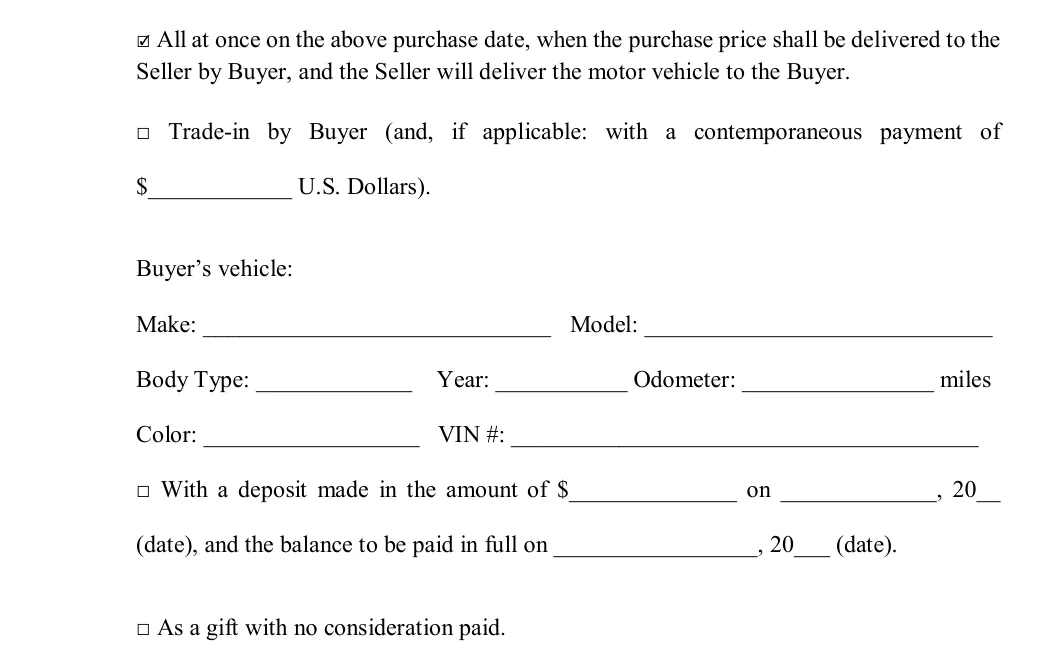
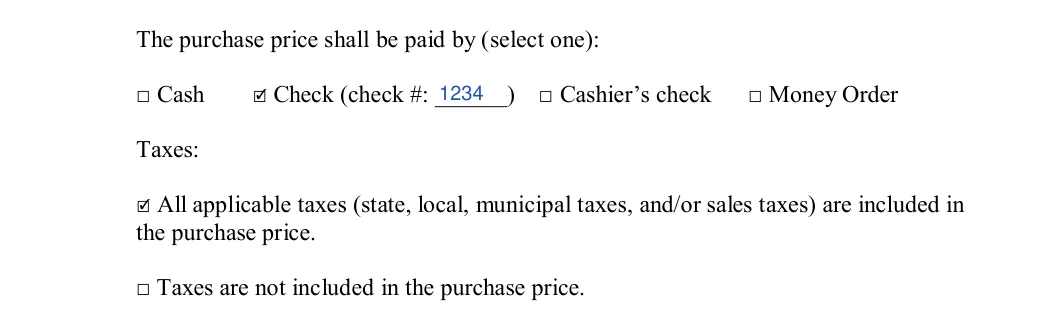
The payment part shows the total price and how it is paid: all at once, with a trade-in, as a deposit with a later balance, or as a gift. The form then asks for the payment type (cash, check, cashier's check or money order) and whether taxes are included in the price.
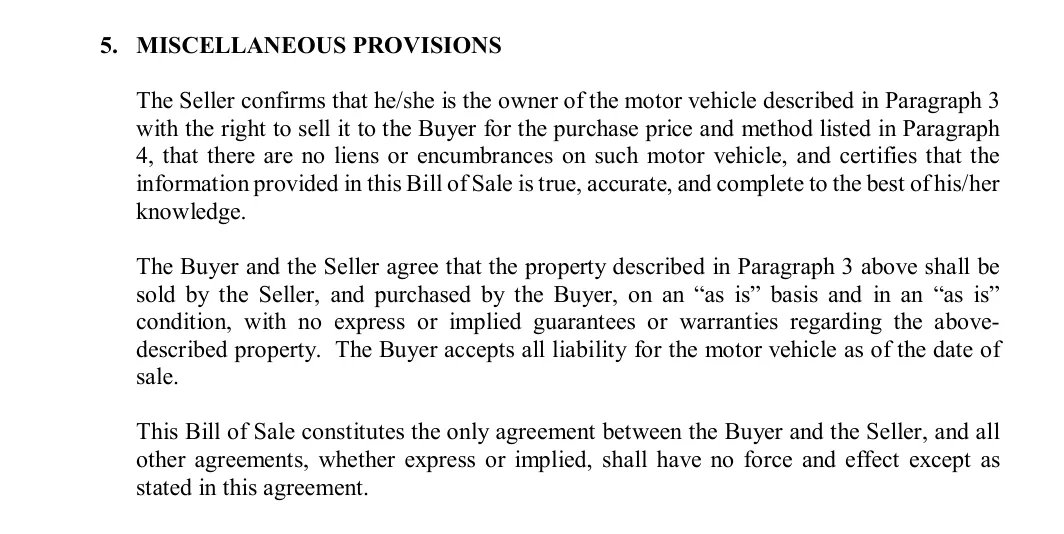
The as-is clause says the buyer takes the vehicle in its present condition. Page 3 of the form also carries the seller's confirmation of ownership and of no liens, and an entire-agreement clause. These paragraphs are read before signing, with nothing to fill in.
A Tennessee bill of sale is needed, notarized, in three title cases: no Tennessee title (Tenn. Comp. R. & Regs. 1320-8-13-.01(2)), a lost or damaged title (Tenn. Comp. R. & Regs. 1320-8-13-.04), or a title held by a lienholder (Tenn. Comp. R. & Regs. 1320-8-13-.02(1)(c)). In other sales, the seller's assignment on the title, if the seller holds it, carries the transfer (Tenn. Code Ann. § 55-3-118(a)), and the bill of sale shows the terms of the deal.
| Title case | What the sale needs | Rule |
|---|---|---|
| Used vehicle with no Tennessee title, existing or pending | A notarized bill of sale and a sworn statement explaining why the vehicle has not been titled, or the title from the state where it was previously registered | Tenn. Comp. R. & Regs. 1320-8-13-.01(2) |
| Title lost, damaged or destroyed | A notarized bill of sale, plus the seller's notarized affidavit of lost or damaged certificate of title | Tenn. Comp. R. & Regs. 1320-8-13-.04 |
| Title held by a lienholder | Instead of assigning the title, the seller delivers a separate notarized bill of sale naming the lienholder and notifies the lienholder of the sale | Tenn. Comp. R. & Regs. 1320-8-13-.02(1)(c) |
A used car with no Tennessee title needs a notarized bill of sale and a sworn statement with its title application, unless the buyer sends the title from the state where it was previously registered (Tenn. Comp. R. & Regs. 1320-8-13-.01(2)). The sworn statement explains why the vehicle has not been titled before. The rule reads:
Applications for certificate of title for other than new vehicles for which there is not currently in existence a tennessee certificate of title, or pending application for same, must be accompanied by a notarized bill of sale and sworn statement, certifying as to why the vehicle has not heretofore been titled, or certificate of title from the state in which previously registered.
A sale with a lost, damaged or destroyed title uses a notarized bill of sale, and the seller also executes a notarized affidavit of lost or damaged certificate of title (Tenn. Comp. R. & Regs. 1320-8-13-.04).
A sale where a lienholder holds the title uses a separate notarized bill of sale naming the lienholder, which the seller delivers instead of assigning the title (Tenn. Comp. R. & Regs. 1320-8-13-.02(1)(c)). The seller also notifies the lienholder of the sale (Tenn. Comp. R. & Regs. 1320-8-13-.02(1)(c)).
The buyer's title application states all liens or encumbrances on the vehicle, along with the applicant's title and the names and addresses of everyone with an interest in the vehicle and the nature of that interest (Tenn. Code Ann. § 55-3-103(a)(3)).
A notarized bill of sale is not sufficient proof of ownership of a vehicle, according to the Tennessee Department of Revenue (Tennessee DOR; SB-3). A properly endorsed title showing the full chain of title is needed to show ownership of a vehicle (Tennessee DOR; SB-3).
The two papers do different jobs. The title moves ownership from seller to buyer. The sale document shows the price, the date, the payment and the as-is terms both sides agreed to.
If you hold a bill of sale but no title, our guide to getting a vehicle title with a bill of sale explains your options.
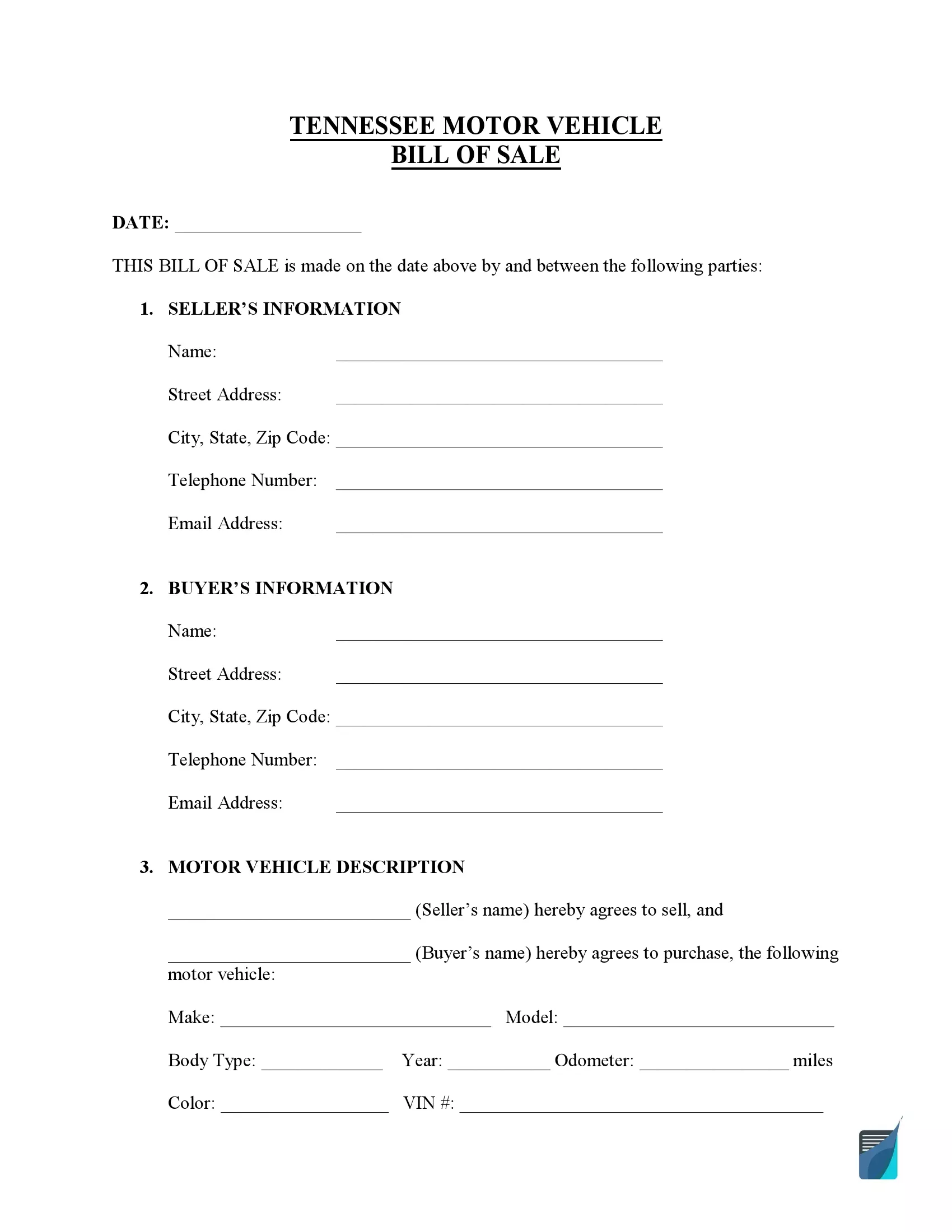
The Tennessee car bill of sale form runs four pages in ten steps, from the sale date at the top to the notary page at the end. Fill in the PDF with the PDF editor or print it and write by hand.
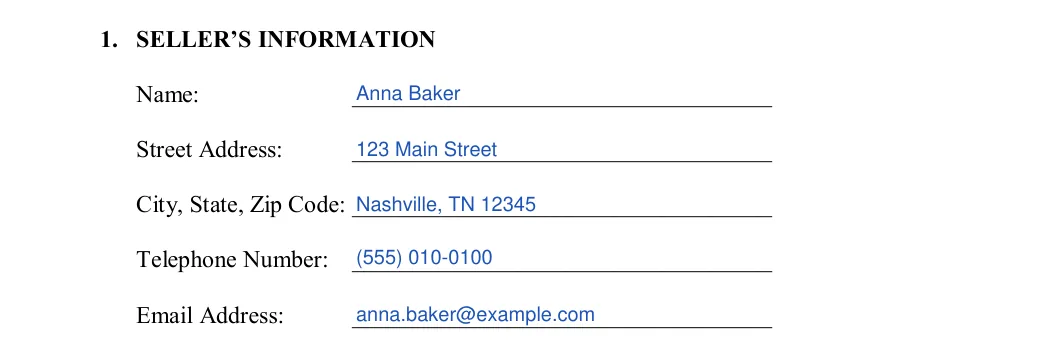
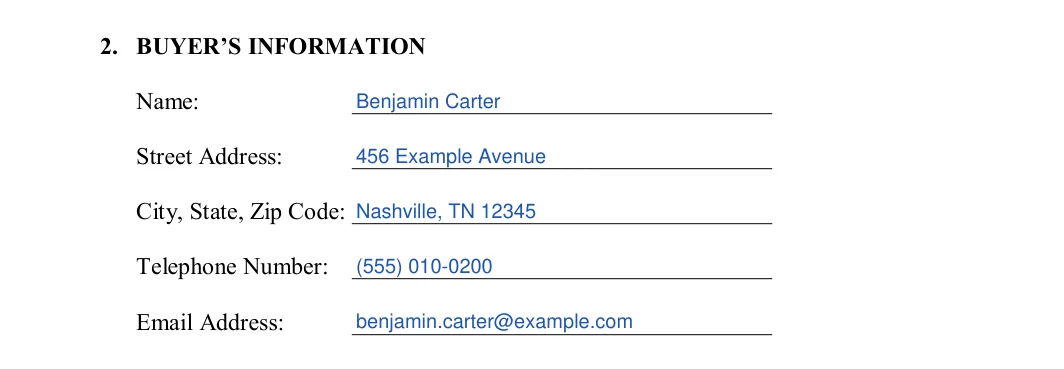
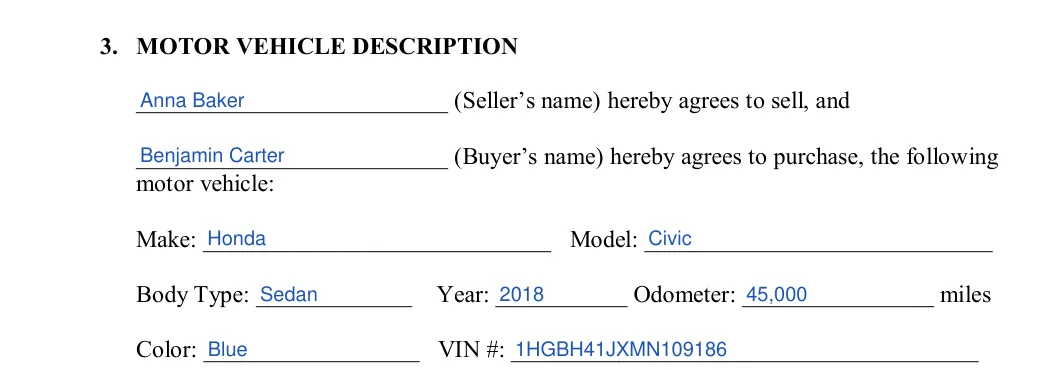
The picture under each step shows the form with sample entries in blue, so you can see where each answer goes. The names, addresses, dates and amounts are examples only.
Write the date of the sale on the DATE line at the top of page 1.

Section 1 on page 1 asks for the seller's details:
Section 2 asks for the same details for the buyer:
Section 3 is a sentence naming the seller and the buyer, followed by the vehicle's details. Copy the VIN from the title or the car itself, character by character:
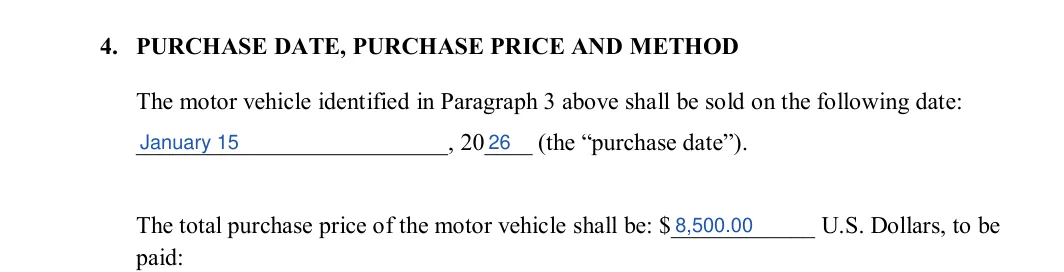
On page 2, enter the purchase date and the total purchase price in U.S. dollars.
Check the one option that fits your sale:
Select the payment type: cash, check with the check number, cashier's check or money order. Then check whether taxes are included in the purchase price.
Page 3 has three paragraphs to read before signing: the seller's ownership and no-liens confirmation, the as-is terms and the entire-agreement clause. Nothing is filled in here.
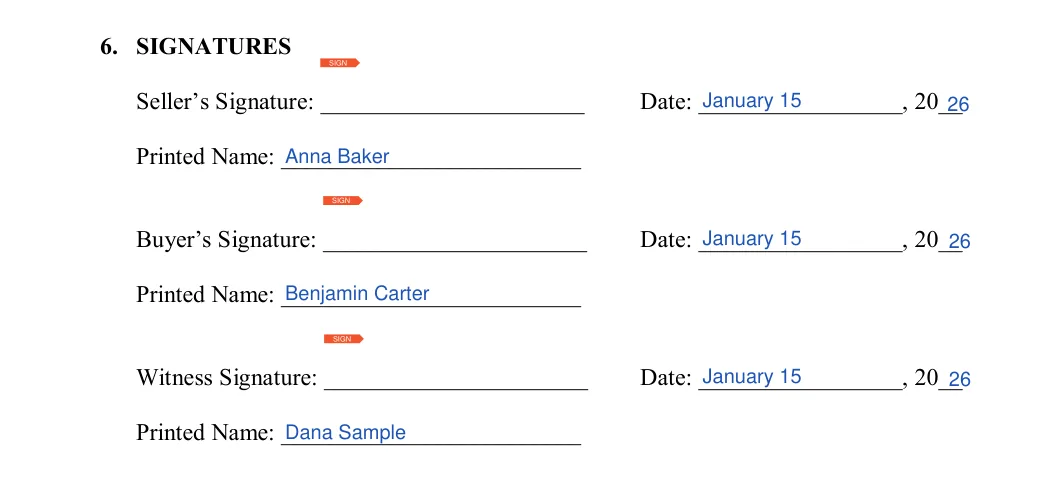
The seller and the buyer each sign and date their own line. The form also has a witness line.
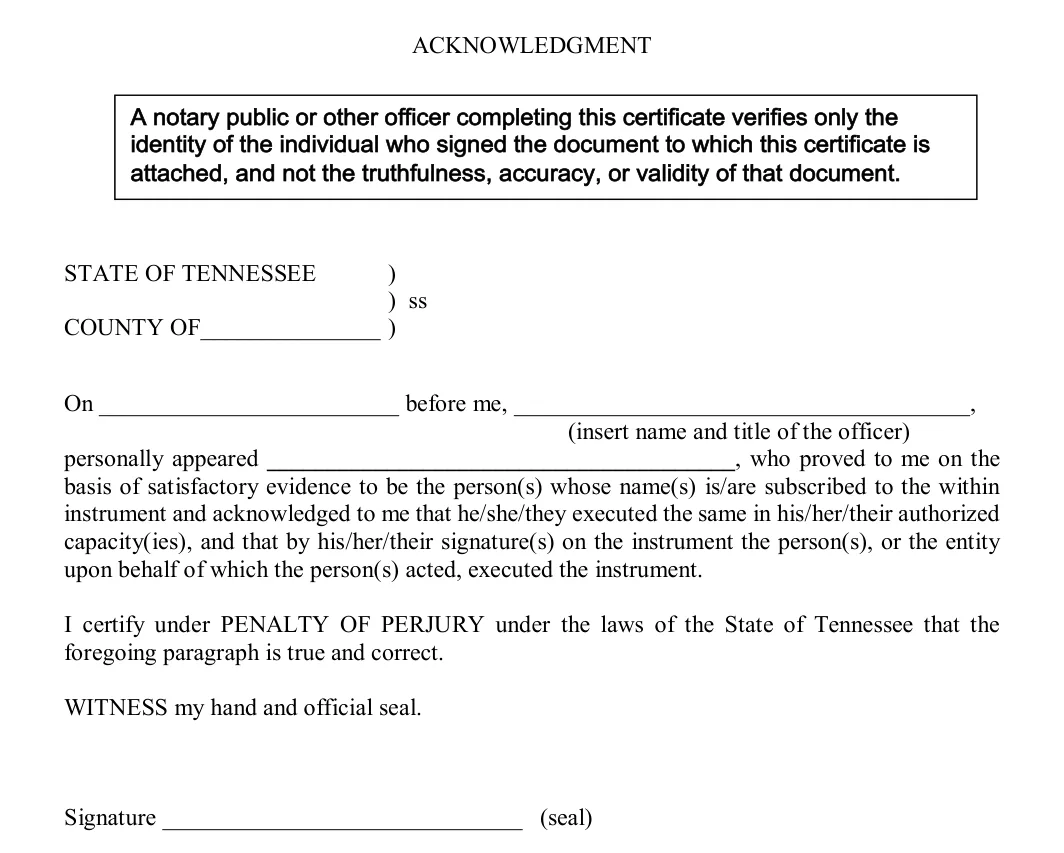
Page 4 holds the notary acknowledgment, which the notary public completes. The form is notarized for a used vehicle with no Tennessee title (Tenn. Comp. R. & Regs. 1320-8-13-.01(2)), a lost or damaged title (Tenn. Comp. R. & Regs. 1320-8-13-.04), or a title held by a lienholder (Tenn. Comp. R. & Regs. 1320-8-13-.02(1)(c)).
A Tennessee title transfer starts with the seller's assignment on the certificate of title, if the seller holds it, and ends with the buyer's title application (Tenn. Code Ann. § 55-3-118(a)). Every motor vehicle, and every trailer, semitrailer and pole trailer, when driven or moved upon a highway, falls under Tennessee's registration and certificate of title provisions, with the exceptions the statute lists (Tenn. Code Ann. § 55-3-101(a)).
The buyer submits the assigned title with the title application and keeps a copy of the signed motor vehicle bill of sale.
Form RV-F1310401 or Certification of Ownership is used when it’s impossible to provide other proper documentation to obtain a title.

A vehicle power of attorney is a legal document allowing a person to appoint someone else to handle the matters concerning the vehicle.

The answers below cover the questions buyers and sellers ask most about a Tennessee vehicle bill of sale. Each legal answer names its rule or source.
No, the sale form alone does not prove ownership: a notarized bill of sale is not sufficient proof of ownership (Tennessee DOR; SB-3). For a used vehicle with no Tennessee title, the application needs a notarized bill of sale and a sworn statement explaining why the vehicle has not been titled, or the title from the state where it was previously registered (Tenn. Comp. R. & Regs. 1320-8-13-.01(2)).
The seller signs the certificate of title over to the buyer, with a statement of all liens or encumbrances, and delivers it when the vehicle is delivered (Tenn. Code Ann. § 55-3-118(a)). The buyer's title application needs a valid certificate of title properly assigned and an odometer disclosure statement, if applicable (Tennessee DOR; F-1317001). A notarized bill of sale is added in the three title cases above: no Tennessee title (Tenn. Comp. R. & Regs. 1320-8-13-.01(2)), a lost or damaged title (Tenn. Comp. R. & Regs. 1320-8-13-.04), or a title held by a lienholder (Tenn. Comp. R. & Regs. 1320-8-13-.02(1)(c)).
The buyer's title application includes an odometer disclosure statement, if applicable (Tennessee DOR; F-1317001). The bill of sale form also has its own odometer reading field in the vehicle description. The official odometer disclosure statement is Form RV-F1317001, listed under Relevant Official Forms above.
On this form, "as is" means the buyer accepts the vehicle in its present condition. The as-is paragraph sits on page 3 with the seller's ownership confirmation and the entire-agreement clause. Both sides read it before signing.
The seller and the buyer each sign and date their own line. The form also has a witness line. A notary completes page 4 when the form is notarized for one of the three title cases: no Tennessee title (Tenn. Comp. R. & Regs. 1320-8-13-.01(2)), a lost or damaged title (Tenn. Comp. R. & Regs. 1320-8-13-.04), or a title held by a lienholder (Tenn. Comp. R. & Regs. 1320-8-13-.02(1)(c)).
Yes, it has a gift option in its payment section, checked when no money changes hands. The rest of the form is filled in the same way: the parties, the vehicle, the date and the signatures.

Other Tennessee Forms
General information, not legal or tax advice.


