Tennessee's small estate law covers estates with probate property of up to $50,000.[2] Under the Small Estate Probate Act, such an estate is handled by a sworn petition for limited letters, filed with the court exercising probate jurisdiction in the county where the decedent had legal residence on the date of death. The petition must list each item of property, its value and each creditor (Tenn. Code Ann. 30-4-102 and 30-4-103).[1] The Small Estate Probate Act came with Public Chapter No. 297 of 2023, which replaced Tennessee's older small estate chapter.[3] The PDF on this page is a FormsPal petition for limited letters, built from that Act. Counties may have their own versions: several county probate courts publish their own petitions, and you may use your county's form instead. Before you file, ask the probate court clerk in the county where the decedent lived which forms the court accepts.
Last Updated: October 2026. This guide is reviewed and updated regularly to reflect current Tennessee law. If you notice an error or outdated information, please contact us.
Create a free high quality Tennessee Small Estate Affidavit online now!
Build Your Document
Answer a few simple questions to make your document in minutes
Save and Print
Save progress and finish on any device, download and print anytime
Sign and Use
Your valid, lawyer-approved document is ready
... or download your Tennessee Small Estate Affidavit Form as a PDF file
What Are the Tennessee Small Estate Laws and Requirements?
Tennessee's small estate law covers a decedent's probate property worth no more than $50,000. It counts only personal property, or an interest in personal property, so real estate and other land are outside the total of the estate.[2] A small estate may be administered after 45 days from the date of death. A copy of the death certificate shows the date, and no petition for a personal representative may have been filed in that time.[1]
Section 30-4-102 of the Tenn. Code Ann. defines the property that counts toward the limit:
"Property" means only personal property, or any interest in personal property, owned by the decedent on the date of death that would be subject to probate, other than personal property held as tenants by the entirety or jointly with right of survivorship, or personal property payable to a beneficiary other than the decedent's estate.
That definition leaves out two kinds of personal property.[2]
Property held as tenants by the entirety or jointly with right of survivorship.
Property payable to a beneficiary other than the decedent's estate.
The same section describes limited letters of administration of a small estate. These letters restrict the person who receives them to the property itemized and identified in the petition for the limited letters. That petition must be attached to and made a part of the limited letters.[2] The petitioner must post a bond equal to the value of the property, backed by a corporate surety (a company that guarantees it), unless the petitioners are the sole heirs or sole beneficiaries or all the adult heirs and beneficiaries consent in writing (Tenn. Code Ann. 30-4-103).[1]
Check the 45 days first. The waiting period runs from the date of the decedent's death, and a copy of the death certificate shows that date. The condition is not met if anyone filed a petition to appoint a personal representative for the estate during those 45 days.[1] You can count the days with our deadline calculator.
Other Tennessee Forms
Different fillable Tennessee forms readily available for download here and that can be personalized in our simple document builder.
Create a free high quality Tennessee Small Estate Affidavit online now!
How Do You Fill Out the Tennessee Small Estate Affidavit Form?
The PDF on this page is a FormsPal form, not a court form. It is a fillable petition for limited letters built from Public Chapter No. 297 of 2023, T.C.A. § 30-4-101 et seq., which replaced the old small estate affidavit with a sworn petition.[3] It has six petition pages and a last page of instructions that is not filed. The 14 steps below follow its parts in order. Fill in the downloaded PDF with our online PDF editor, or print it and write the answers by hand.
Counties may have their own versions. Several county probate courts, among them Putnam, Coffee, Hawkins, Hamilton, Montgomery, Shelby and Wilson, publish their own small estate petitions, and you may use your county's form instead of this one. Some courts also want a proposed order with the petition. FormsPal's proposed order and limited letters form (PDF) has one, together with the letters form set out in T.C.A. § 30-4-103(9).[1]
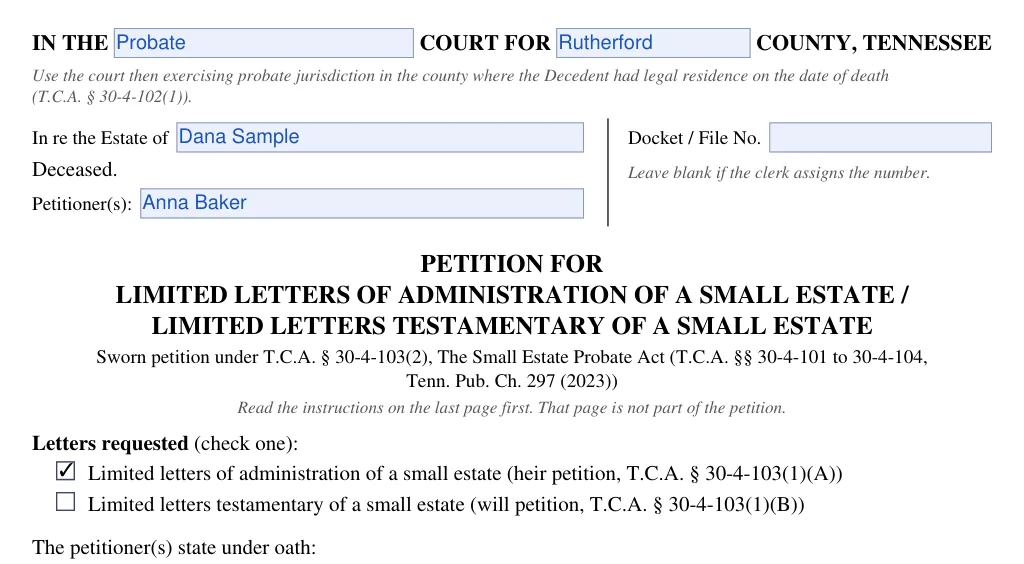
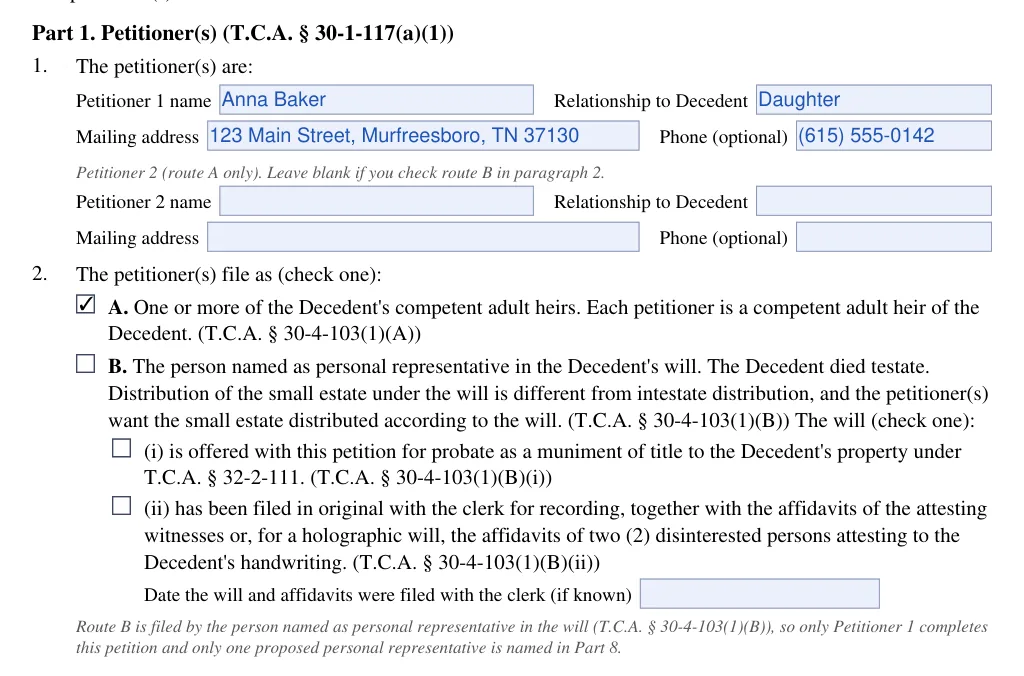
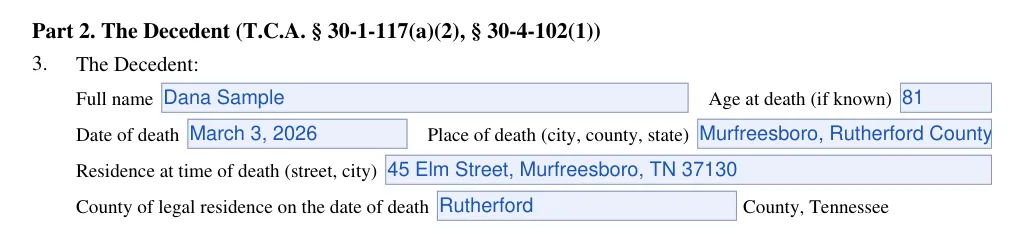
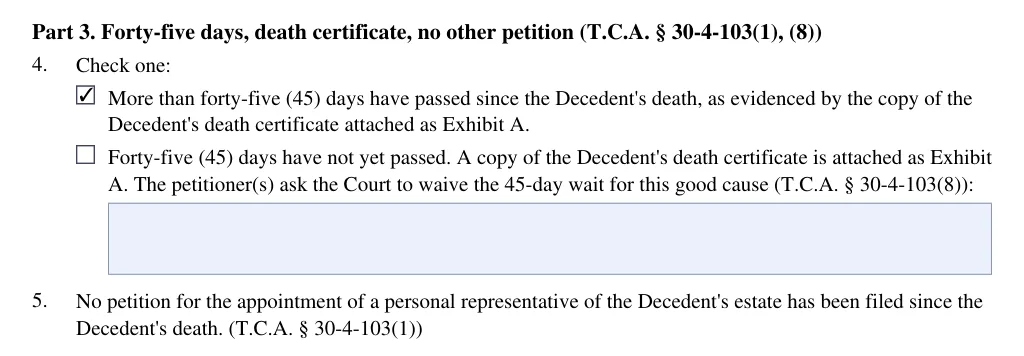
The screenshots under each step show the FormsPal Tennessee petition filled with sample entries in blue, so you can see where each answer goes. The names, addresses, dates and amounts are examples only.
Caption and letters requested (page 1). Write the name of the court that handles probate in the county where the decedent lived on the date of death, that county, the decedent's full name and each petitioner's name. Leave the docket number blank if the clerk assigns it. Then check limited letters of administration if one or more heirs file, or limited letters testamentary if the person named in the will files to have the will followed.Step 1: sample entries, not a real document.
Part 1, petitioners (page 1). Paragraph 1 takes each petitioner's name, relationship to the decedent and mailing address. In paragraph 2, check route A if the petitioners are competent adult heirs of the decedent. Check route B if you are the person named as personal representative in the will, the will divides the estate differently from intestate distribution and you want the will followed. Then check whether the will is offered for probate as a muniment of title (B(i)) or has been filed with the clerk for recording with the witnesses' affidavits (B(ii)). Route B has one petitioner only, so leave Petitioner 2 blank.Step 2: sample entries, not a real document.
Part 2, the decedent (page 2). Enter the decedent's full name, age at death if known, date and place of death, residence at the time of death and the county of legal residence on the date of death.Step 3: sample entries, not a real document.
Part 3, the 45 days (page 2). Check the first box if more than 45 days have passed since the death. Either way, attach a copy of the death certificate as Exhibit A. If 45 days have not passed, check the second box and explain the good cause for the court to waive the wait. Paragraph 5 states that no petition to appoint a personal representative has been filed since the death.Step 4: sample entries, not a real document.
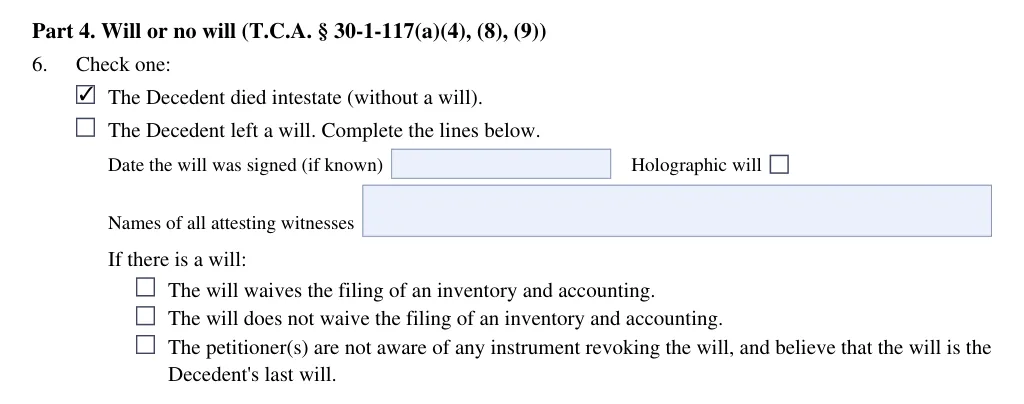
Part 4, will or no will (page 2). Check whether the decedent died without a will or left one. For a will, enter the date it was signed if known and the names of all attesting witnesses, tick the box for a handwritten (holographic) will, and check whether the will waives an inventory and accounting and that you know of no document revoking it.Step 5: sample entries, not a real document.
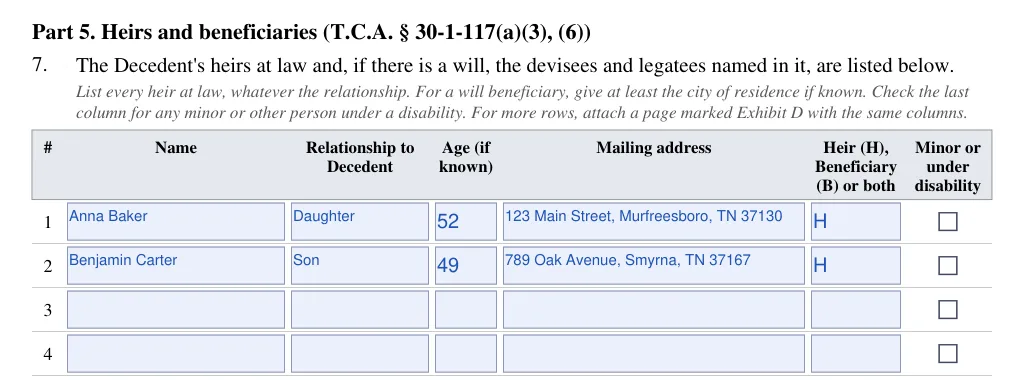
Part 5, heirs and beneficiaries (pages 2 and 3). List every heir at law, whatever the relationship, with relationship, age if known and mailing address. Mark each row H (heir), B (will beneficiary) or both, and check the last column for a minor or a person under a disability. For more than eight people, attach a page marked Exhibit D.Step 6: sample entries, not a real document.
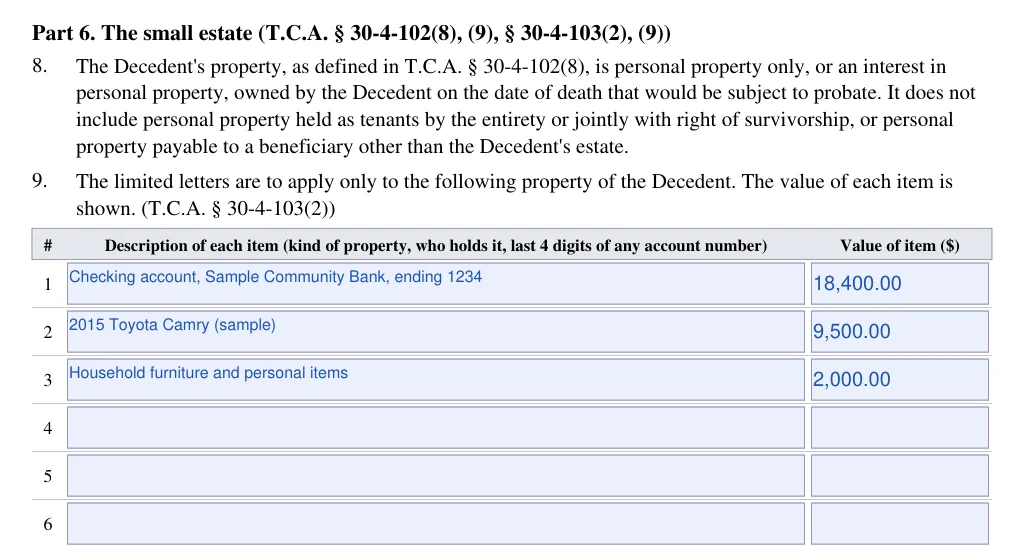
Part 6, the small estate (page 3). List each item of personal property the limited letters should cover, with who holds it and its value, then enter the total. The letters reach only the items you list. The total must not exceed $50,000, and real property is not included.Step 7: sample entries, not a real document.
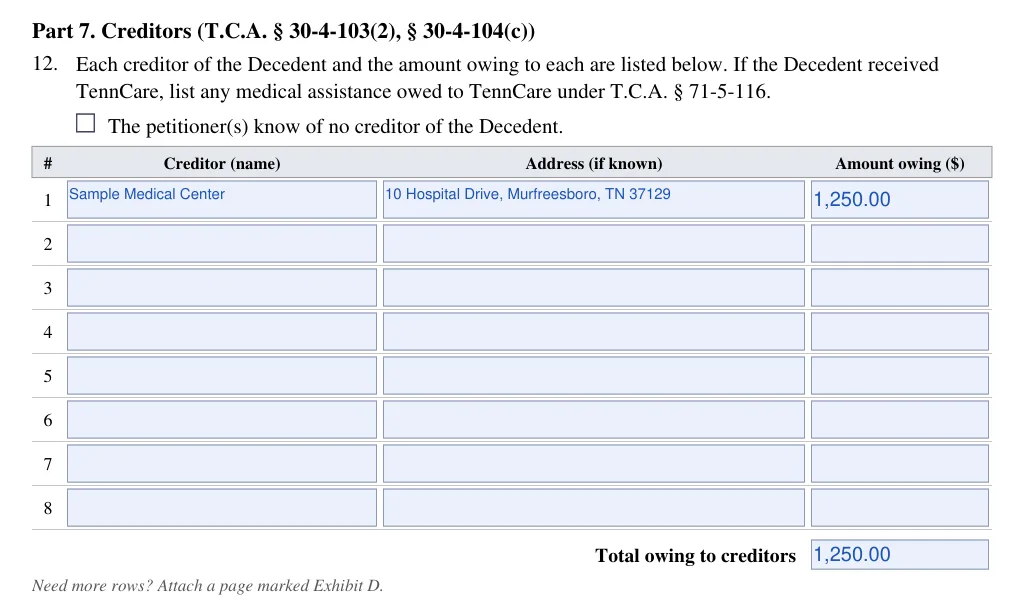
Part 7, creditors (page 4). List each creditor with its address if known and the amount owed, including any medical assistance owed to TennCare, then the total. If you know of no creditor, check the box above the table.Step 8: sample entries, not a real document.
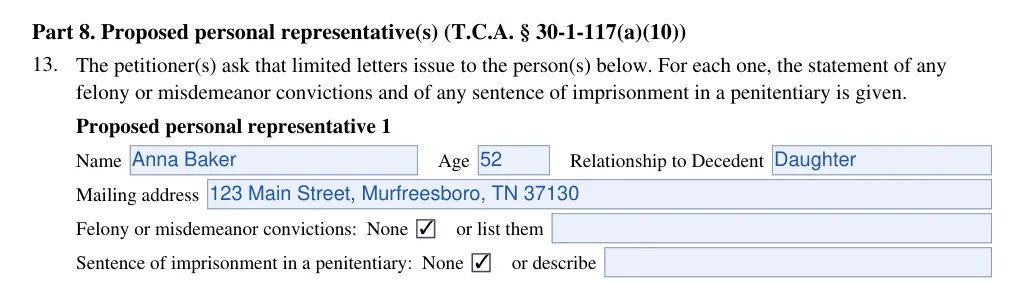
Part 8, proposed personal representative (page 4). Give the name, age, relationship and mailing address of the person who should receive the letters. Then check None or list any felony or misdemeanor convictions and any sentence of imprisonment in a penitentiary. A second proposed personal representative is for route A only.Step 9: sample entries, not a real document.
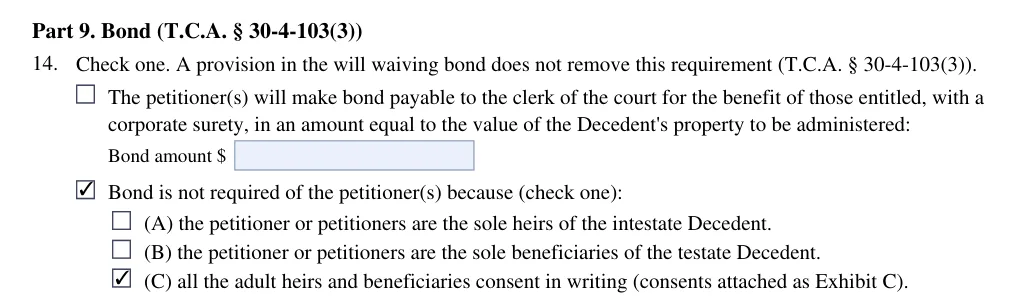
Part 9, bond (page 4). Check that the petitioners will post a bond equal to the value of the property, with a corporate surety, and enter the amount. Or check that no bond is required and why: the petitioners are the sole heirs, the sole will beneficiaries, or all adult heirs and beneficiaries consent in writing (attach the consents as Exhibit C). A will that waives bond does not remove this requirement.Step 10: sample entries, not a real document.
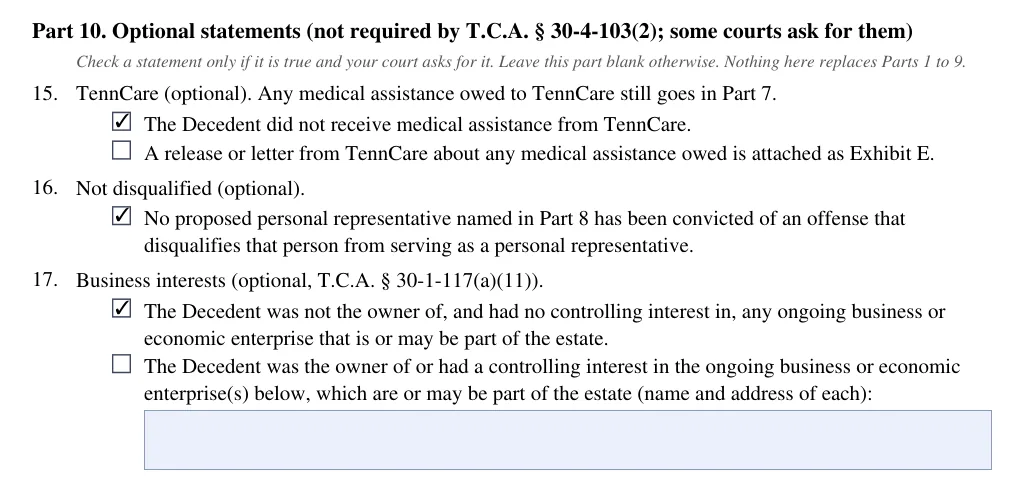
Part 10, optional statements (page 5). The Act does not require these. Check a statement only if it is true and your court asks for it: that the decedent did not receive TennCare medical assistance, or that a TennCare release is attached as Exhibit E, that no proposed personal representative is disqualified by a conviction, and whether the decedent owned or controlled an ongoing business.Step 11: sample entries, not a real document.
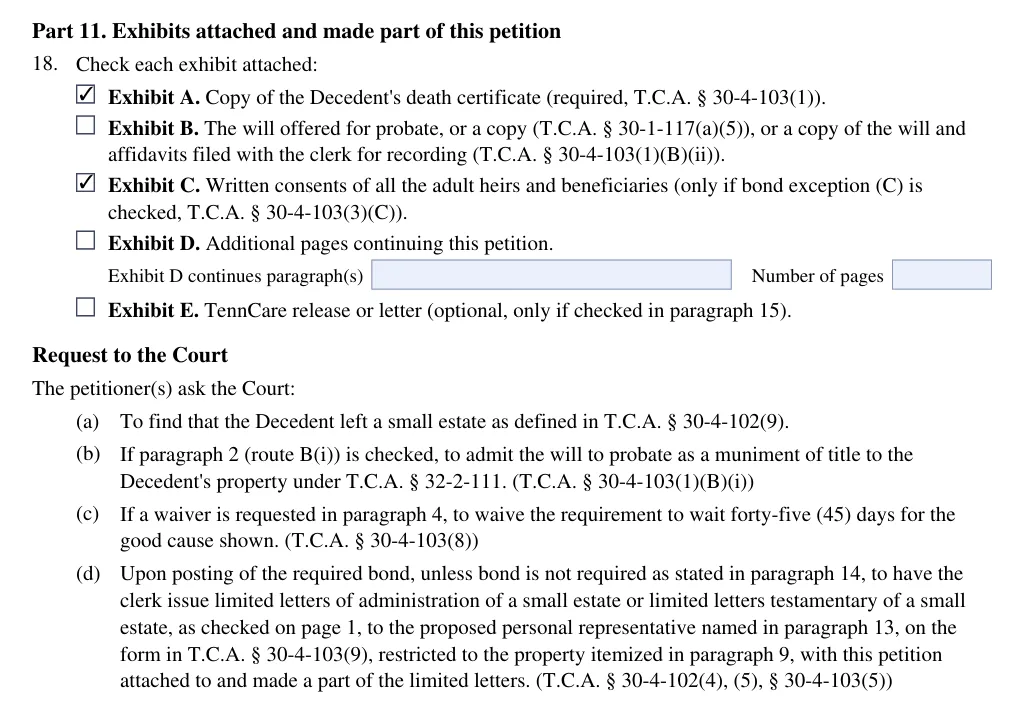
Part 11, exhibits, and the request to the court (page 5). Check each exhibit you attach: A, the death certificate (required), B, the will, C, written consents, D, extra pages (with the paragraphs they continue and the page count), and E, a TennCare release. The request to the court that follows has nothing to fill in.Step 12: sample entries, not a real document.
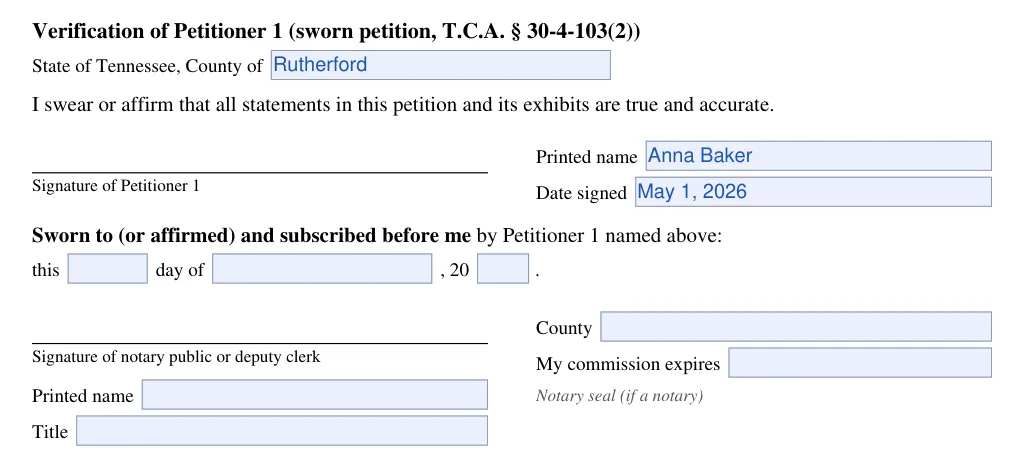
Verification of Petitioner 1 (page 6). Enter the county where you sign. Sign in front of a notary public or a deputy clerk, then add your printed name and the date. The officer completes the jurat below your signature.Step 13: sample entries, not a real document.
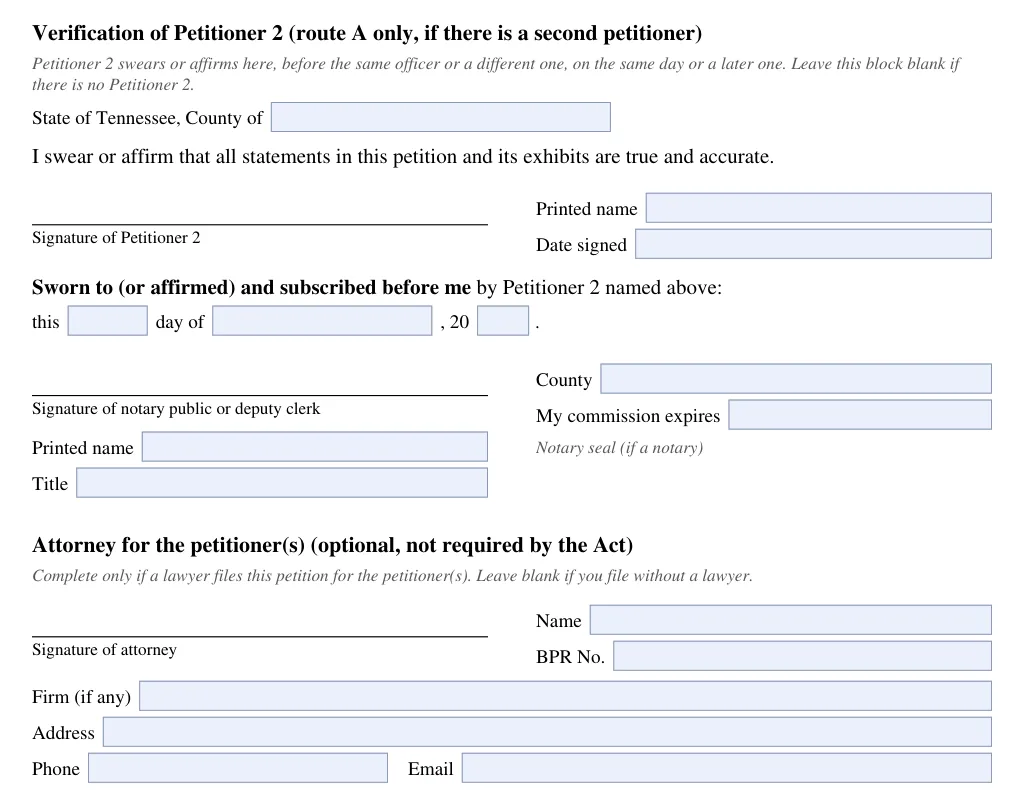
Petitioner 2 and attorney blocks (page 6). A second petitioner (route A only) swears in a separate block with its own jurat, so the two petitioners can sign on different days or before different officers. If a lawyer files the petition, the lawyer signs the attorney block and adds a Tennessee BPR number, address, phone and email. Remove the instructions page before you file.Step 14: sample entries, not a real document.
Gather the creditor names, account numbers and asset values before you start, so you can complete each part of the form in one sitting. Check each name and date against the death certificate before you sign. Keep a copy of the finished form with the death certificate and the other estate papers.
Frequently Asked Questions
Most questions about a Tennessee small estate come down to the $50,000 limit and the kind of property that counts toward it. These answers come from Sections 30-4-102 and 30-4-103 of the Tenn. Code Ann.[2]
Do I need probate if the estate is small?
Tennessee defines a small estate as the probate estate of a decedent whose probate property does not exceed $50,000.[2] A small estate may be administered after 45 days from the date of death, if no petition for a personal representative was filed in that time.[1]
What is the limit on small estate affidavits in Tennessee?
The limit is fifty thousand dollars ($50,000) of probate property, as defined in Section 30-4-102 of the Tenn. Code Ann.[2]
How much does an estate have to be worth to go to probate in TN?
The small estate definition stops at probate property of $50,000. Only personal property counts toward that value.[2]
What are the requirements for a small estate affidavit in Tennessee?
Tennessee's small estate rules set these requirements:
Only personal property owned by the decedent at death counts.
Property held as tenants by the entirety or jointly with right of survivorship does not count, and neither does property payable to a beneficiary other than the estate.
Mara has been practicing estate planning and trust law in California since 2003, taking pride in helping clients of all backgrounds and asset profiles form a complete and customized estate plan. Her specialties are: estate planning, wills and trusts, trust and probate administration.