
A Texas divorce settlement agreement is a written document in which spouses record how they will divide their property, handle their debts, and provide support. It does not replace the divorce case, because the court still reviews the terms.[1.4] Fill out the free template below online, or download the PDF. You can also browse our free marital agreement form page.
Last Updated: October 2026. This guide is reviewed and updated regularly to reflect current Texas law. If you notice an error or outdated information, please contact us.
Build Your Document
Answer a few simple questions to make your document in minutes
Save and Print
Save progress and finish on any device, download and print anytime
Sign and Use
Your valid, lawyer-approved document is ready
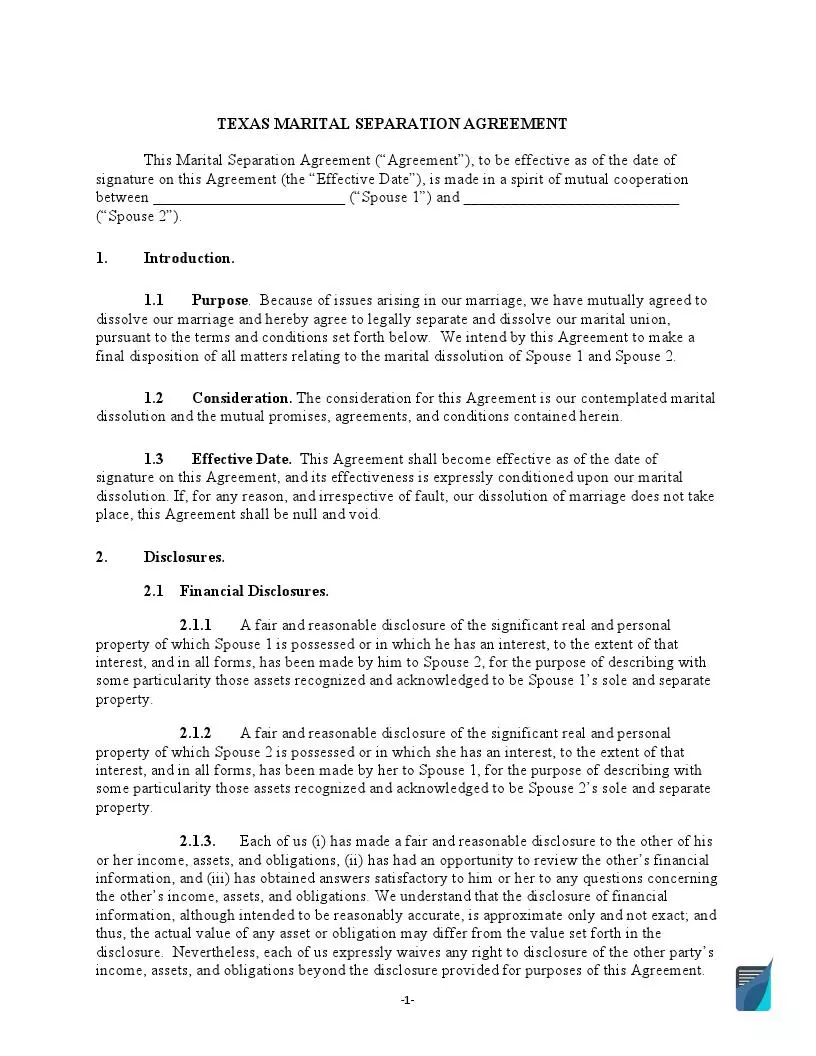
Spouses decide what goes into their own Texas divorce settlement agreement. The FormsPal template, titled Texas Marital Separation Agreement, runs eight pages. It has 18 numbered sections, a signature page for both spouses, and a notary acknowledgment page.
Every section of this Texas divorce settlement agreement template is a blank to fill in, so you can keep the terms you agree on and leave out the rest. Many couples have a lawyer read the finished agreement before they sign, especially when children, a home, or retirement accounts are involved.
Signing a Texas divorce settlement agreement is not the last step. The court still reviews it, and it may ask the spouses for a revised one if it finds the terms are not just and right.[1.4]
Texas law lets spouses make a written agreement about the division of their property, their liabilities, and maintenance (financial support) for either spouse. The court decides whether to approve the agreement. If the court finds the terms just and right, they are binding on the court.[1.4] The sections below explain how the agreement, the final decree, and the court's own division of property fit together.
The key rule is the standard the court applies to the terms. Section 7.006 of the Tex. Fam. Code states it this way:
If the court finds that the terms of the written agreement in a divorce or an annulment are just and right, those terms are binding on the court.
The same section covers what happens next:
When spouses do not settle the division themselves, the court divides their property. In a decree of divorce, the court orders a division of the estate of the parties in a manner it deems just and right. It must have due regard for the rights of each party and any children of the marriage.[1.1] The same chapter adds four points that matter when you draft an agreement:
A Texas divorce settlement agreement often records parenting time, child support, and spousal support. The FormsPal template has a section for each. Because these terms affect the children, many parents have an attorney review them before signing. If parenting time is part of your terms, FormsPal also has a parenting plan form, and it lists child support forms for Texas.
Popular Local Marital Settlement Agreement Forms
A marital settlement agreement, often known as a property settlement agreement, is a powerful instrument that can help you work out the divorce proceeding and eliminate major hassle. The following are the states the people of which search for this form the most.
Many people search for a Texas separation agreement when they plan to live apart. The FormsPal template is built for spouses who are ending the marriage. Under its own terms it takes effect when both spouses sign, but only if the marriage actually ends (section 1.3 of the template). FormsPal also has a marriage separation agreement template for comparison.
Spouses who agree on every term can ask the court to approve the signed agreement as part of their divorce.[1.4]

A Texas divorce is a court case, and spouses can reach a settlement agreement while it is pending. This checklist shows the usual order of events. It describes common practice, not deadlines, so ask the court or an attorney about the exact steps and timing for your case.[1.4]
After a divorce, some people also review their other documents, such as a Texas last will or a Texas power of attorney.
These answers come from the Texas Family Code sections cited at the end of this page. They cover what a settlement agreement is, how the court treats it, and how property and retirement accounts are divided in a Texas divorce.
A divorce settlement agreement is a written agreement in which spouses record how they will divide their property and liabilities and whether either spouse will receive maintenance (financial support). Texas law allows spouses to make this kind of agreement to promote amicable settlement of disputes in a suit for divorce.[1.4]
In Texas, a settlement agreement is the written agreement spouses may enter into during a suit for divorce or annulment. It can cover the division of property, the liabilities of the spouses, and maintenance of either spouse. The court then reviews the terms, and terms that are just and right are binding on the court.[1.4]
In a decree of divorce, the court orders a division of the estate of the parties in a manner it deems just and right. It must have due regard for the rights of each party and any children of the marriage.[1.1] Spouses who agree can put their own division in a written settlement agreement, which the court reviews.[1.4]
The Texas Family Code says the court must determine the rights of both spouses in a pension, retirement plan, individual retirement account, and other employer or financial plans.[1.2] The share each spouse receives therefore comes from the court's decision, made under the rule that the division must be just and right.[1.1] Spouses can also settle it in a written agreement that the court approves.[1.4]
Property in a Texas divorce is divided in one of two ways.
The court may also consider whether a specific asset will be taxed.[1.5]

Other Marital Settlement Agreement Forms by State
General information, not legal or tax advice.
Every legal statement on this page comes from the Texas Family Code chapter listed below. The bracketed numbers in the text point to the section of that chapter that supports the statement.
