
A Nebraska prenuptial agreement is a written contract signed before the wedding that sets out how property, debt, and spousal support will be handled if the marriage ends. Nebraska law calls it a premarital agreement and governs it under the Uniform Premarital Agreement Act.[1] It takes effect on the day you marry, not the day you sign it.[5]
Is Nebraska a 50 50 divorce state? No. Without a prenup, a divorce court divides marital property by equitable distribution, which means a fair split rather than an automatic half each. A prenup lets the two of you set those terms in advance. Our general prenup guide covers the rules shared by every state.
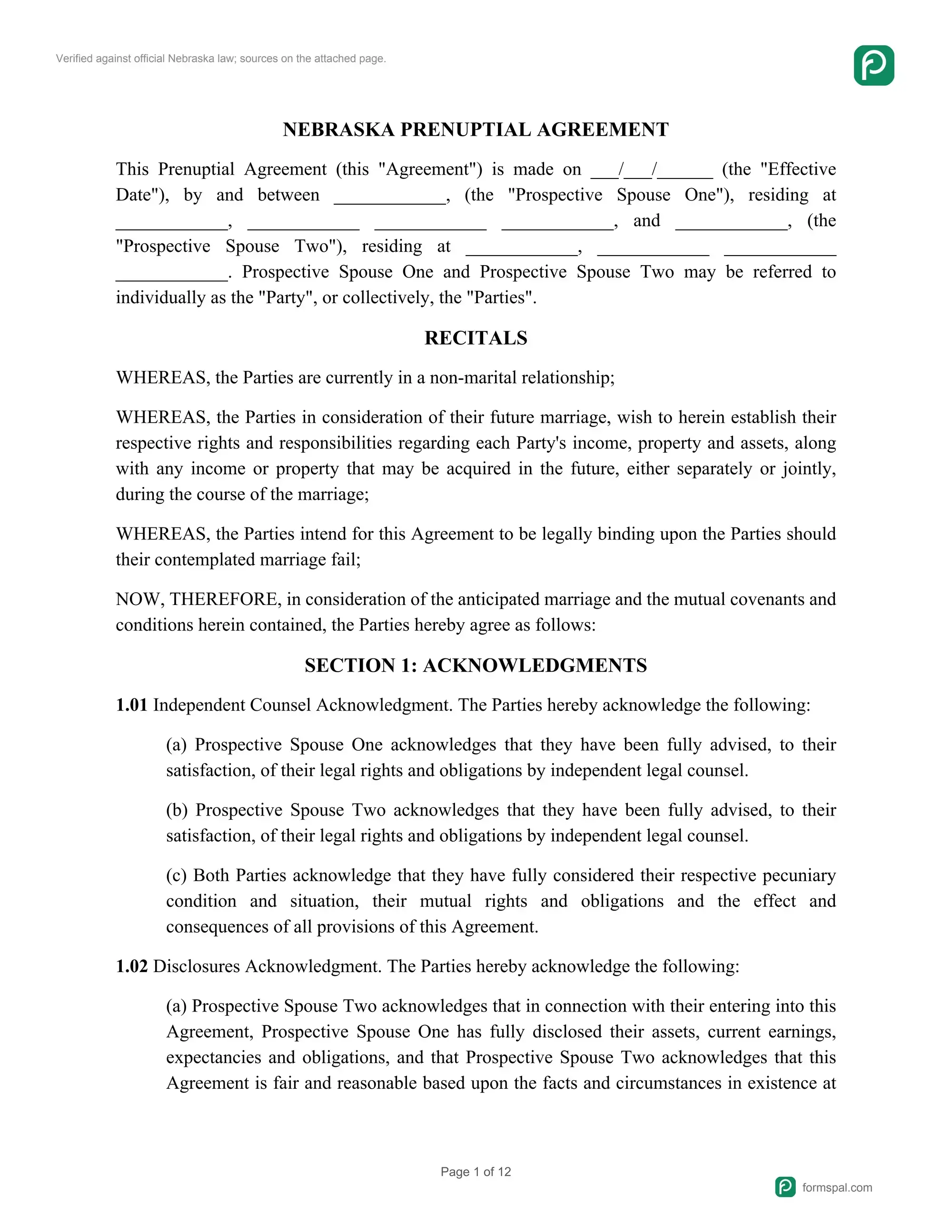
Build Your Document
Answer a few simple questions to make your document in minutes
Save and Print
Save progress and finish on any device, download and print anytime
Sign and Use
Your valid, lawyer-approved document is ready
You may see this document called a premarital agreement, an antenuptial agreement, or simply a prenup. Nebraska statutes use premarital agreement, and that is the term used throughout this page.
Section 42-1002(1) of the Neb. Rev. Stat. defines a premarital agreement as an agreement between prospective spouses made in contemplation of marriage and to be effective upon marriage. So it is a contract about your finances, settled before the wedding, that stays dormant until the marriage begins.[2.1]
The same statute defines property just as broadly. Property means an interest, present or future, legal or equitable, vested or contingent, in real or personal property, including income and earnings.[2.2] That wide definition is why a business, an inheritance, a retirement account, and assets neither spouse has bought yet can all be handled in a prenup.
A Nebraska premarital agreement has to clear a short list. The agreement must be in writing, it must be signed by both parties, and no notary or witness signature is required for either step.[3] The Uniform Premarital Agreement Act supplies every other rule, and it applies to any premarital agreement signed on or after July 16, 1994.[9]
A premarital agreement must be in writing and signed by both parties.
A valid Nebraska premarital agreement needs all of the following.
Financial disclosure is not a formality you can skip. A court can refuse to enforce it if a party was not given that disclosure and the terms were unconscionable when signed.[6.2] Exchange written lists of your assets, debts, income, and expected inheritances, then keep copies.
Nebraska sets no statutory signing deadline. Signing on the eve of the wedding still works against you, because the timing itself becomes evidence that the agreement was not signed freely.
On the day you marry, not the day you sign. Until the wedding the document has no legal force at all, so a couple who sign and then call the wedding off are left with a contract that never started. A premarital agreement becomes effective upon marriage.[5] If the marriage is later declared void, it is enforceable only to the extent necessary to avoid an inequitable result.[7]
The clock on enforcement runs differently inside a marriage. Any statute of limitations on a claim under a premarital agreement is tolled during the marriage of the parties.[8] Equitable defenses limiting the time for enforcement, including laches and estoppel, stay available to either spouse.[8]
Almost anything financial, and Section 42-1004 of the Neb. Rev. Stat. sets out eight categories. Seven name a specific subject, from property rights to which state law governs the reading of the agreement. The eighth is a catch-all, bounded only by public policy and the criminal code.[4.8]
One limit is absolute. A premarital agreement may not adversely affect a child's right to support.[4.9] Custody and parenting time are decided by a court on the child's best interests at the time, not by your contract.
Section 42-1006 of the Neb. Rev. Stat. names two grounds on which a Nebraska court can refuse to enforce a premarital agreement. Neither ground is a change of heart, and neither is a bad bargain standing alone. The first is about how the document was signed. The second is about the terms together with what each party knew about the other one's finances.[6.1]
In the statute's own terms, a court will not enforce it where either of these is proved.
Who decides whether the terms were unconscionable? An issue of unconscionability of a premarital agreement shall be decided by the court as a matter of law.[6.6]
A spousal support waiver carries one more limit. Suppose eliminating support would leave one spouse eligible for public assistance at separation or marital dissolution. A court may then, notwithstanding the terms of the agreement, require the other party to provide support to the extent necessary to avoid that eligibility.[6.5]
Yes. Nebraska adopted the Uniform Premarital Agreement Act as Sections 42-1001 to 42-1011 of the Neb. Rev. Stat., and the Act applies to every premarital agreement signed on or after July 16, 1994.[1] Section 42-1006 sets out the narrow grounds on which a court will refuse to enforce one, and each of them turns on voluntariness or financial disclosure.[6.1]
No. Nebraska divorce courts divide marital property by equitable distribution. A court splits the assets fairly after weighing factors such as how long the marriage lasted and what each spouse contributed. Fairly does not mean equally, and there is no automatic half-each rule. A prenup replaces that judicial discretion with terms the two spouses chose for themselves.
Five steps: exchange financial disclosures, agree on terms, put the agreement in writing, sign it before the wedding, and store it with your estate papers. The agreement then takes effect the moment you marry, so there is nothing further to do on the day itself.[5]
Already married? A premarital agreement only works between prospective spouses, so a postnuptial agreement is the document you need instead.[2.1]
Last Updated: September 2026 This guide is reviewed and updated regularly to reflect current Nebraska law. If you notice an error or outdated information, please contact us.

Unless noted otherwise, the sources below are from the Neb. Rev. Stat..