
A Nebraska last will and testament is a written legal document in which an individual, the testator, directs how their property is distributed to chosen beneficiaries after death, executed the way Nebraska law requires.
Creating one helps prevent family disputes over an estate and is a core part of estate planning for Nebraska residents.
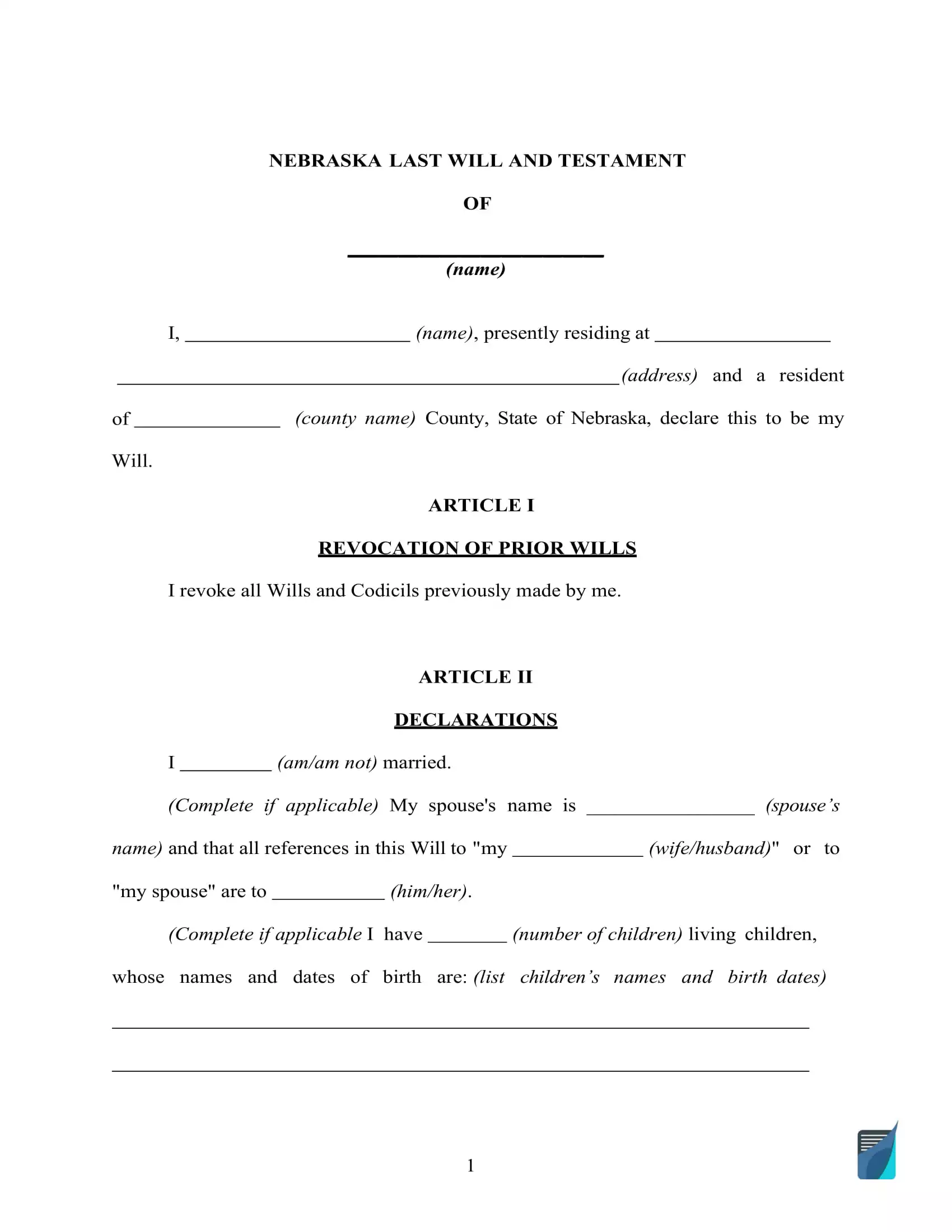
Below you will find a fillable Nebraska last will template in PDF and DOCX formats. This page also covers your Nebraska will’s requirements, relevant statutes, and general writing tips for putting one together.
Build Your Document
Answer a few simple questions to make your document in minutes
Save and Print
Save progress and finish on any device, download and print anytime
Sign and Use
Your valid, lawyer-approved document is ready
A Nebraska last will and testament is also called a "will," or known as a "last will." Whichever term you use, the same statutory signing and witnessing rules in this guide apply.
Last Updated: September 2026. This guide is reviewed and updated regularly to reflect current Nebraska law. If you notice an error or outdated information, please contact us.
Nebraska law sets specific rules for who may make a will, how it must be signed, and when it can be made self-proving. The table below summarizes the state’s core requirements from that primary source. Nebraska law also provides two ready-made statutory affidavit forms that can be signed with the will or after it. Those who sign do not have to testify in court later.[2.1]
| Requirements | State laws | |
| Statutes | Chapter 30 – Decedents’ Estates; Protection of Persons and Property | |
| Definitions | 30-2209. General definitions. | |
| Signing requirement | Two witnesses | 30-2327. Execution |
| Age of testator | 18 or older | 30-2326. Who may make a will |
| Witness age | 18 or older | 30-2330. Who may witness; interested witness; intestate share |
| Self-proving option | Allowed | 30-2329. Self-proved will |
| Handwritten option | Recognized if meeting certain conditions | 30-2327. Execution |
| Oral option | Not recognized | |
| Holographic option | Recognized if meeting certain conditions | 30-2328. Holographic will |
| Depositing a will | Possible with a Nebraska County Court ($2 fee) | 30-2355. Deposit of will with the court in testator’s lifetime |
Follow these steps to prepare your Nebraska last will, whether you use the builder above or fill in the downloadable template yourself. Work through each step in order, since later sections often build on the details you enter earlier, such as the executor and beneficiaries who receive your property at your death.

Note: an executor must be at least 19 years old in Nebraska. (30-2412)
It might be wise to appoint an alternative person to act as an executor in the event the first one is unwilling or incapable of carrying out your will.


In case you’ve got an asset distribution plan that’s different from even, it’s possible to describe it within this section. Keep in mind that joint and living trust property can’t go in your last will.

Pick people who will likely be available if the will is ever contested, and review the content of every section carefully before finalizing the document.


Yes. Nebraska law requires a last will to be in writing, signed by the testator or by someone else in the testator’s presence and at the testator’s direction. It must then be signed by at least two witnesses who watched the signing or heard the testator acknowledge it.[1]
No, according to Nebraska law, a last will can be valid without notarization. But you can make your will self-proving by attaching an affidavit to it, which requires a notary acknowledgment.[2.2]
To make it self-proving, Nebraska law requires:
Making your last will self-proving quickens probate and adds a layer of security if the will’s credibility is ever challenged.
To create a holographic will, you must write the whole document by hand. These documents are typically used in emergencies until a typewritten document can be prepared, whether by a lawyer or with a fillable template.
These documents can contain ambiguous directions and miss key terms, which makes them harder to enforce and can delay probate. It is usually best to use a template or document builder to write your own will.
The testator must meet Nebraska’s testamentary capacity rules to make or change a last will. This means being 18 years old or older and of sound mind when the will is signed.
Sound mind means the testator understands what a will does, recognizes their own property, and knows who their natural heirs are, without a mental illness such as dementia or a comparable condition blocking that understanding.
No, you cannot simply disinherit your spouse in Nebraska. After your death, they can renounce what is written in your will and opt for an elective share of your augmented estate, along with some other allowances (see 30-2322 and 30-2324). The only way to influence this is by entering into a prenuptial or postnuptial agreement where your spouse would waiver their right to this elective share.
No, only you can change or revoke your will. There can be just one situation when another person is permitted to intervene. It is when you are physically unable to sign your own will, a notary public is permitted to do it in your stead yet only with you and two witnesses present and by your direction. The witnesses must also sign along with the notary (see 64-105.02).
| Related documents | Cases when you may want to create one |
| Codicil | You wish to make a single or several slight alterations to your will. |
| Self-proving affidavit | You want to save time and legal fees for your will’s signers. |
| Living will | You want to specify what heath care treatment you prefer if you cannot express that by yourself. |
| Living trust | You would like to deal with your end-of-life matters without probate. |
This page is general information about a Nebraska last will, not legal advice. For advice on your situation, talk to a Nebraska attorney.
