
A Montana will is a document containing the final wishes of its creator (the testator) and determining exactly how and by whom their assets will be used in the event of their death. The document must be signed by two adult witnesses to be valid in this state with an option to be notarized and made self-proving for faster probate.
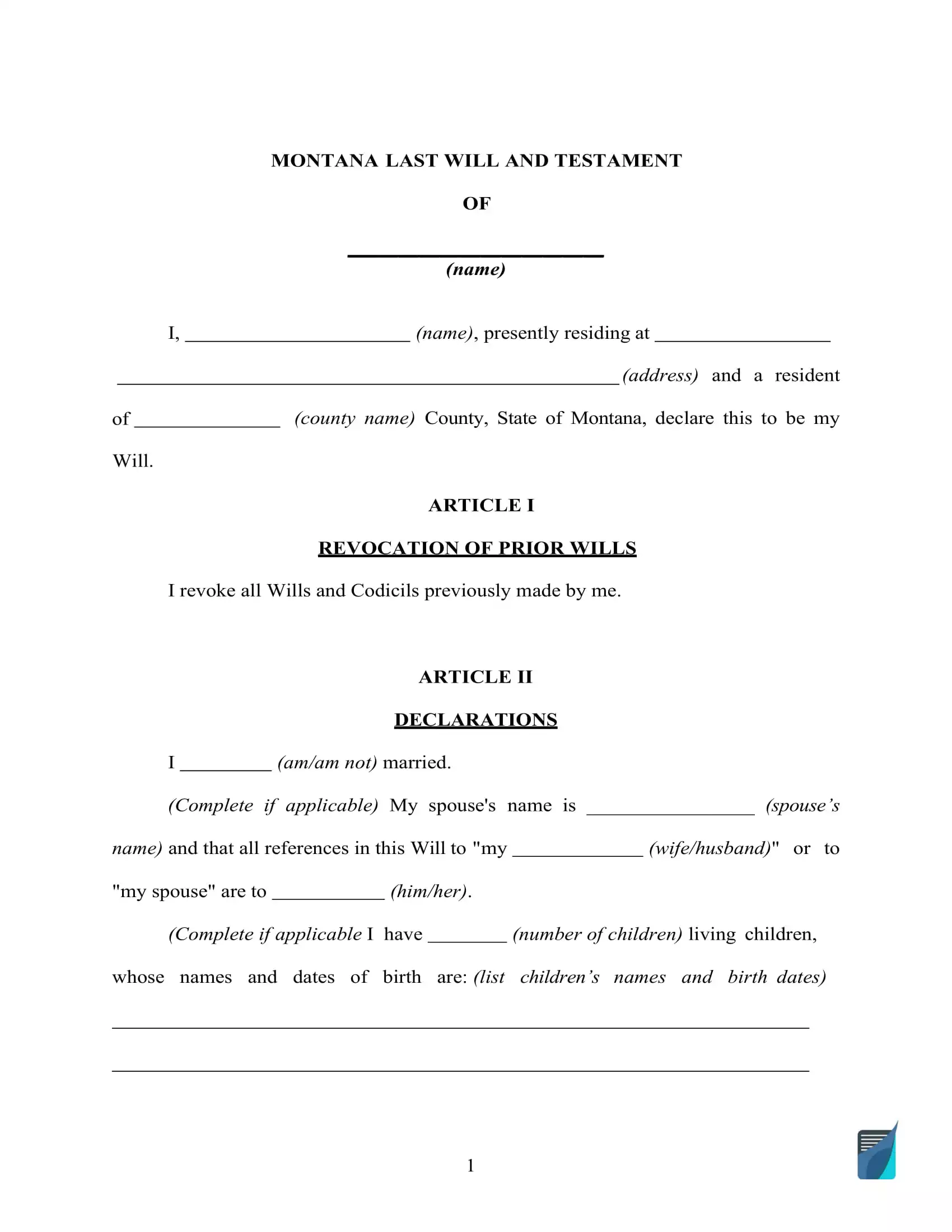
If you’re searching for a fillable Montana will template, you can find one below in PDF and DOC, as well as some recommendations regarding last will creation and requirements.
Last Updated: September 2026. This guide is reviewed and updated regularly to reflect current Montana law. If you notice an error or outdated information, please contact us.
Montana law sets specific rules for a valid last will. The document must be in writing and signed by the testator, or signed in the testator’s name by someone else in the testator’s conscious presence and at the testator’s direction.[2] At least two witnesses must sign after watching the signing or hearing the testator acknowledge it.[2] A will that meets these formalities can also be made self-proving with a sworn affidavit, which speeds up probate by removing the need for witness testimony in court.[1]
| Requirements | State laws | |
| Statutes | Title 72 – Estates, Trusts, and Fiduciary Relationships; Chapter 2 – Intestacy, Wills, and Donative Transfers | |
| Definitions | 72-1-103. General definitions | |
| Signing requirement | Two witnesses | 72-2-522. Execution — witnessed wills — holographic wills |
| Age of testator | 18 or older | 72-2-521. Who may make a will |
| Age of witnesses | 18 or older | 72-2-525. Who may witness |
| Self-proving wills | Allowed | 72-2-524. Self-proved will |
| Handwritten wills | Recognized if meeting certain conditions | 72-2-522. Execution — witnessed wills — holographic wills |
| Oral wills | Not recognized | |
| Holographic wills | Recognized if meeting certain conditions | |
| Depositing a will | Possible with the Montana Clerk of District Court’s Office (No fee) | 72-2-535. Deposit of will with court in testator’s lifetime |
Montana also recognizes a holographic will. If the signature and the material portions of the document are in your own handwriting, the will can be valid even without witnesses.[2]
1. Think about your possible choices. Before starting, you may want to determine if you’re going to use the services of an attorney to build your estate plan (usually if you have a lot of assets) or prepare the whole thing yourself. If you wish to create a last will on your own, you can fill out a free will template or get it done via our step-by-step document creator. The latter provides more flexibility and options, which usually results in a more personalized will.
Please, read relevant Montana laws and requirements carefully before writing a last will.
2. Indicate your details. Establish the testator and their particulars: full name and address (city, county, and state). Review the information you entered and the rest of the passage.

3. Designate the executor. In Montana, the executor is also called the personal representative. In this particular part, you must establish who is going to execute your will by filling out their full name, as well as their city, county, and state of residence. Most states have specific policies concerning the out-of-state agents and executors, which typically would mean extra headache and paperwork. But, in Montana, there are no such limitations. Yet, it is usually recommended to designate a person who resides in the same state as you.
Your personal representative might be chosen from friends, family members, or attorneys. The best option for your case is determined by the persons involved and the circumstances. Before selecting an executor, it’s a good idea to think about your estate planning goals and the implications of each option.
It may well happen that your main personal representative will not be able to execute your will because of a sickness, death, disinclination, or some other reasons. In this case, the court can choose its own agent to handle the duties. In order to prevent that, it is possible to select an alternative executor.

4. Indicate the guardian (optional). It’s possible to appoint a trusted person as a guardian in case you’ve got underage or dependent children that need to be looked after. If neither parent is available and there are no instructions regarding who should take care of your kids, the guardian will be selected by the court.

5. Establish your beneficiaries. Now you indicate those who are going to receive your property. Fill in their full names, places of residence, and your connection to them (e.g., spouse, child, other family member, friend, etc). If you want to, you can make donations to charitable organizations via your will by making them your beneficiaries.
6. Designate property. Write down your property and explain how you want it to be distributed among your inheritors. Such property can include cash, shares, real estate, business ownership, money for arrearage, as well as any material items of monetary value that you own.
What your will cannot control. Property you own in joint tenancy with someone else, payable-on-death or transfer-on-death accounts, and retirement or life insurance policies with a named beneficiary all pass directly to that co-owner or beneficiary. Assets already held in a trust also bypass your will. Listing any of these in your will does not change who receives them.

7. Continue with the witnesses putting the signatures at the end of the document. Montana law requires at least two witnesses to sign a last will for it to be valid. Each witness must either watch you sign the will or hear you acknowledge your signature before they sign it themselves.[2] Only somebody who isn’t your named beneficiary (or their spouse) and is of 18 years or more could be selected as a witness.
A small tip: consider selecting witnesses who are younger than you to make sure that they can be present in case the will is contested in the court or if any other problem takes place. After a careful review of every section in your last will and testament, all signatories (you and your two witnesses) must write their names and full addresses and sign the document.


Other Montana Forms
A self-proving affidavit lets your will skip live witness testimony in Montana probate court, since the witnesses’ sworn statements already establish that the will was properly signed.[1] You can add this affidavit at the same time you sign your will, or at any later date.[1]
The affidavit must be sworn before an officer authorized to administer oaths, such as a notary public, who certifies it under an official seal.[1] In it, you and your witnesses declare, among other things, that you sign the will as your "free and voluntary act."[1] Montana law provides a statutory form for an affidavit signed at the same time as the will:
"I, .........., the testator, sign my name to this instrument this ...... day of ......, 20..., and being first duly sworn, do hereby declare to the undersigned authority that i sign and execute this instrument as my will, that i sign it willingly (or willingly direct another to sign for me), that i execute it as my free and voluntary act for the purposes expressed in it, and that i am 18 years of age or older, of sound mind, and under no constraint or undue influence."
If you and your witnesses did not sign the affidavit when you signed the will, Montana law also provides a separate statutory form to make the will self-proved later, using a sworn statement signed after the fact instead.[3] These self-proving provisions are optional, but most estate planners recommend them.
This section answers the questions Montana residents ask most often about writing and validating a last will. The answers are based on Title 72, Chapter 2 of the Montana Code Annotated, covering witness rules, testamentary capacity, and how to make a will self-proving.
Testamentary capacity is a term used to describe the testator’s (the person writing the will) legal and mental ability to write and alter their last will and testament.
In Montana, to write a will, you must be of sound mind and at least 18 years old. “Sound mind” means you understand what a will is, how it works, what property you have, and who will receive it.
If you decide to add a self-proving affidavit, it’ll be rather advantageous as this document acts as an alternative for in-court testimony of witnesses at the time of probate, and it will remove the necessity to summon witnesses to court.
No, you cannot disinherit your spouse completely as they have the right to an elective share.
Yes, you can. In Montana, you are allowed to revoke or adjust your last will at any moment. You can do so by attaching a codicil that contains the changes or by creating a completely new will.
| Related documents | When to create it |
| Codicil | You wish to make a single or a few small changes to your last will. |
| Self-proving affidavit | You want to steer clear of potential problems in the probate court. |
| Living will | You want to express your wishes concerning the end-of-life treatment and life-prolonging procedures. |
| Living trust | You need additional privacy and safety when the time to distribute your assets comes. |
This page is general information about Montana last wills, not legal advice. For advice on your situation, talk to a Montana attorney.
