
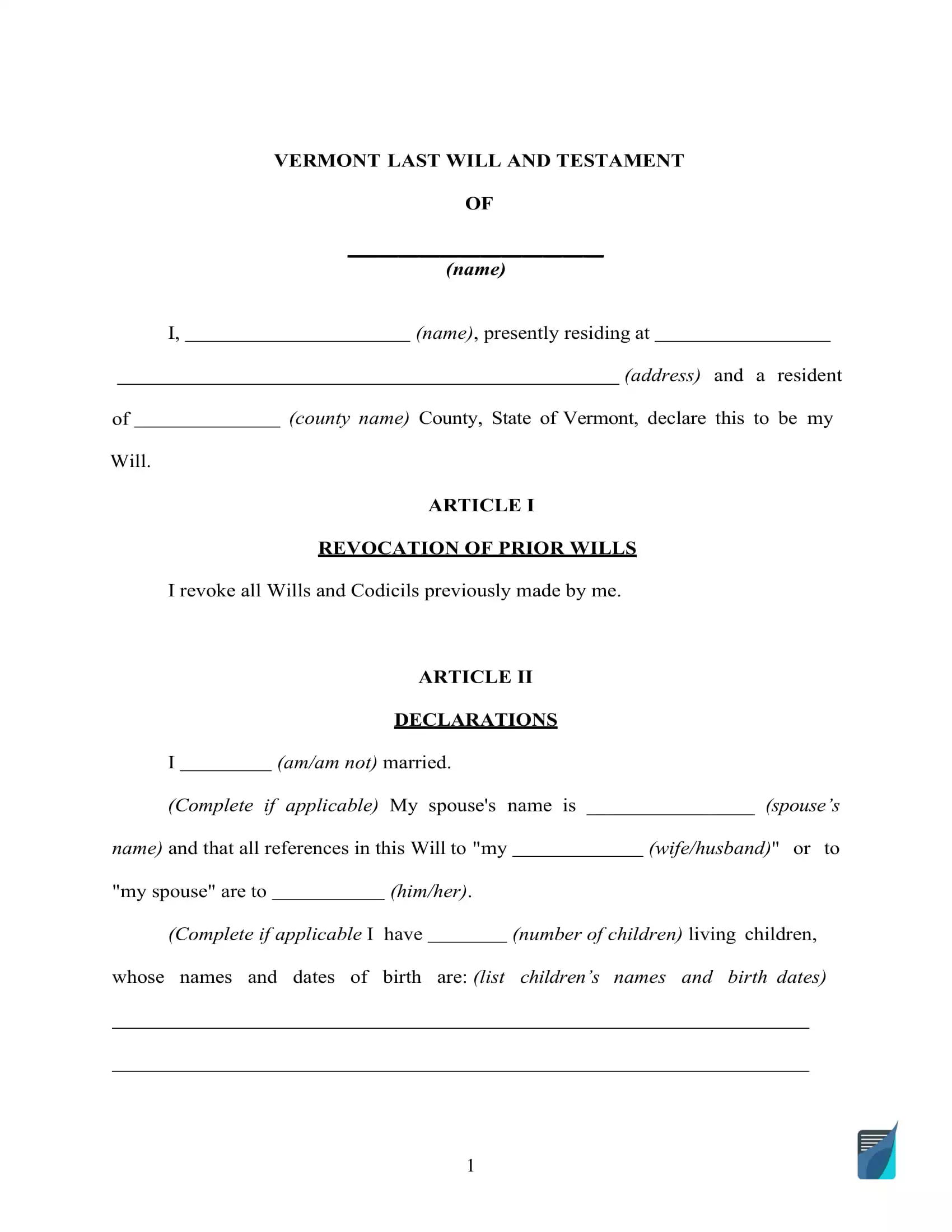
A Vermont last will and testament template is a document that contains the final will of its maker (testator) and outlines how and by whom his or her property will be distributed after the testator’s death.
Vermont law requires specific signing and witness steps for the will to be valid, covered below, along with a free downloadable will form in PDF or Word format.
Build Your Document
Answer a few simple questions to make your document in minutes
Save and Print
Save progress and finish on any device, download and print anytime
Sign and Use
Your valid, lawyer-approved document is ready
Last Updated: September 2026. This guide is reviewed and updated regularly to reflect current Vermont law. If you notice an error or outdated information, please contact us.
| Requirements | State laws | |
| Statutes | Title 14, Decedents Estates and Fiduciary Relations, Chapter 1, Wills | |
| Signing requirement | Two witnesses | § 5, Execution of will, requisites |
| Age of testator | 18 or older or an emancipated minor | Title 14, Chapter 1 |
| Age of witnesses | 18 or older | § 5, Execution of will, requisites |
| Self-proving wills | Allowed | 14 V.S.A. § 5[1] |
| Handwritten wills | Might be recognized if witnessed according to the state law | § 5, Execution of will, requisites |
| Oral wills | Might be recognized in specific cases | Not addressed by 14 V.S.A. § 5 |
| Holographic wills | Might be recognized in specific cases | |
| Depositing a will | Possible with the Probate Division of the Vermont Superior Court | Title 14 |
Beyond the table above, the Vermont statute is the definitive source for exactly how a will must be signed to count. The content of this Vermont last will and testament template must be in writing, and it must be attested and subscribed by two or more credible, competent witnesses in the presence of the testator and of each other.[1] A witness who does not meet that standard, or who signs outside the testator's presence, can put the whole document at risk during probate.
Keep your signed will somewhere your executor can find it, and tell them (or your attorney) where it is. A will that cannot be located is treated very differently than one that is simply out of date.
Filling out a Vermont last will and testament template takes seven steps, from choosing how you want to create the document to signing it in front of two witnesses. Each step below covers one part of the form, with a screenshot from the builder showing what it looks like in practice.


Other Vermont Forms
A will is valid in Vermont when the witnesses watch the testator sign it and then sign it themselves, attesting to what they saw, all in each other's presence.[1] Skipping any part of that sequence, such as a witness signing later or outside the room, is the most common reason a Vermont will fails during probate.
No, a self-proving affidavit is optional in Vermont, not required.[1] Vermont’s own statute refers to this option as the self-proving will provisions of section 108 of this title.[1] Including one may be quite useful given that it removes the demand for witnesses’ testimony in the course of probate, which facilitates the procedure considerably.
Vermont is not a community property state. Often called marital property, it is a form of asset ownership provided by the law that says that 50 % of all assets (including arrears) of one spouse belongs to another and stays such upon divorce. Vermont law determines that you can cut your spouse out of your last will entirely, but some minimum amount of your estate can still be owned by them.
For other members of your family, it’s possible to legally disinherit anybody else. It refers to your adult children and other relatives. Simply include disinheritance paragraphs in your last will.
Yes, it is possible.
In Vermont, if you have not engaged in an agreement stating the opposite, it is possible to revoke or alter the content of your last will at any time.
It can be a good idea to modify your will when an important event comes about in your life. These include but are not limited to:
In Vermont, the law implies that the court will recognize a last will and testament in case it’s damaged or lost. However, the probate court is not likely to accept anything except for the initial version of the last will to probate.
In line with Vermont law, the will’s absence can be regarded as its revocation. That implies that the trustee should prove the last will’s credibility, which in turn might prove to be rather difficult.
For holographic last wills, the process may be much more problematic because sworn witnesses and testimony are demanded. The reason behind not providing the last will and testament and its elements must be demonstrated too.
Only at your direction and in your presence can someone sign your will (See Vermont Estate Code). The testator can express their wishes in words, by way of giving a positive answer to an inquiry or using body language.
A notary is allowed to sign the testator’s name if the testator isn’t able to do it due to a physical impairment. The notary has to be directed to do this in the presence of a witness. This witness is chosen the same way someone could choose an executor – they must not have any legal or equitable interest in any property and assets that are the issue matter of or influenced by the will.
| Related documents | Times when you might want to create one |
| Codicil | There are some small adjustments you wish to make to your last will. |
| Self-proving affidavit | You wish to facilitate the probate in the future. |
| Living will | You want to state your wishes concerning the end-of-life health care and life-prolonging procedures. |
| Living trust | You want to look at an alternative to a last will. |
This page is general information about Vermont last wills, not legal advice. For advice on your situation, talk to a Vermont attorney.
