
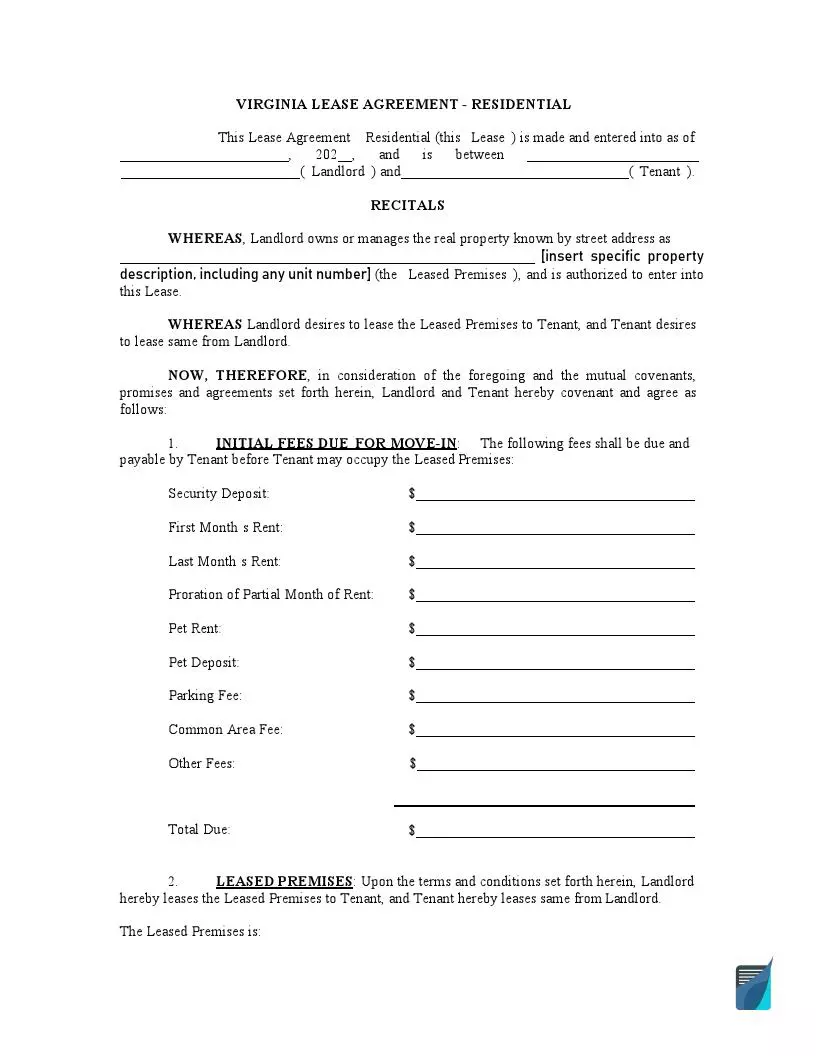
A Virginia lease agreement is a written contract between a landlord and a tenant for renting residential property. It states the rent amount, the lease length, and each party's duties for the property's condition and use. The Virginia Residential Landlord and Tenant Act sets rules for security deposits and notice periods. Download a template below or build one with FormsPal's document builder.
Last Updated: September 2026. This guide is reviewed and updated regularly to reflect current Virginia law. If you notice an error or outdated information, please contact us.
Build Your Document
Answer a few simple questions to make your document in minutes
Save and Print
Save progress and finish on any device, download and print anytime
Sign and Use
Your valid, lawyer-approved document is ready
A Virginia lease agreement is also called a Virginia rental agreement or a VA rental lease. All three names refer to the same document.
Lease agreements and rules for completing them differ in every US state. In Virginia, laws that regulate this topic are incorporated in the Residential Landlord and Tenant Act that starts with section 55.1-1200 of the Code of Virginia.
In Virginia, the landlord must give the tenant notice before entering and may enter only at reasonable times, and must give at least 72 hours' notice of routine maintenance the tenant did not request (Va. Code § 55.1-1229). In an emergency the landlord may enter without the tenant's consent.[3]
If the lease provides for it, the landlord and tenant may send notices electronically, though a tenant may ask to send and receive notices on paper (Va. Code § 55.1-1202).[4]
Federal law also requires a lead-based paint disclosure for housing built before 1978. Before the tenant is bound, the landlord must disclose any known lead-based paint or hazards and give the tenant an EPA-approved pamphlet, with the disclosure attached to or written into the lease (42 U.S.C. § 4852d).[5]
Methamphetamine disclosure. If the landlord actually knows the unit was used to manufacture methamphetamine and it has not been cleaned up to state guidelines, the landlord must give a prospective tenant a written disclosure before the lease is signed (Va. Code § 55.1-1219).[6]
Defective drywall disclosure. If the landlord knows of unremediated defective drywall in the unit, the landlord must give a prospective tenant a written disclosure before the lease is signed (Va. Code § 55.1-1218).[7]
Military air zone disclosure. In localities with a military air installation, the landlord must disclose in writing before signing if the property is in a designated noise zone or accident potential zone (Va. Code § 55.1-1217).[8]
Planned demolition disclosure. For multifamily units, the landlord must tell prospective tenants in writing of any existing plan, within six months, to displace tenants for demolition, substantial rehabilitation, or conversion (Va. Code § 55.1-1216(C)).[9]
Virginia caps a security deposit at two months' periodic rent. The landlord must return it, or an itemized written notice of deductions along with any balance due, within 45 days after the tenancy ends or the tenant vacates the unit, whichever occurs last.[1]
The security deposit and any deductions, damages, and charges shall be itemized by the landlord in a written notice given to the tenant, together with any amount due to the tenant, within 45 days after the termination date of the tenancy or the date the tenant vacates the dwelling unit, whichever occurs last.
If there is more than one tenant, the deposit must be returned as one check payable to all of them, sent to a forwarding address one of them provides. This does not apply if the tenants agree otherwise in writing. Where the tenant has an assignee or a sublessee, the landlord may hold a deposit from only one party.[1]
Virginia law gives tenants specific rights around a move-out inspection and sets what happens if a landlord does not follow the rules below. Several of these rules run on a strict day count, which you can track with FormsPal’s deadline calculator.
Move-in inspection report. Within five days after move-in, the landlord must give the tenant a written report of existing damage, which stands unless the tenant objects in writing within five days of receiving it (Va. Code § 55.1-1214).[10]
Mold disclosure. The landlord's move-in report must state whether there is visible mold. If it says none, the tenant has five days after receiving the report to object in writing (Va. Code § 55.1-1215).[11]
Virginia sets separate notice deadlines for two situations. One is when a landlord withholds part of the security deposit to cover a tenant's unpaid utility charges. The other is when a damage insurance policy stands in for part of it.
If utilities are billed by submetering, energy allocation equipment, or a ratio utility billing system, the lease must clearly say so and state the allocation method (Va. Code § 55.1-1212).[12]
Virginia law sets the notice a landlord or tenant must give to end a periodic tenancy. It also sets separate notice rules for a bulk nonrenewal by a large owner and for a rent increase during a holdover tenancy. These periods apply unless the lease sets a different term.
There are several types of lease agreements in Virginia as well as in other states. They are used for different deals. For instance, when you rent a house, one form is needed, and when you rent a commercial building to develop an office, another form should be used.
The most common lease agreements in Virginia include the Association of Realtor’s form, a room lease, a standard residential lease, and a commercial lease. Other forms exist for more specific deals.
When you decide to rent space, it does not matter if you are a tenant or a landlord. Make sure that you have chosen the correct template of a lease agreement that suits the deal.
| Document Name | Virginia Rental Lease Agreement Form |
| Other Names | VA Rental Lease, Virginia Residential Lease Agreement |
| Relevant Laws | Virginia Residential Landlord and Tenant Act |
| Security Deposit Amount | Two months’ rent |
| Security Deposit Return | Forty-five (45) days from termination date |
| Avg. Time to Fill Out | 18 minutes |
| # of Fillable Fields | 119 |
| Available Formats | Adobe PDF |
The questions below answer what Virginia renters and landlords most often ask about a lease agreement, including the security deposit rules and the notice needed to end a tenancy. Each answer names the Virginia Code section it comes from.
A Virginia landlord cannot demand or receive a security deposit worth more than two months' periodic rent.[1]
The landlord must itemize any deductions in a written notice. The deposit, or the balance due, must be returned within 45 days after the tenancy ends or the tenant vacates the unit, whichever is later.[1]
Virginia law gives the landlord 45 days to act, counted from the end of the tenancy or the date the tenant moves out, whichever happens later. In that time, the landlord must return the deposit or send an itemized written notice of what it kept.[1]
For a month-to-month tenancy, the landlord must give the tenant at least 30 days of written notice before the next rent due date. For a week-to-week tenancy, seven days of written notice is enough, unless the lease sets a different period.[2]
To end a periodic tenancy without cause, either the landlord or the tenant gives the other written notice:
A fixed-term lease ends on its stated end date under the terms the lease sets.[2]

Other Rental Lease Agreement Forms by State
General information, not legal or tax advice.
