
An Idaho small estate affidavit is a written statement made by or on behalf of the person claiming a decedent's property, called the successor. Under Idaho Code § 15-3-1201, anyone who owes the decedent money or holds the decedent's personal property must pay or deliver it to the successor. The successor presents an affidavit, and 30 days must have passed since the death.[1] Download the court's free affidavit form below, or fill in a small estate affidavit online with FormsPal and save it as a PDF to print and sign.
Last Updated: October 2026. This guide is reviewed and updated regularly to reflect current Idaho law. If you notice an error or outdated information, please contact us.
Build Your Document
Answer a few simple questions to make your document in minutes
Save and Print
Save progress and finish on any device, download and print anytime
Sign and Use
Your valid, lawyer-approved document is ready
Idaho Code § 15-3-1201, published by the Idaho Legislature, sets the rules for collecting a decedent's personal property by affidavit. The estate must not exceed $100,000, at least 30 days must have passed since the death, and no petition for a personal representative may be pending or granted. The affidavit comes from the successor or someone acting for the successor.[1]
The statute sets these legal conditions:
Idaho Code § 15-3-1201 describes the limit in these words:
The fair market value of the entire estate of the decedent which is subject to probate, wherever located, less liens and encumbrances, does not exceed one hundred thousand dollars ($100,000)
Before the affidavit is presented, the department named in the statute must give notice by regular mail. The notice goes to any person the department knows to be an heir, successor or creditor of the estate. The department must also certify it in writing.[1]
Within 60 days of mailing the notice, a person who claims the right to reimbursement for priority estate expenses may send the department a written demand for payment. The demand comes with any documentation of the expenses.[1]
Idaho Code § 15-3-1201(a) covers personal property only: debts owed to the decedent, tangible personal property, and instruments such as stock. The section does not provide a way to transfer real property by affidavit.[1]
| Estate Limit | $100,000 (fair market value, less liens and encumbrances) |
| Waiting Period After Death | 30 days |
| Personal Representative Application | None pending or granted in any jurisdiction |
| Department Notice | By regular mail, before the affidavit is presented |
| Reimbursement Demand | Within 60 days of mailing the notice |
| State Law | Idaho Code § 15-3-1201 |

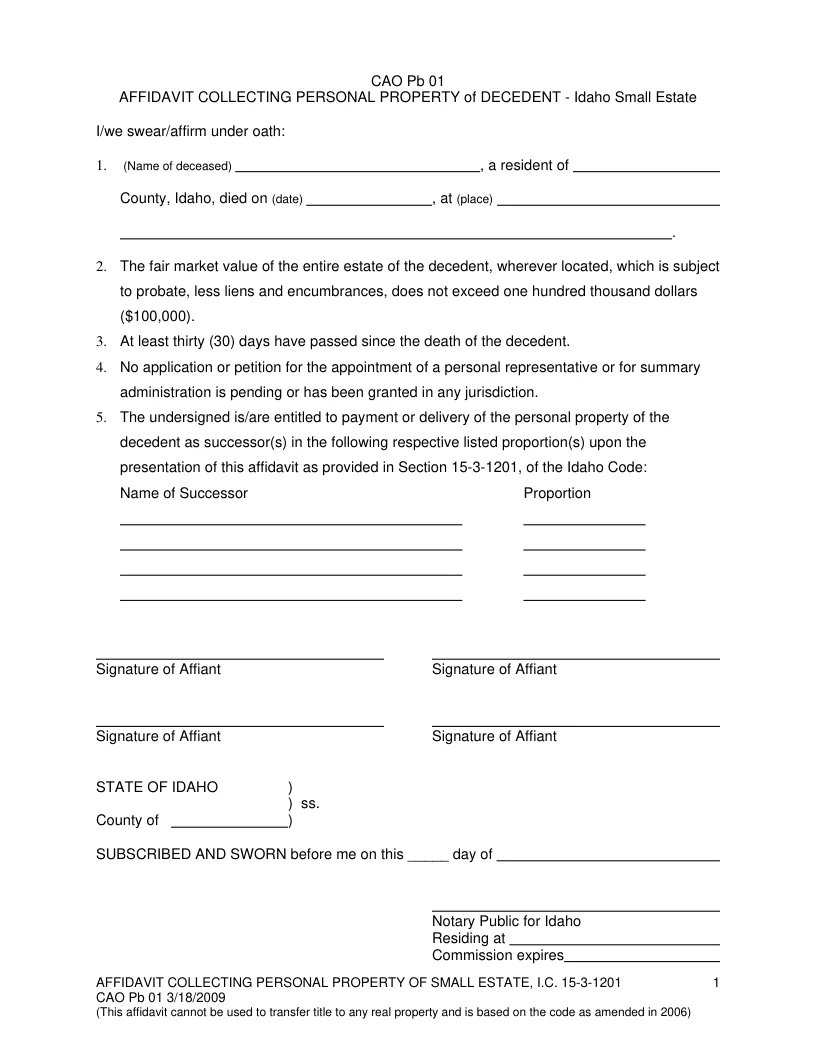
The court form on this page has each affiant swear to four printed statements, items 2 to 5. Three of them restate the conditions in Idaho Code § 15-3-1201, and the fourth names the successors' right to the property.[1]
The PDF on this page is the Idaho Court Assistance Office form "Affidavit Collecting Personal Property of Decedent - Idaho Small Estate", CAO Pb 01 (3/18/2009). It is one page. Item 1 names the decedent, items 2 to 4 are printed statements, item 5 lists the successors and their shares, and the form ends with four affiant signature lines and the notary block. Fill it in with our online PDF editor, or print it and write the answers by hand.
Have these details ready before you open the form. Each one matches a line on the page.
The screenshots under each step show form CAO Pb 01, the Idaho court form, filled with sample entries in blue, so you can see where each answer goes. The names, places, dates and shares are examples only.

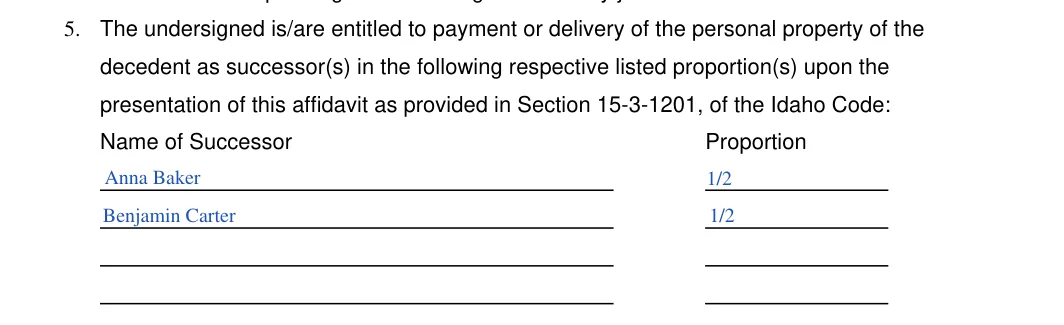

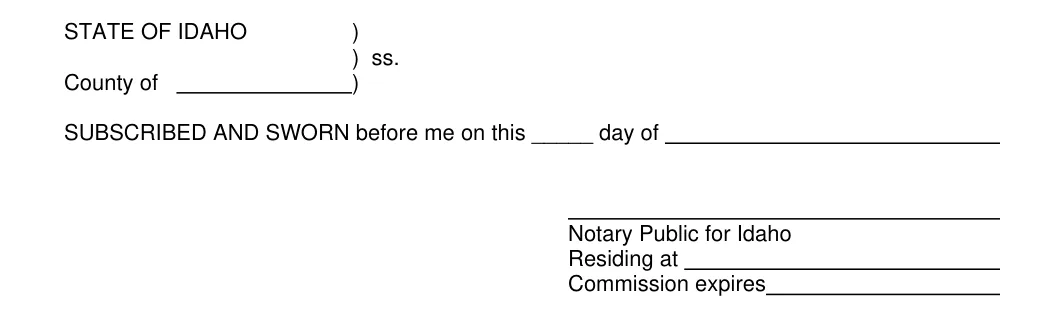
When the form is complete, print it. Sign it in front of a notary public, because the form carries a notary block for the sworn statement. Its footer notes that the affidavit cannot be used to transfer title to real property. Check each detail you provided against the death certificate before you sign.
The court form fits on a single page. It opens with the sworn statements and ends with the notary block, so every blank you need to fill in sits in one place.
These answers come from the text of Idaho Code § 15-3-1201. They cover whether Idaho has an affidavit procedure, how a small estate relates to probate, and the dollar limit that applies.[1]
Yes. Under Idaho Code § 15-3-1201, a person who owes the decedent money or holds the decedent's personal property must pay or deliver it to a person claiming to be the successor. The successor presents an affidavit made by or on behalf of the successor.[1] If the decedent lived in another state, use the small estate affidavit form for that state.
Idaho sets a $100,000 limit for the small estate procedure. The limit is the fair market value of the entire estate that is subject to probate, wherever located, less liens and encumbrances.[1]
The amount is $100,000, counted at fair market value less liens and encumbrances.[1]
General information, not legal or tax advice.
