
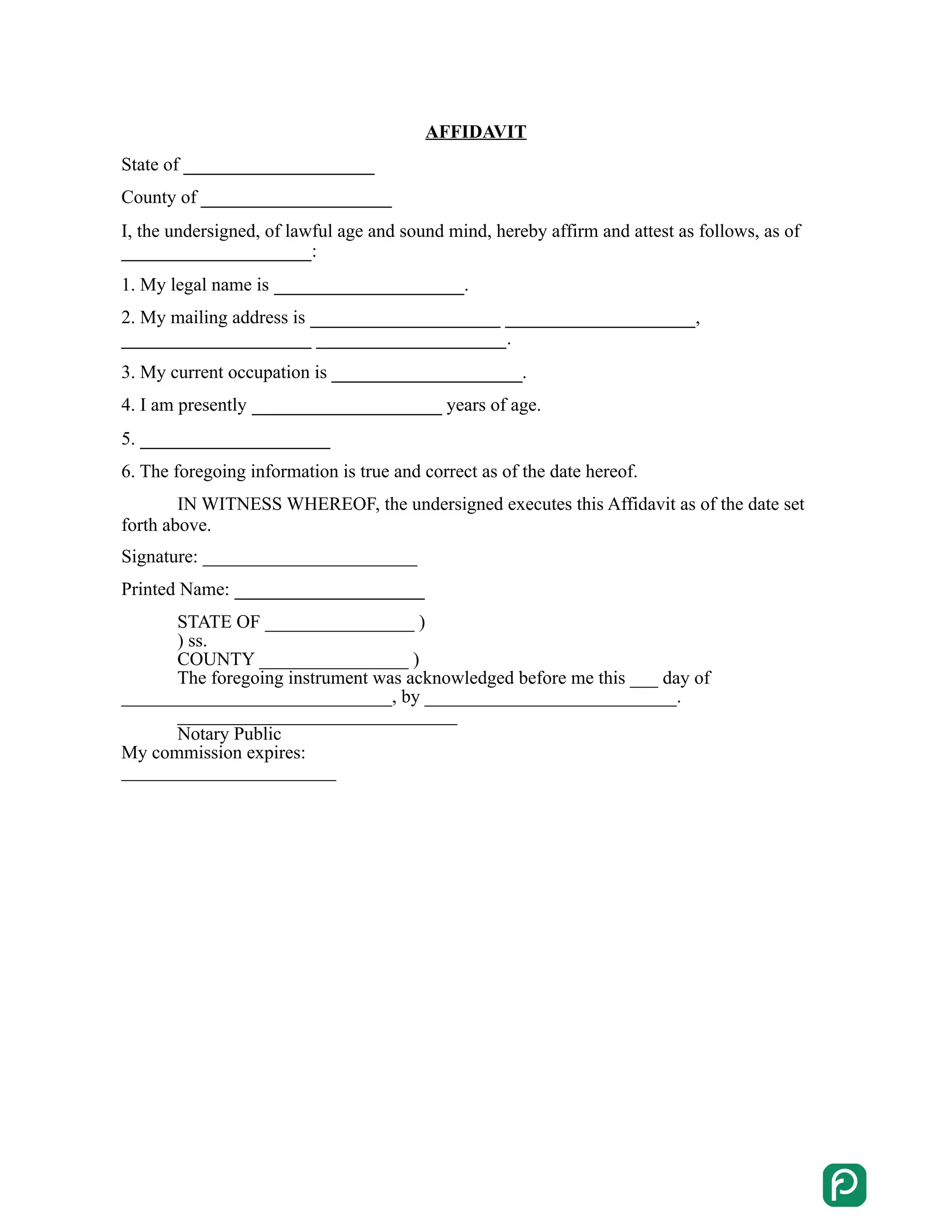
A New Jersey affidavit is a written statement of facts that you confirm is true. New Jersey affidavit forms are used to provide evidence in court or to prove that a statement made is true. They can be helpful for immigration, real estate transactions, and employment purposes. Several types are available, including affidavits of support, consent forms, and identity forms.
Last Updated: October 2026. This guide is reviewed and updated regularly to reflect current law. If you notice an error or outdated information, please contact us.
Build Your Document
Answer a few simple questions to make your document in minutes
Save and Print
Save progress and finish on any device, download and print anytime
Sign and Use
Your valid, lawyer-approved document is ready
New Jersey affidavit forms are widely used in legal proceedings and are recognized by courts in the state. You may benefit from an Affidavit of Consideration (Form RTF-1) to avoid paying the fee during property transfer or Form L-8 to release assets to the beneficiaries.

New Jersey Affidavit of Consideration (RTF-1) must be filed with the deed when transferring ownership of real property in New Jersey. This form is used to report the amount of consideration paid for the property. This information is vital for determining the appropriate property transfer tax due to New Jersey regulations (unless the transfer meets an exemption). The form requires detailed information about the parties involved in the property transfer, as well as the amount of money paid for the property.

New Jersey Form L-8 (Affidavit for Non-Real Estate Investments) is an affidavit for individuals or entities exempt from paying the state’s withholding tax on non-real estate investments. The form is meant to be filled out by entities that have either no New Jersey tax liability or qualify for a reduced withholding tax rate. It is used to disclose and report the investment income of a non-resident individual or entity.
Gather a few details before you start and the questionnaire goes much faster. Having everything in front of you also helps you avoid typing mistakes in names, dates, and addresses. Here is what to have ready.
FormsPal turns a short questionnaire into a finished affidavit. You answer a few questions about yourself and the statement you want to make, and the document is built from your answers. You can save your progress and finish later on any device.
Small details are easy to miss when you fill in a document quickly. Take a few minutes to review the finished affidavit before you print it, and look for the slips below.
An affidavit is a written statement of facts. The person who makes it confirms the facts are true and signs it. People often attach one to an application, a request, or a transaction to support what they say.
Common types include affidavits of support, consent forms, identity forms, and an affidavit of death. For example, an affidavit of death can establish proof of death for a person who passed away. You can find the Affidavit of Consideration (RTF-1) and Form L-8 in the list above.
Select Create My Document, answer the questions, and download your finished affidavit. You can save your progress and come back on any device.
Read every answer one more time. Check that names, dates, and addresses are spelled the way they appear on your ID, then keep a signed copy with your records.
General information, not legal or tax advice.
