

Form L-8 at a glance
What it is: Form L-8 is the Affidavit for Non-Real Estate Investments: Resident Decedents, for release of New Jersey bank accounts, stock in New Jersey corporations, brokerage accounts, and New Jersey investment bonds.
Who signs: The executor, administrator, or beneficiary signs, and the signature must be notarized.
Where and when to file: Take or send the completed form directly to the bank or other financial institution holding the funds. Do not mail this form to the Division of Taxation.
This form can be completed by: the executor; administrator; the surviving Class A joint tenant (often a spouse or civil union partner); or Class A "Payable On Death (POD)" beneficiary of the assets for which release is sought.
What to bring and attach to Form L-8
If the decedent died with a will, and the assets pass to the beneficiaries through the will, a complete copy of the last will and testament, codicils, and separate writings must be submitted with this form.
A filled-in Form L-8 example: a surviving spouse releases a joint checking account
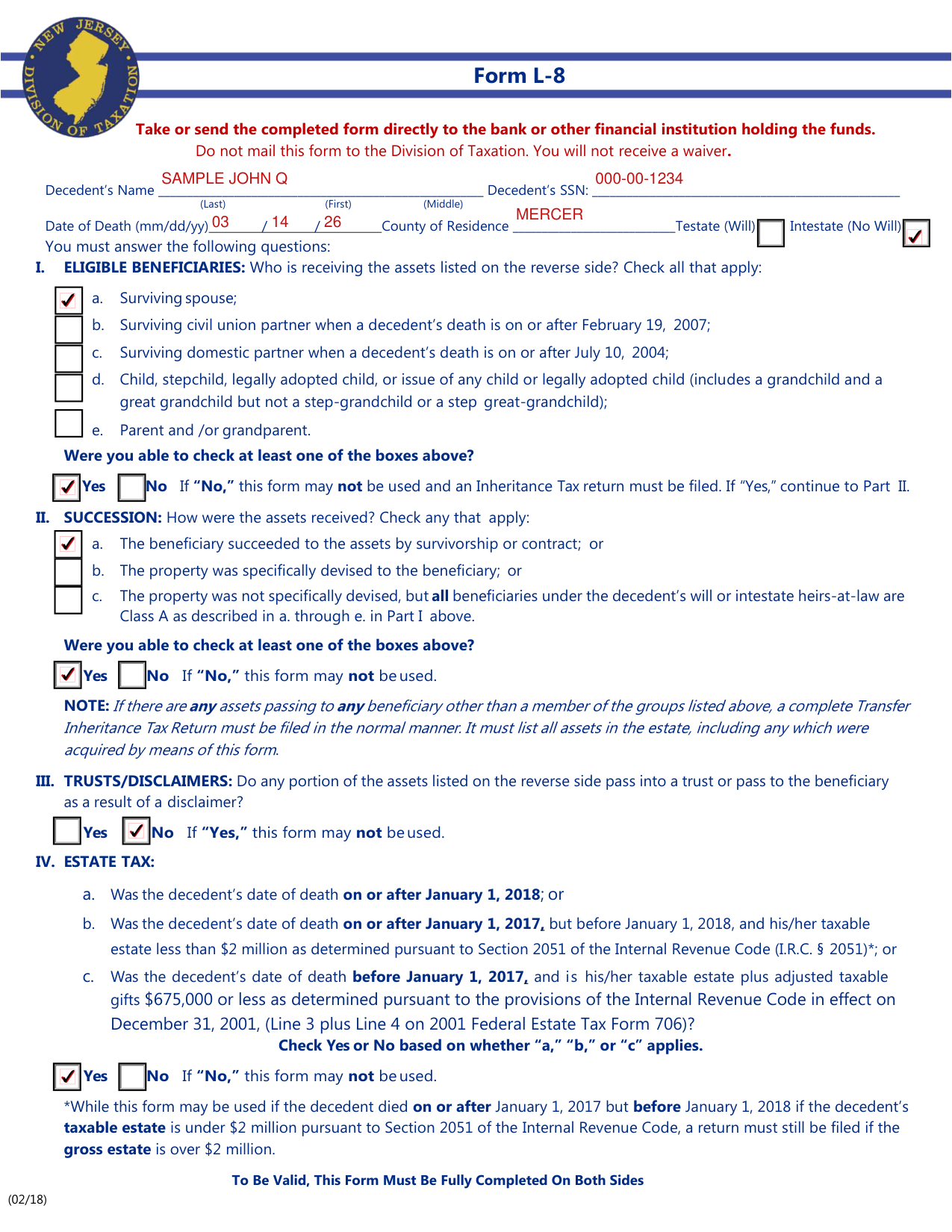
How to fill out Form L-8, box by box
Decedent, date of death and county

Enter the Decedent's Name (Last, First, Middle) and the Decedent's SSN.
Enter the Date of Death (mm/dd/yy) and County of Residence, and check Testate (Will) or Intestate (No Will).
Part I, eligible beneficiaries
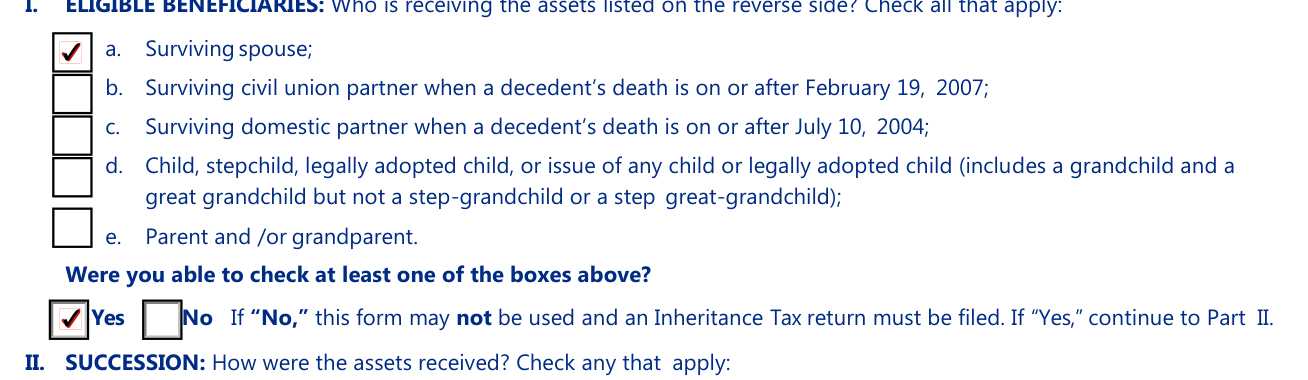
Check the box or boxes corresponding to the type of beneficiary who is receiving the assets that will be listed in Part V. If at least one of the boxes does not apply, the L-8 cannot be used to release these assets. Qualified civil union partners and domestic partners must provide a legal certificate to document their status.
Box a is Surviving spouse. Box d is Child, stepchild, legally adopted child, or issue of any child or legally adopted child (includes a grandchild and a great grandchild but not a step-grandchild or a step great-grandchild). Box e is Parent and /or grandparent.
If "No," this form may not be used and an Inheritance Tax return must be filed. If "Yes," continue to Part II.
Part II, succession
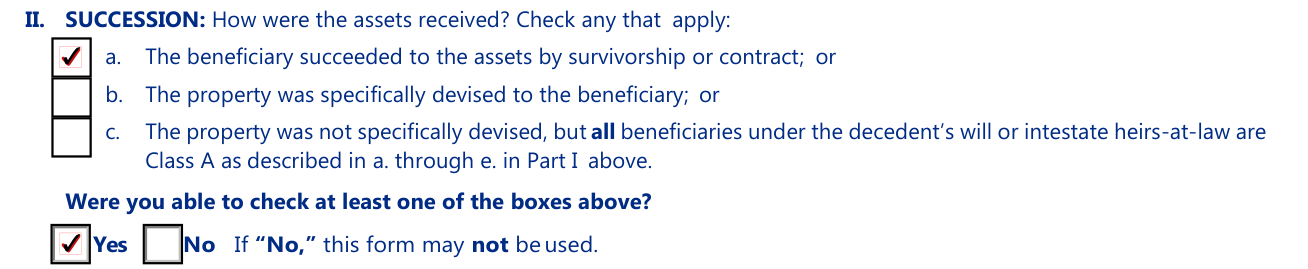
(02/18) Check Box a if the assets on the form pass directly to the beneficiary by operation of law. This means they were jointly held, POD, or Transfer on Death (TOD). (A copy of the will is not needed); Check Box b if the will states that these specific assets reported on the L-8 form pass to a particular named beneficiary. (Attach a copy of the will); Check Box c if there was no will (intestate) and all the beneficiaries in the entire estate are Class A beneficiaries as listed in Part I; or Check Box c if there was a will (testate), but there were no specific bequests and all the beneficiaries in the entire estate are one of the Class A beneficiaries listed in Part I (attach a copy of the will).
If "No," this form may not be used.
Part III, trusts and disclaimers

Do any of the assets pass into a trust or pass to the beneficiary as a result of a disclaimer? If "Yes," this form may not be used.
If any of the assets you wish to release pass into or through a trust, where the trust decides how the assets are distributed, you cannot use the L-8.
For the purposes of this form, it is not generally considered a "trust" when there is a bequest in the will to a minor (who is a Class "A") to be held "in trust" until he/she reaches a specific age. In all other cases, a full return must be filed with the Inheritance Tax Branch, even if the assets all appear to be passing to Class A beneficiaries.
Part IV, estate tax
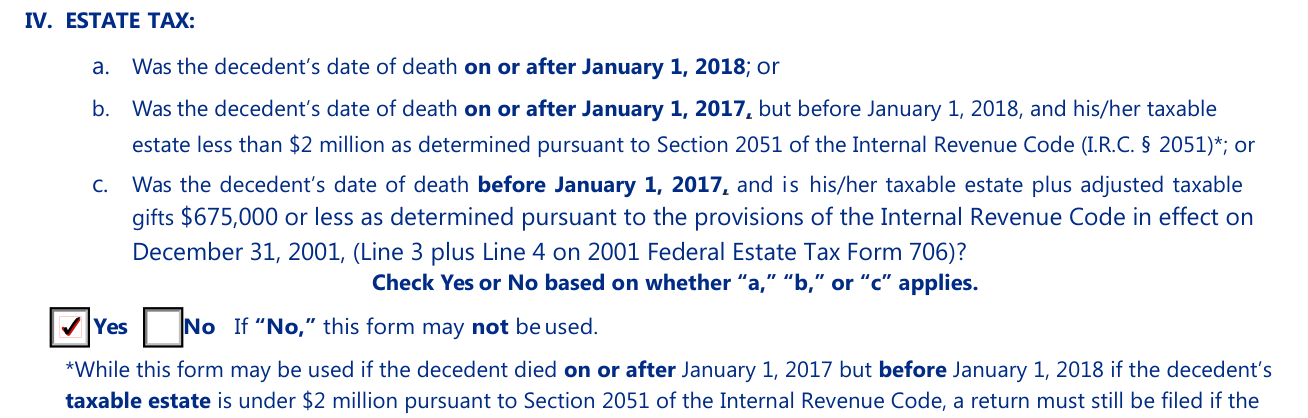
Check Yes or No based on whether "a," "b," or "c" applies. If "No," this form may not be used.
You must be able to answer "YES" to either a, b, or c to qualify to use this form.
a. Was the decedent's date of death on or after January 1, 2018.
If the decedent died on or after January 1, 2018, then there is no Estate Tax.
b. Was the decedent's date of death on or after January 1, 2017, but before January 1, 2018, and his/her taxable estate less than $2 million as determined pursuant to Section 2051 of the Internal Revenue Code (I.R.C. § 2051)? (checked November 8, 2026)
c. Was the decedent's date of death before January 1, 2017, and is his/her taxable estate plus adjusted taxable gifts $675,000 or less as determined pursuant to the provisions of the Internal Revenue Code in effect on December 31, 2001, (Line 3 plus Line 4 on 2001 Federal Estate Tax Form 706)? (checked November 8, 2026)
If the date of death was before January 1, 2017, the entire taxable estate must be under $675,000. Even if you qualify to use this form, a return is still required if the gross estate is over $675,000. (checked November 8, 2026)
Part V, property

A separate affidavit is required for each institution releasing assets.
List all the assets in this institution for which you are requesting a release. If this is a bank, list each account in this bank separately. Follow the column headings for each asset.
Enter the Description of Asset (Checking, Savings, CD, IRA, # of Shares, etc.), How held/Registered (Joint, POD, TOD, Individual, etc.) and Date of Death Value (Full Value).
Under "How held/Registered," you may enter "NOD" (Name of Decedent) if the account was in the name of the decedent alone.
If it was Paid on Death (POD) to a person, enter "POD to" and the person or persons' names (e.g., POD Jane Doe and John Doe).
If it was jointly held, enter "NOD and/or" the beneficiary's name.
Bank accounts and brokerage accounts: must list the full balance as of the date of death.
Stock: List the name of the company and number of shares held under "Description of Asset." Bonds: Include the name of the issuer, face value under "Description of Asset."
Part VI, beneficiaries

List the name of each beneficiary and his/her relationship to the decedent.
The relationship must be one of the Class A beneficiaries listed in Part I of the L-8.
"Executor," "Estate," and "Beneficiary" are not correct relations to the decedent in this column.
You must use terms such as "Child," "Spouse," or "Grandchild."
Signing before a notary public
This form is an affidavit and must be signed by the executor, administrator, or beneficiary, and the signature must be notarized.
On the form: "I hereby request the release of the property listed in Part V above. I certify that the beneficiaries of said property are listed in Part VI above and that this form is completed in accordance with its filing requirements."
Write the County after "State of New Jersey County of," and fill in "Subscribed and sworn before me this day of". Sign where it says SIGN. Under Deponent: Executor / Administrator / Joint Tenant / Heir-at-Law, enter the Deponent's Social Security or Federal Identification Number.
The Notary Public signs, and enters the Street Address, Town/City, State and Zip.
The original is filed with the Division of Taxation
The original of this affidavit must be filed by the releasing institution within five business days of execution with the Division of Taxation, Transfer Inheritance and Estate Tax Branch, 50 Barrack Street, PO Box 249, Trenton, NJ 08695-0249.
The affiant (person who made affidavit) should be given a copy.
Part VII, the releasing institution

This Form Must Be Signed by the Releasing Institution Before Mailing to the Division of Taxation.
If your situation is different
The asset is real estate or the beneficiary is not Class A
This form cannot be used for real estate. For real estate investments, use Form L-9.
You cannot use this form to release any asset passing to a beneficiary other than the Class A beneficiaries specifically listed in Part I.
For example, sisters and brothers of the decedent, sons-in-law or daughters-in-law of the decedent, nieces and nephews, aunts and uncles, ex-spouses, mutually acknowledged children, step-grandchildren and charities cannot use this form (and must file a return to receive waivers).
Common questions about Form L-8
What is an L8 form in NJ?
Form L-8 is the Affidavit for Non-Real Estate Investments: Resident Decedents, for release of New Jersey bank accounts, stock in New Jersey corporations, brokerage accounts, and New Jersey investment bonds. To be valid, this form must be fully completed on both sides.
How do I get an inheritance tax waiver in NJ?
You will not receive a waiver from this form. People who cannot use this form must file a return to receive waivers.
Where to get help with Form L-8
If you have any question as to whether you are permitted to release assets, please call the Inheritance Tax general information number at (609) 292-5033 and ask to speak to an Information Section representative.
Sources
[1] Form L-8 (02/18), Affidavit for Non-Real Estate Investments: Resident Decedents, New Jersey Division of Taxation (the Official source link on this page).
