
Updated:
A California deed of trust is a real estate loan security document. The borrower signs it, and a trustee holds title for the lender until the loan is repaid. Buyers and owners borrowing against California property use this deed of trust form.
Key facts
Build Your Document
Answer a few simple questions to make your document in minutes
Save and Print
Save progress and finish on any device, download and print anytime
Sign and Use
Your valid, lawyer-approved document is ready
Other California Deed Forms
A California deed of trust is a security instrument for a real estate loan: the borrower transfers legal title to a trustee, who holds it for the lender until the debt in the promissory note is paid in full.
The deed works together with the note. The note is the borrower's promise to repay the loan. The deed of trust ties that promise to one piece of real property, so the property stands behind the debt.
The document ends its role once the loan is repaid. At that point, the trustee returns title to the borrower through a reconveyance, and the property is free of the loan.
A trust deed names a borrower, a lender and a trustee, and each party has its own label in the form's wording: the borrower is the trustor, the lender is the beneficiary, and the trustee is the neutral holder of title.
The trust deed names the trustee by full name and address in its opening paragraphs. The trustee is a separate party from the borrower and the lender, and it acts only under the powers the deed gives it. Before you fill out the form, confirm with the lender which trustee the loan uses.
A deed of trust adds a trustee that a mortgage does not have: a mortgage is a two-party arrangement between borrower and lender, while a deed of trust places title with a third party for the lender's benefit.
California's foreclosure sections treat the two instruments side by side. For the purposes of Sections 2924 to 2924h, Cal. Civ. Code § 2920(b) defines "mortgage" to also mean any security device or instrument, other than a deed of trust, that confers a power of sale affecting real property, to be exercised after breach of the obligation it secures.
The power of sale clause lets the trustee sell the property after the borrower breaks the loan terms. Before that power is used, the trustee, mortgagee or beneficiary, or an authorized agent, shall first file for record a notice of default in the office of the recorder of each county where the trust property or some part of it is situated (Cal. Civ. Code § 2924(a)(1)).
A deed of trust secures a loan that real property backs, whether the borrower buys the property with the money or borrows against property already owned.
A deed of trust only secures a debt; it does not sell or give away the property. A trust transfer deed is a different document: it moves property into a living trust, with no loan involved. To sell or give the property itself, see the California grant deed or the California quitclaim deed, and our overview of deed forms.
A California deed of trust rests on three sections of California law: a transfer of real property, other than an estate at will or a term of one year or less, only by operation of law or by a signed writing (Cal. Civ. Code § 1091), an acknowledgment before recording (Cal. Gov. Code 27287), and the notice that recording gives (Cal. Civ. Code 1213). Compare each rule with your loan papers, so the names, the property and the dates match across every document.
Under Cal. Civ. Code § 1091, an estate in real property, other than an estate at will or for a term not exceeding one year, can be transferred only by operation of law, or by an instrument in writing subscribed by the party disposing of it, or by an agent authorized by writing. In a deed of trust, the borrower is the party who conveys title to the trustee.
Under Cal. Gov. Code 27287, apart from the exceptions that section lists, an instrument's execution shall be acknowledged by the person executing it before it can be recorded.
Under Cal. Civ. Code 1213, every conveyance of real property acknowledged or proved, certified and recorded as prescribed by law is constructive notice of its contents to subsequent purchasers and mortgagees from the time it is filed with the recorder for record. Once signed and acknowledged, the deed of trust can be recorded with the recorder (Cal. Gov. Code 27287).
The trust deed form draws on the loan papers and the current deed, so keep both within reach and confirm that every name and number on the form matches them.
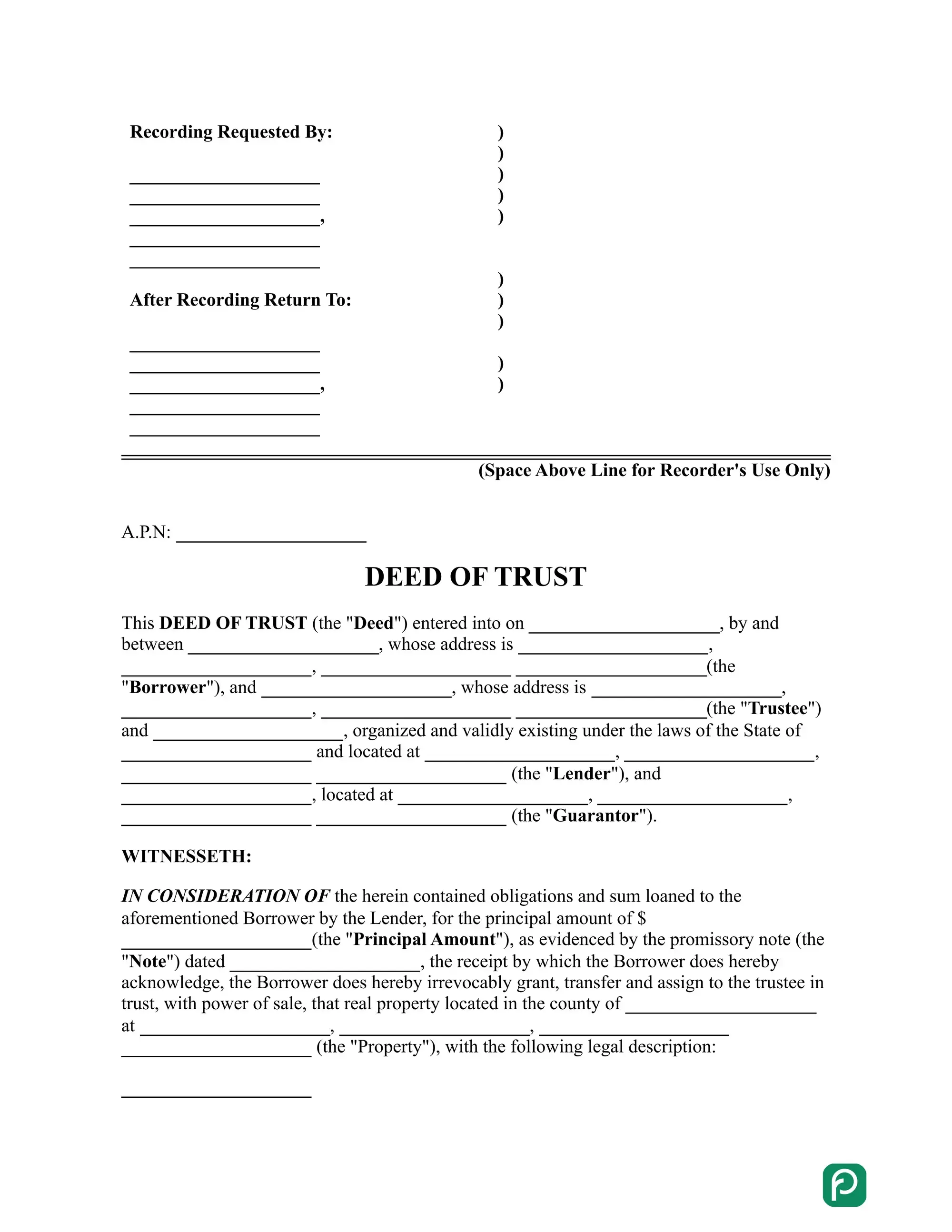
The California trust deed form follows a fixed order of lettered points, from the return address at the top to the signatures at the end. Work through it in this order:
The signing stage turns the completed form into a recordable instrument, in these steps:
The trust deed example below shows how the details fit together, with a sample entry for each part of the form. The names, addresses and figures below are made up for illustration, so replace each one with the information from your own loan documentation.
| Part of the form | Sample entry |
|---|---|
| Return address | Anna Baker, 123 Main Street, Anytown, CA 90000 |
| Date in point A | The day you fill out the form |
| Borrower (trustor) | Anna Baker, 123 Main Street, Anytown, CA 90000 |
| Lender (beneficiary) | Example Lending Company, 456 Oak Avenue, Anytown, CA 90000 |
| Trustee | Sam Rivera, 789 Pine Road, Anytown, CA 90000 |
| Note | Two hundred fifty thousand dollars ($250,000), with the last repayment on June 1, 2056 |
| Property | 123 Main Street, Anytown, Sample County, CA 90000, plus the full legal description copied from the current deed |
A trust deed goes wrong most often through details copied too quickly: the names, the loan amount and the property description link the borrower, the lender and the trustee to the loan, so each one deserves a second check.
Yes. "Trust deed" and "deed of trust" name the same document, which secures a loan with real property and places title with a trustee for the lender.
No. A trust transfer deed moves property into a living trust, while a deed of trust secures a loan. The two share a word but serve different purposes.
The deed's power of sale comes into play. Before it is used, the trustee, mortgagee or beneficiary, or an authorized agent, shall first file for record a notice of default with the recorder of each county where the property or part of it is situated (Cal. Civ. Code § 2924(a)(1)).
The current deed to the property holds it. Copy the legal description exactly as written, including every number and abbreviation.
The Note is the written promise to repay the loan. In the form, the Note paragraph holds the date, the loan amount and the date of the last repayment.
General information, not legal or tax advice.
