
A California transfer on death deed is a deed that lets a property owner name beneficiaries to receive residential property directly when the owner dies. The beneficiary takes the property without probate, and the owner can revoke the deed at any time before death.[1.2] Fill in the FormsPal template with our online builder, then sign it, have it notarized and record it.
Last Updated: October 2026. This guide is reviewed and updated regularly to reflect current California law. If you notice an error or outdated information, please contact us.
Build Your Document
Answer a few simple questions to make your document in minutes
Save and Print
Save progress and finish on any device, download and print anytime
Sign and Use
Your valid, lawyer-approved document is ready
California law lets a property owner use a revocable transfer on death deed to name beneficiaries who receive residential property when the owner dies.[1.2] The rules come from the California Probate Code, which sets out the statutory form of the deed in sections 5642 and 5644.[1.1] On the FormsPal template the owner is called the grantor.
A transfer on death deed has no effect until the owner dies. The statutory form says the deed can only transfer residential property. It also asks you to fill in only what the form requires and to add no other instructions or conditions.[1.1]
If your property is in another state, start from our transfer-on-death deed forms page and pick that state. Other kinds of deeds are listed in our deed forms guide.
To be valid, the deed must be signed by 2 persons, both present at the same time, who witness your signing of the deed or your acknowledgment that it is your deed. The signatures of the witnesses do not need to be notarized.[1.2] The form says you should avoid using a beneficiary as a witness.[1.1]
A complete deed has these parts:
Take the completed and notarized deed to the county recorder for the county where the property is located, and follow the recorder's instructions.[1.1]
This form must be recorded on or before 60 days after the date it is notarized or it will not be effective.
You can revoke the deed at any time before death.[1.2] The statutory form lists 2 ways to revoke a recorded deed. You can record a revocation form that is witnessed and notarized, or you can record a new transfer on death deed that is witnessed and notarized. A deed cannot be revoked by a will, so changing your California will does not change the deed.[1.1]
When it is recorded, a new transfer on death deed revokes any transfer on death deed you made before signing it.[1.2]
The deed transfers only your own ownership share of the property, not the share of any co-owner. A co-owner who wants to name a beneficiary must sign and record a separate deed of their own.[1.2]
When you name a beneficiary, state the person's full name and do not use general terms such as “my children.” If you name more than one beneficiary, they become co-owners in equal shares as tenants in common.[1.1]
If a beneficiary dies before you but others survive you, the share of the deceased beneficiary is divided equally between the surviving beneficiaries. If all of your beneficiaries die before you, the deed has no effect.[1.1]
After the owner dies, the statutory form lists what the beneficiary must do:
Deciding who counts as an heir can be complicated, so the beneficiary may want professional help with these requirements.[1.1]
Other California Deed Forms
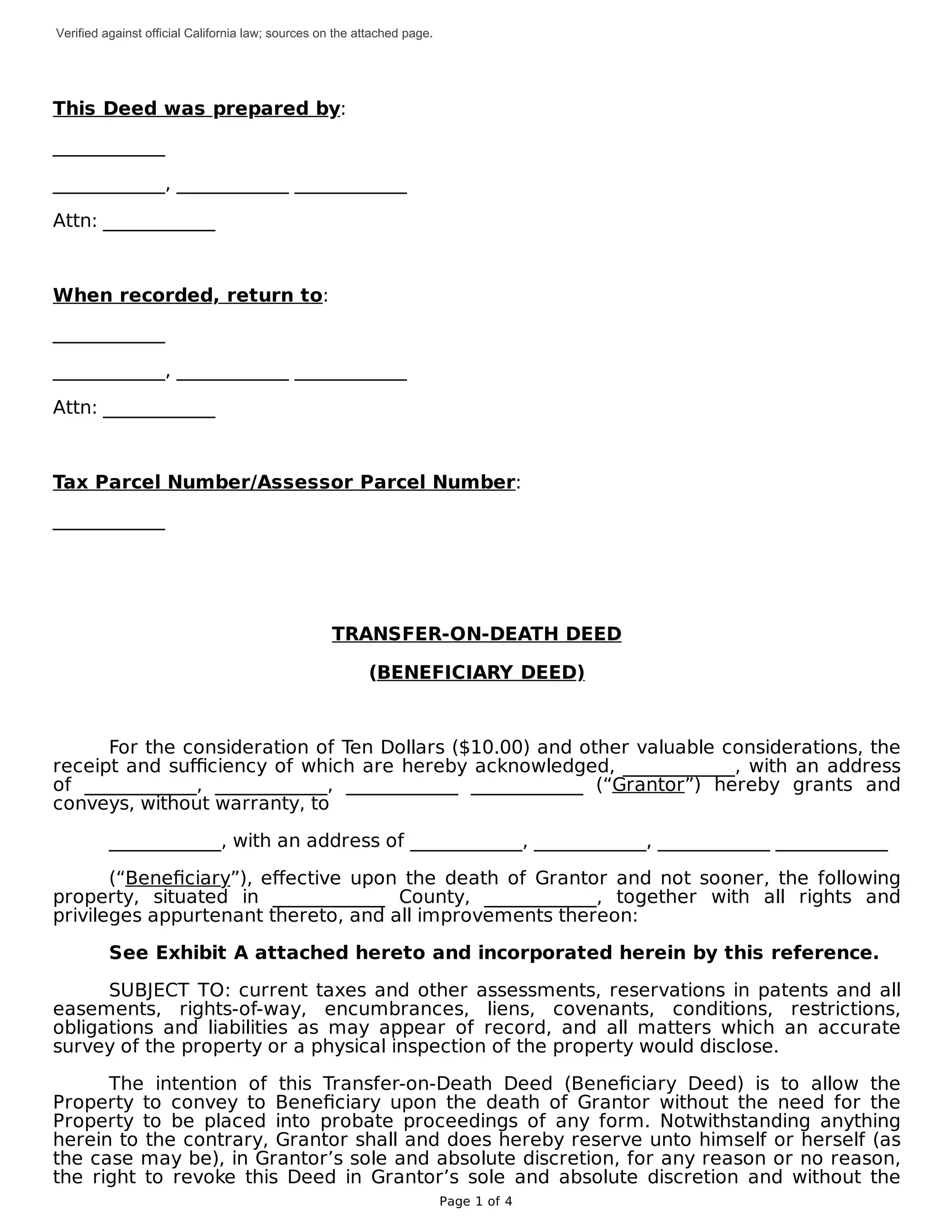
The FormsPal California transfer on death deed template has 10 parts to complete, in the order below. Fill them in with our online document builder and print the deed, then check each entry against your deed records before you sign and keep a copy with your estate planning papers.
The screenshots under each step show the FormsPal California transfer-on-death deed template filled with sample entries in blue, so you can see where each answer goes. The names, addresses, dates and amounts are examples only.
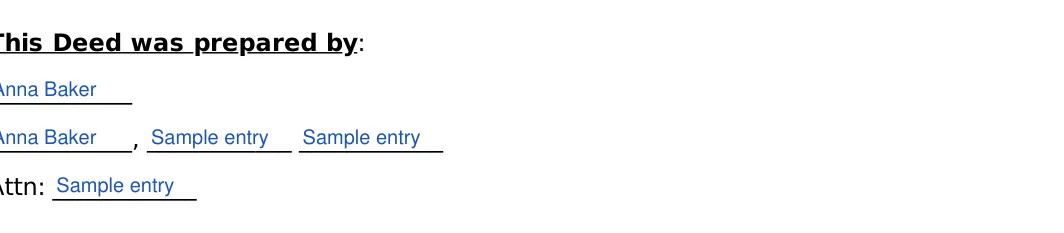
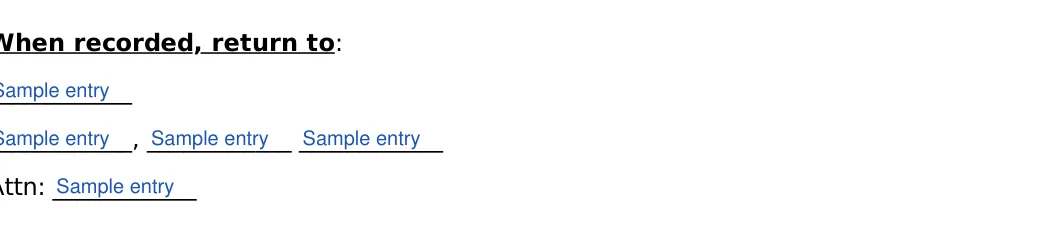

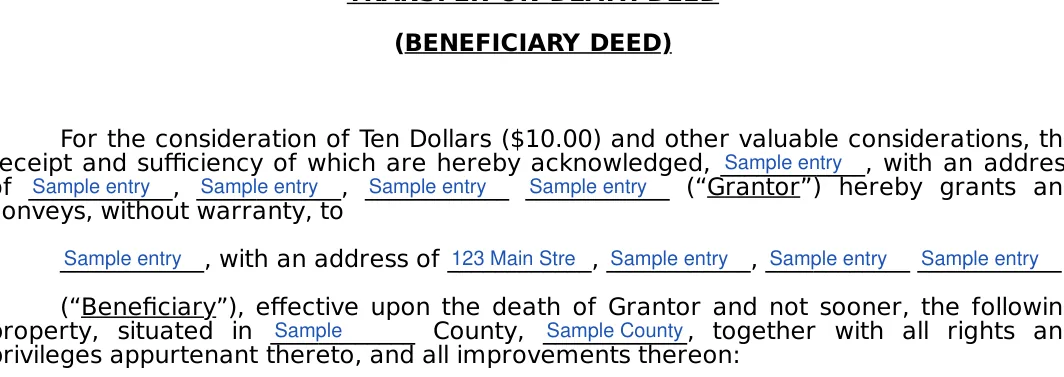


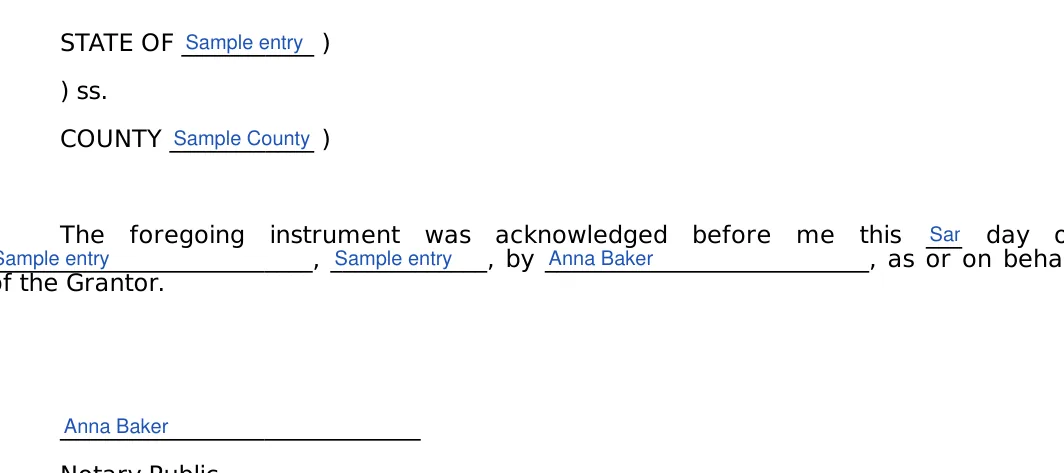


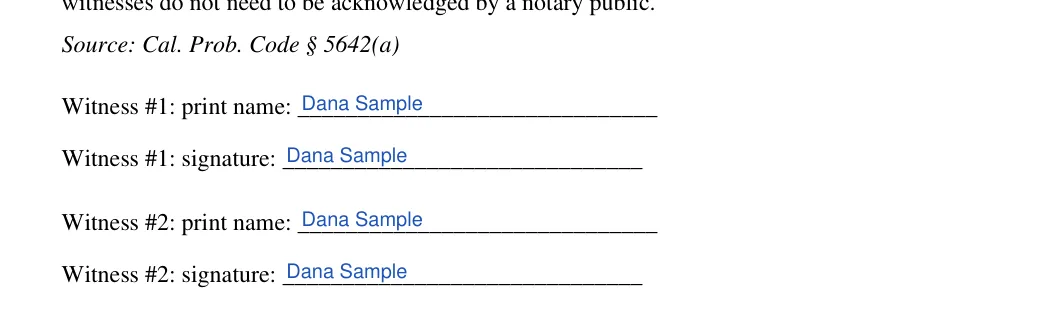
The FormsPal template is built for signing in front of 2 witnesses and a notary public. Once the deed is complete and notarized, record it with the county recorder on or before 60 days after the notarization date.[1.2] The steps below cover signing, copies and recording.
A common question about a California transfer on death deed is what happens to the property at the owner's death, and the answer comes from the statutory form in the Probate Code. For questions about your own property, ask a California attorney.
Yes. The owner transfers all of the owner's interest in the described property to the named beneficiary on the owner's death.[1.2] The identified property goes to the named beneficiary without probate, and the deed has no effect until the owner dies.[1.1]
General information, not legal or tax advice.
