
A California quitclaim deed is a written document that a property owner (the grantor) signs to pass whatever interest they hold in real property to another person (the grantee). Most transfers of real property interests require a signed written instrument.[4] People mostly use this deed form with someone they trust, because it passes the property without any warranty. Download the free form below or use our Quitclaim Deed Form builder.
Last Updated: October 2026. This guide is reviewed and updated regularly to reflect current California law. If you notice an error or outdated information, please contact us.
Build Your Document
Answer a few simple questions to make your document in minutes
Save and Print
Save progress and finish on any device, download and print anytime
Sign and Use
Your valid, lawyer-approved document is ready
Other California Deed Forms
A California quitclaim deed has to meet three rules from the state's codes. It is a written instrument signed by the owner or by an agent authorized in writing.[4] The person who signed it must acknowledge it before it can be recorded.[3] Once recorded, it gives later buyers and lenders legal notice of it.[2]
The mode of transferring real property is set by Sections 1091 to 1099 of the Cal. Civ. Code. The recording rules follow in Sections 1169 to 1220.[1]
An estate in real property can be transferred only by operation of law or by a written instrument. The instrument is signed in one of two ways:
The rule does not reach an estate at will or an estate for a term of one year or less.[4] The statute puts it this way:
An estate in real property, other than an estate at will or for a term not exceeding one year, can be transferred only by operation of law, or by an instrument in writing, subscribed by the party disposing of the same, or by his agent thereunto authorized by writing.
Section 1092 of the Cal. Civ. Code gives a statutory form for a grant of an estate in real property. A deed may follow that form or use words to the same effect. Either way, it passes the estate or interest in the property that the grantor could lawfully convey.[1]
Under Section 27287 of the Cal. Gov. Code, before an instrument can be recorded, its execution must be acknowledged by the person executing it.[3]
Recording is what puts a deed on the public record. A conveyance that is acknowledged or proved and certified, then recorded as the law prescribes, is constructive notice of its contents. The notice reaches later purchasers and mortgagees from the time the deed is filed with the recorder. In plain words, the law treats later buyers and lenders as knowing what the deed says.[2]
The transferee completes a Preliminary Change of Ownership Report and may file it with the deed. If it is not filed, the recorder may charge an extra recording fee (Section 480.3 of the Cal. Rev. and Tax. Code).[5]
A county, and some cities, may charge a documentary transfer tax when real property is sold for more than $100 (Section 11911 of the Cal. Rev. and Tax. Code). No tax applies under that section when the property is not sold.[6]
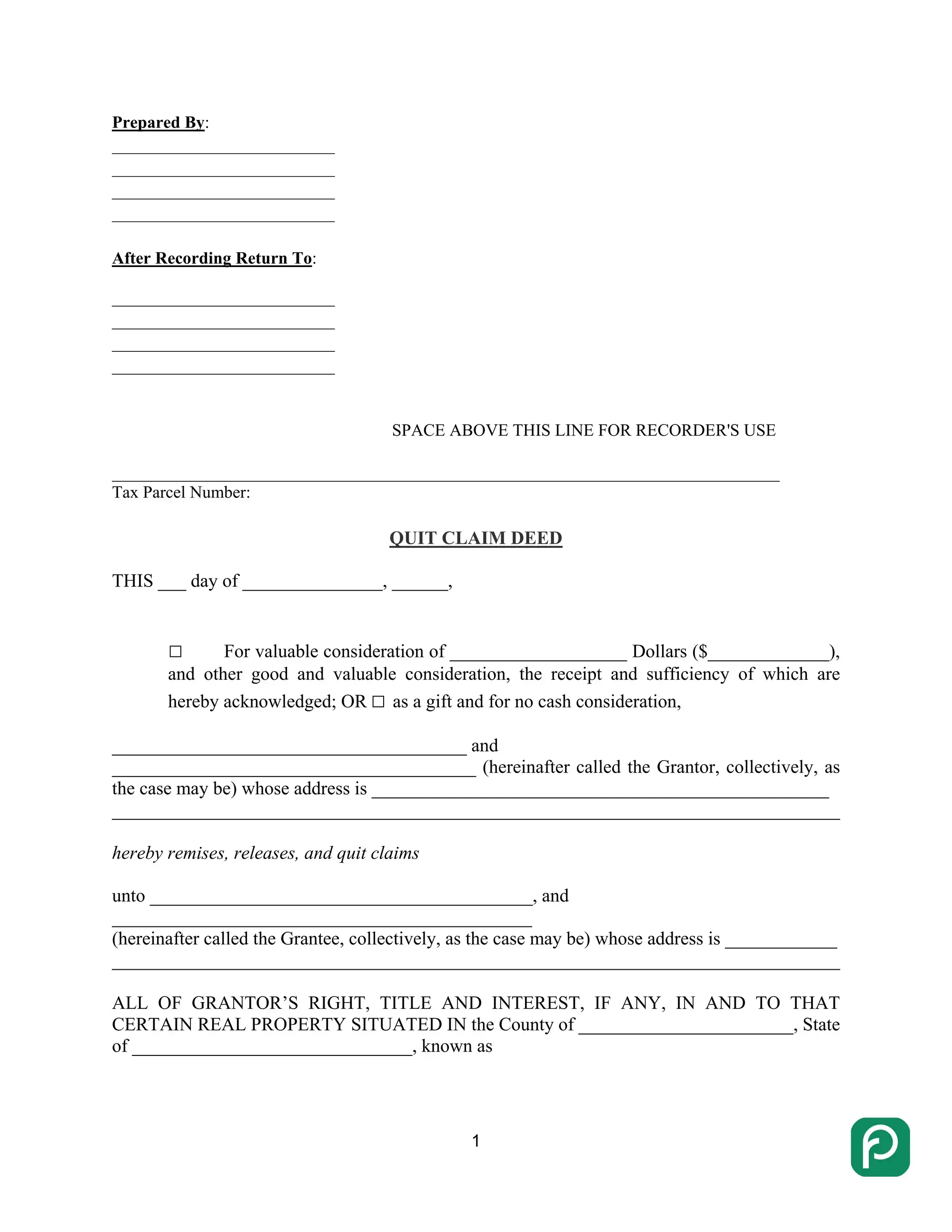
The FormsPal quitclaim deed form for this state runs five pages, and page 3 is blank. Work through the parts below in the order they appear on the form. If you downloaded the PDF, you can fill it in on screen with our PDF editor, or print it and write by hand.
Once the deed is signed and acknowledged, see the recording rules above. The deed is recorded by the county recorder of the county where the property is located (Section 1169 of the Cal. Civ. Code). Ask that office what else it wants to see with the deed.[7]
A quitclaim deed fits cases where ownership transfers between people who already trust each other. The grantor passes only the interest they hold, and page 2 of the form says the property passes without any warranty. The grantee takes the property as it stands, with any easements or liens that go with it. For that reason this deed suits a simple transfer inside the family.
People commonly use a quitclaim deed to:
If you need a different type of deed, compare the California grant deed or the transfer-on-death deed.
These answers help you understand the signing, acknowledgment and recording questions that come up most when someone prepares a quitclaim deed. Each answer follows the legal sections listed in the Sources section at the end of this page.
A quitclaim deed is a written document in which a grantor passes whatever interest they hold in real property to a grantee. In California, an estate in real property can be transferred only by operation of law or by a written instrument. The owner signs it, or an agent authorized in writing signs for the owner.[4]
The instrument is signed by the party giving up the property, or by an agent:
Before the deed can be recorded, its execution must also be acknowledged by the person executing it.[3]
Recording files the deed with the county recorder. A deed that is acknowledged or proved and certified, then recorded as the law prescribes, is constructive notice of its contents to later purchasers and mortgagees.[2]

Other Quitclaim Deed Forms by State
General information, not legal or tax advice.
