
A Washington quitclaim deed is a written document that passes the grantor's existing interest in real estate to the grantee. It conveys only the rights the grantor holds at that moment, nothing more.[2] People commonly use it to transfer ownership of real property between family members or other trusted parties.
Last Updated: October 2026. This guide is reviewed and updated regularly to reflect current Washington law. If you notice an error or outdated information, please contact us.
Build Your Document
Answer a few simple questions to make your document in minutes
Save and Print
Save progress and finish on any device, download and print anytime
Sign and Use
Your valid, lawyer-approved document is ready
Washington law requires a quitclaim deed to be in writing, signed by the grantor, and acknowledged before a person authorized to take acknowledgments of deeds. That is the same standard that applies to every deed in the state.[1] When it follows the statutory form, it passes the grantor's existing rights in the property to the grantee.[2] Recording the deed protects it against later buyers.[3]
Three sections of the Revised Code of Washington govern this deed:
Every deed must be in writing, signed by the party bound by it, and acknowledged by the party before some person authorized to take acknowledgments of deeds. For a quitclaim deed, the party bound is the grantor, the person giving up the interest.[1]
An acknowledgment is a formal declaration, made in front of the authorized official, that the signature is the grantor's own. Our form includes a notary acknowledgment block on page 5.
Recording is what protects a deed against later buyers. An unrecorded conveyance is void as against a later purchaser or mortgagee who acts in good faith and gives valuable consideration. That applies when the buyer's own conveyance is recorded first.[3] The statute puts it this way:
Every such conveyance not so recorded is void as against any subsequent purchaser or mortgagee in good faith and for a valuable consideration from the same vendor, his or her heirs or devisees, of the same real property or any portion thereof whose conveyance is first duly recorded.
When the deed is presented for recording, its first page must have a top margin of at least three inches and one-inch margins on the bottom and sides. Every other page needs margins of at least one inch (Wash. Rev. Code § 65.04.045).[4]
The first page must also carry the recording information: the return name and address, the document title, the reference numbers of any documents assigned or released, the grantor and grantee names, an abbreviated legal description and the assessor's parcel or account number. Put this information on page one, or attach a cover sheet if page one lacks it (Wash. Rev. Code §§ 65.04.045, 65.04.047).[5]
The county auditor charges a recording fee, set per page by state law (Wash. Rev. Code § 36.18.010).[6]
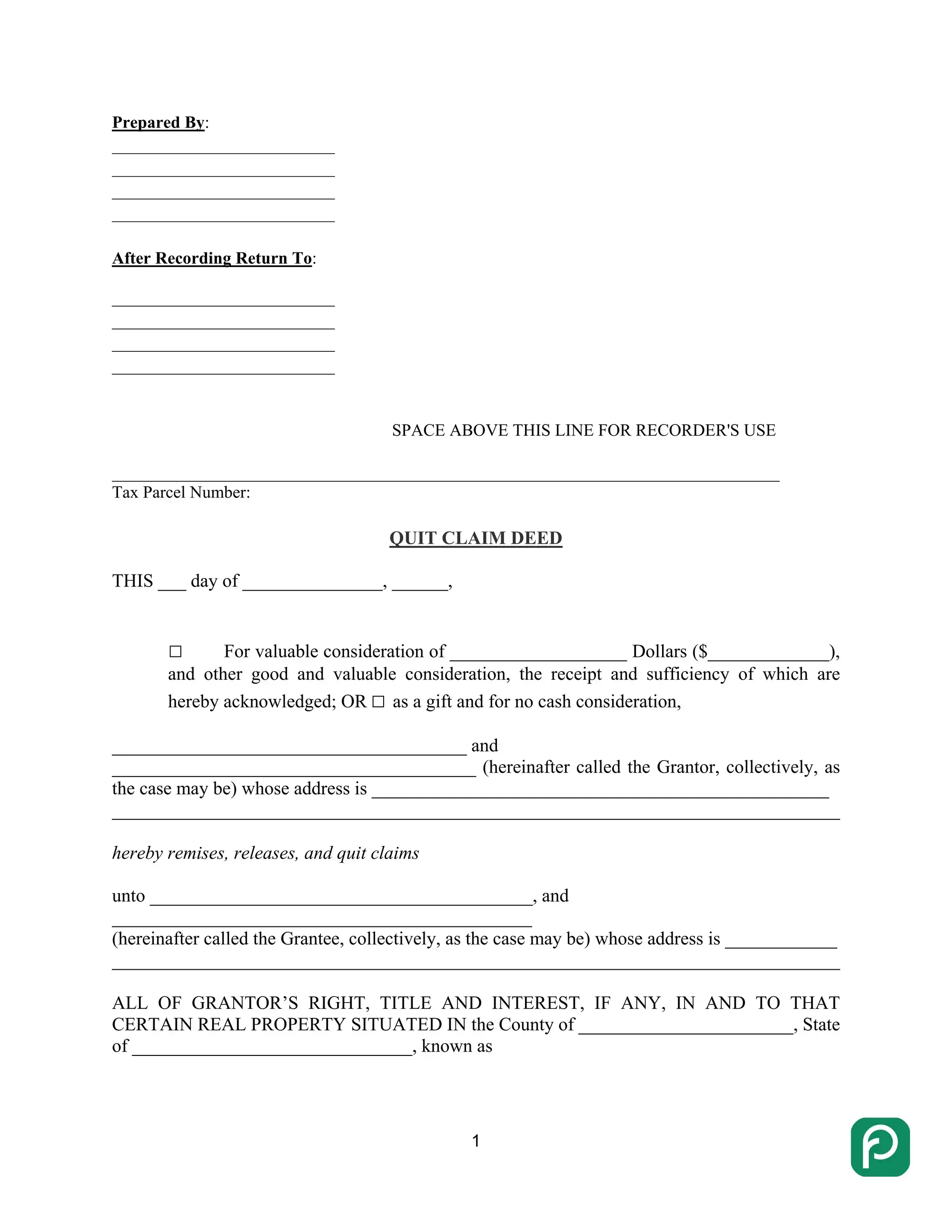
Our Washington quitclaim deed form runs five pages. Pages 1 and 2 contain the grantor, the grantee and the property description, page 3 is blank, page 4 is the signature page, and page 5 is the acknowledgment. The instructions below follow that sequence. You can fill in the downloaded PDF with our PDF editor or build the deed online with our form builder.
This section answers a common question about the Washington quitclaim deed. The answer below is based on the Revised Code of Washington and explains what the deed passes to the grantee. It is general information and not advice for your situation.
A Washington quit claim deed passes the grantor's interest in the property to the grantee, and nothing more. A deed in the statutory form, when otherwise properly signed and acknowledged, is a good and sufficient conveyance, release and quitclaim to the grantee. It passes all the then existing legal and equitable rights of the grantor in the property described.
By itself, the deed does not extend to the after acquired title unless words are added expressing such intention. In plain terms, title the grantor gets later does not pass unless the deed says it should.[2]

Other Quitclaim Deed Forms by State
General information, not legal or tax advice.
Unless noted otherwise, the sources below are from the Revised Code of Washington.
