
A Texas quitclaim deed is a written document that a property owner (the grantor) signs to transfer whatever interest they hold in real property to another person (the grantee). Texas law does not require a covenant of warranty in a conveyance.[1.1] People most often use this deed form when ownership moves within the family, for example to give a home as a gift, add an owner, or transfer property to a spouse. Download the free form below, or use our quitclaim deed form builder.
Last Updated: October 2026. This guide is reviewed and updated regularly to reflect current Texas law. If you notice an error or outdated information, please contact us.
Build Your Document
Answer a few simple questions to make your document in minutes
Save and Print
Save progress and finish on any device, download and print anytime
Sign and Use
Your valid, lawyer-approved document is ready
Texas sets its deed rules in the Property Code. Two sections matter most for a quitclaim deed. Section 5.022 covers the form of a conveyance, and Section 12.001 covers what a deed needs before it can be recorded. The sections below explain each rule in plain words.[1][2]
Section 5.022(a) of the Tex. Prop. Code sets out a statutory form of deed. Under that section, the statutory form or a form that is the same in substance conveys a fee simple estate in real property with a covenant of general warranty.[1.2]
A deed that follows the statutory form is enough to convey the grantor's interest in the property it describes. An equivalent deed that makes the parties' transaction plain is not invalid just because its wording differs.[1.2]
Section 5.022(b) adds that a covenant of warranty is not required in a conveyance. No one has to insert a warranty clause, and no one is barred from adding any other clause the parties consider proper.[1.1]
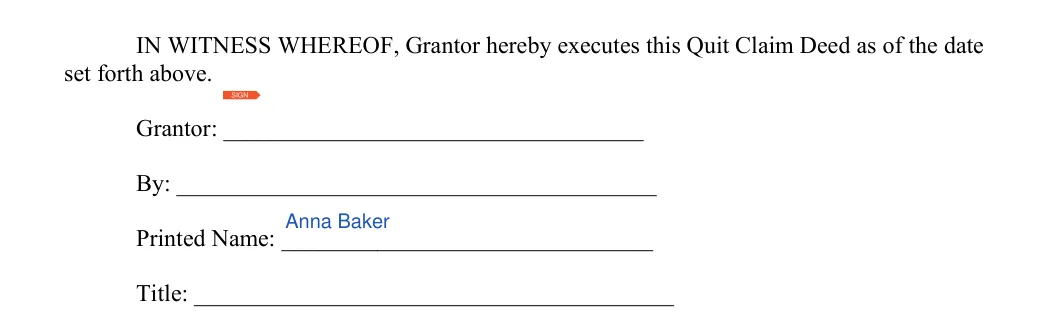
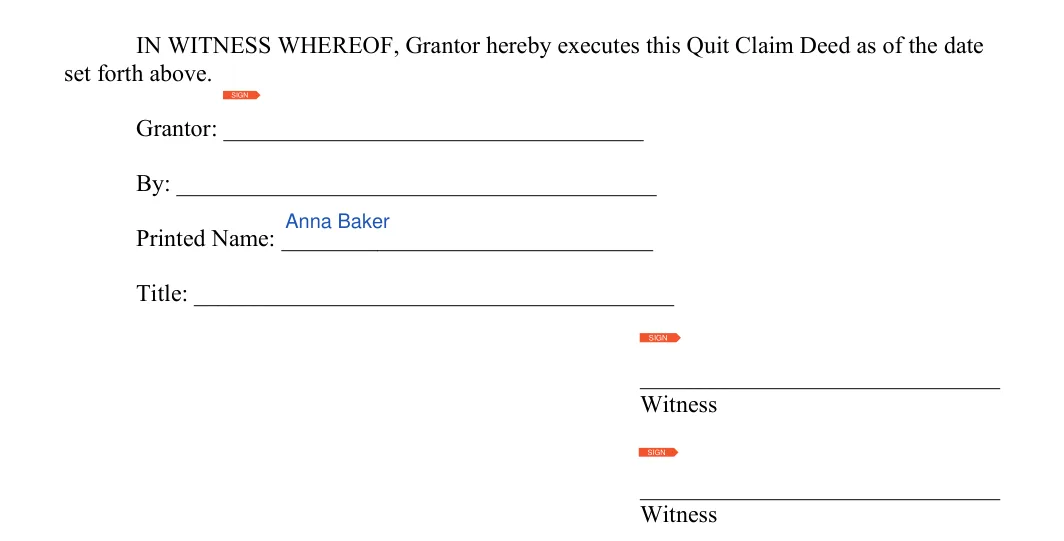
The grantor must sign the deed. Under Section 12.001 of the Tex. Prop. Code, a deed that conveys real property may not be recorded unless it is signed and acknowledged or sworn to in one of two ways. The statute puts it this way:
An instrument conveying real property may not be recorded unless: it is signed and acknowledged or sworn to by the grantor in the presence of two or more credible subscribing witnesses or acknowledged or sworn to before and certified by an officer authorized to take acknowledgements or oaths, as applicable
In plain words, the grantor signs the deed and then does one of these:
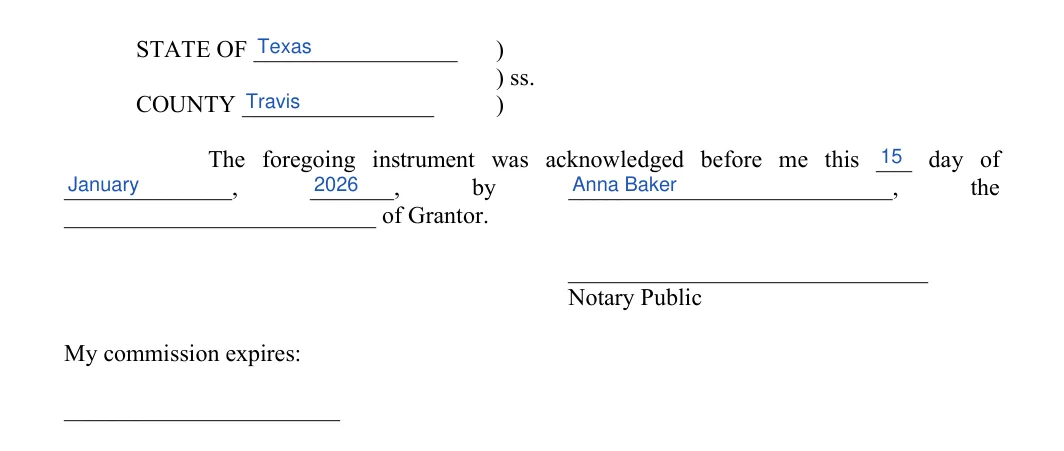
Many people use a notary public for this step. A notary public has the same authority as the county clerk to take acknowledgments of written instruments, so a notary is an officer authorized to take the acknowledgment the deed needs for recording (Tex. Gov't Code 406.016(a)(1)).[3.1]
A notary may charge a fee for taking the acknowledgment of a deed, in an amount set by state law (Tex. Gov't Code 406.024(a)).[3.2]
An instrument concerning real or personal property may be recorded if it has been acknowledged, sworn to with a proper jurat, or proved according to law.[2.1] A person who presents a deed for recording in person must also show a photo identification to the county clerk, as Section 191.010 of the Local Government Code requires.[2.2]
Take the signed and acknowledged deed to the county clerk's office to have it recorded. The county clerk is the recording office and keeps the index to all recorded deeds (Tex. Loc. Gov't Code 193.003(a)).[4.1]
Once the deed is properly recorded in the proper county, it is notice to all persons that the deed exists, and it is open to public inspection (Tex. Prop. Code 13.002).[5.1]
The county clerk records the deed once the filing fees set by state law are paid (Tex. Loc. Gov't Code 118.011(a)(2)).[6.1]
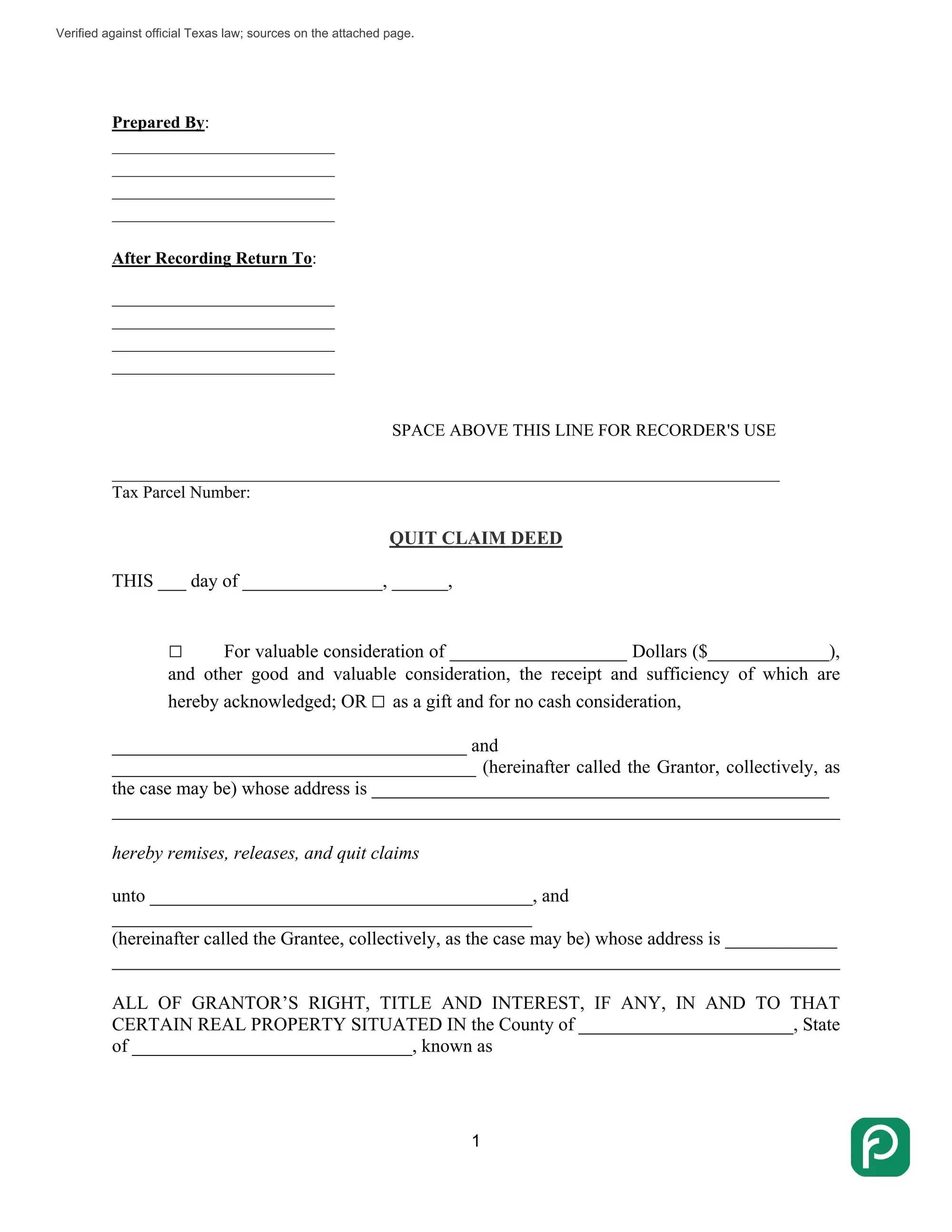
The FormsPal form runs five pages. Page 3 is blank, and the fields are on pages 1, 2, 4 and 5. Work through the parts below in the order they appear on the form. If you downloaded the PDF, you can fill it in on screen with our PDF editor, or print it and write by hand.
The screenshots under each step show the FormsPal Texas quitclaim deed template filled with sample entries in blue, so you can see where each answer goes. The names, addresses, dates and amounts are examples only.
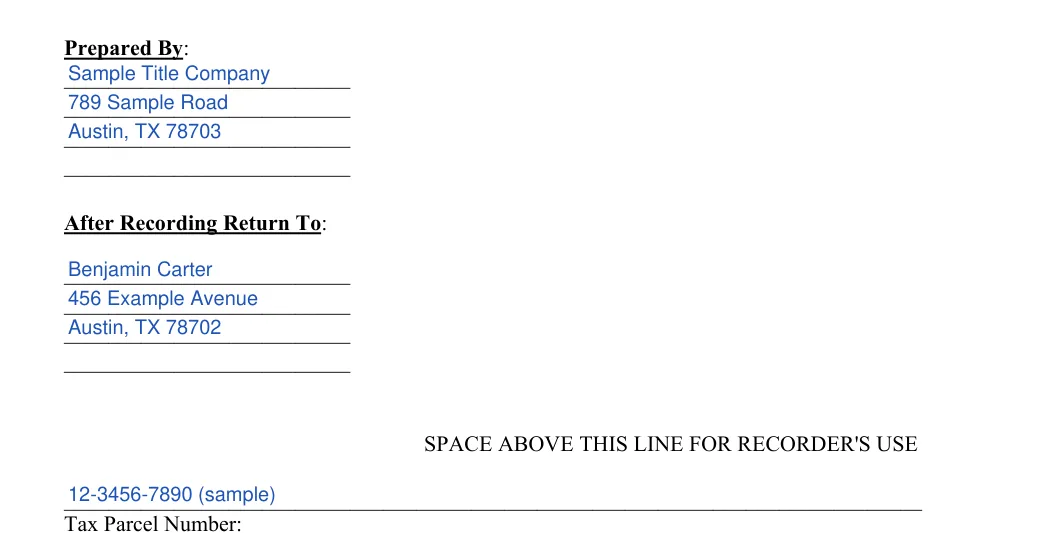
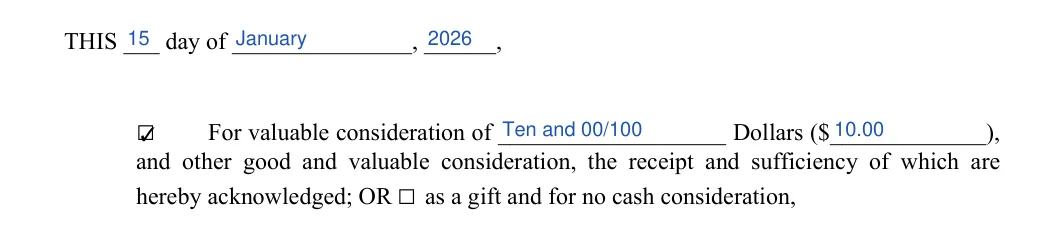




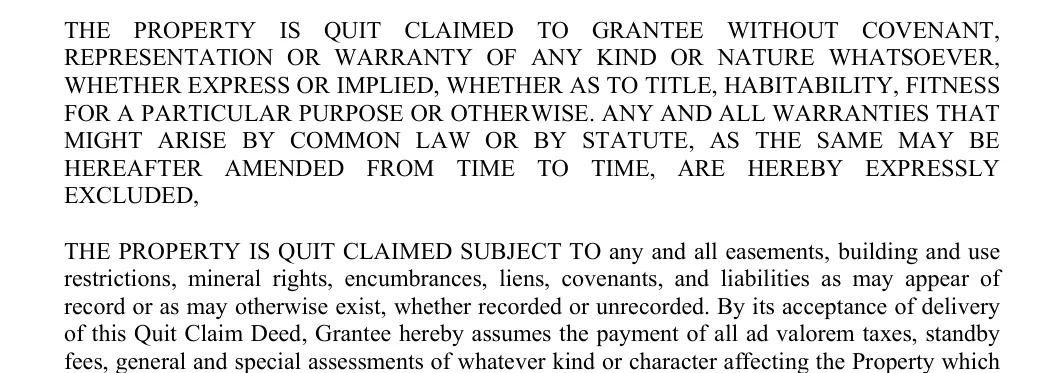
Once the deed is signed and acknowledged, see the recording rules above before you take it to the county.
A quitclaim deed fits cases where ownership moves between people who already trust each other. The grantor transfers only the interest they hold, and the form passes the property without any warranty, as page 2 of the form states. For that reason the deed suits an individual who wants a simple transfer inside the family.
Typical uses include:
In practice, a buyer who needs the seller to stand behind the title usually asks for a different type of deed, because a quitclaim deed carries no warranty of title.
The grantor, the person the interest passes from, must sign the deed. A deed that conveys real property may not be recorded unless the grantor has signed it and it has been acknowledged or sworn to as the statute describes.[2.2]

A quitclaim deed is the document a grantor signs to pass whatever interest they have in real property to a grantee. In Texas, an instrument concerning real or personal property may be recorded once it has been acknowledged, sworn to with a proper jurat, or proved according to law.[2.1]
Other Quitclaim Deed Forms by State
General information, not legal or tax advice.
Unless noted otherwise, the sources below are from the Texas Property Code, published by the Texas Legislature Online.
