
A Georgia quitclaim deed is a written document that passes the grantor's interest in real estate to the grantee. It carries no warranty, so it makes no promise about who owns the property. The grantor is the person giving up the interest, and the grantee is the person receiving it, and the form is most often used between spouses and relatives. Download the free form below or build one online in minutes.
Last Updated: October 2026. This guide is reviewed and updated regularly to reflect current Georgia law. If you notice an error or outdated information, please contact us.
Build Your Document
Answer a few simple questions to make your document in minutes
Save and Print
Save progress and finish on any device, download and print anytime
Sign and Use
Your valid, lawyer-approved document is ready
Use this deed form when real property moves between people who trust each other. If you are buying from a stranger, think twice, because the Georgia quitclaim deed form carries no warranty of any kind. The form says so itself on page 2, so read the printed documents before you sign.
A deed to land in Georgia must be an original written document signed by its maker, attested by an officer, and attested by one other witness.[2.1] A deed that the law requires to be recorded takes effect against good-faith third parties only from the time it is filed with the clerk of the superior court.[1]
Section 44-5-30 of the Official Code of Georgia Annotated (O.C.G.A.) covers how a deed to land is signed and attested.[2.1] Its words are:
A deed to lands shall be an original document, in writing, signed by the maker, attested by an officer as provided in code section 44-2-15, and attested by one other witness.
In plain words, the deed needs three things:
File the signed deed with the clerk of the superior court. Under Section 44-2-2(c), a deed that must be recorded takes effect against a good-faith buyer or lienholder only from the time it is filed in the clerk's office.[1] So file the deed soon after it is signed.
Under O.C.G.A. 44-2-1, every deed conveying land is recorded in the office of the clerk of the superior court of the county where the land is located.[1.1]
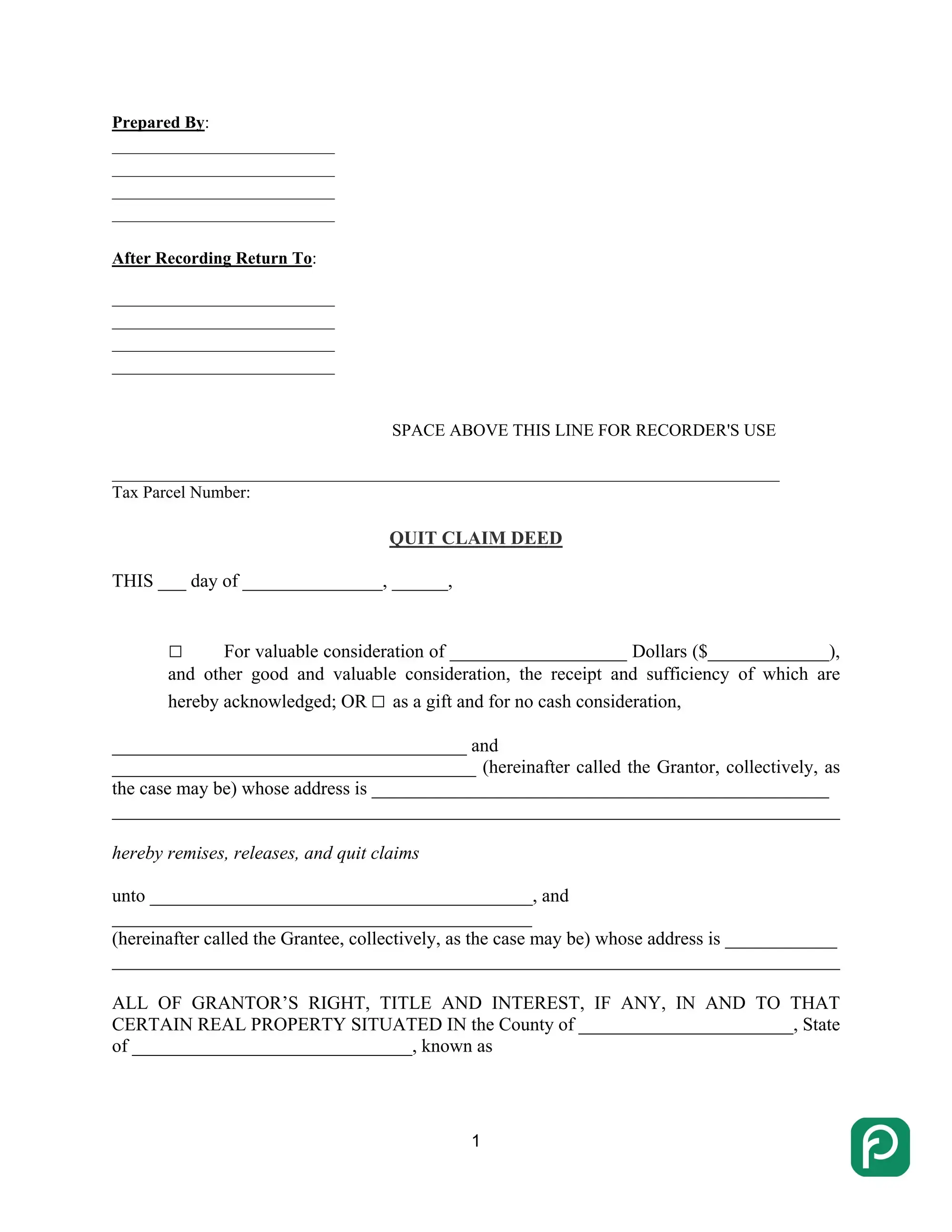
The FormsPal Georgia quitclaim deed runs five pages, and page 3 is blank on purpose. Fill in the parts below in order, then have the deed signed, witnessed and notarized as described under Signing Requirements above. You can complete the PDF in our PDF editor or print it and write by hand.
Keep a copy of the signed and notarized deed for your records before you file the original.
After the signatures are done, file the deed with the clerk of the superior court, as covered under Recording Requirements above.
Georgia does not require any one prescribed form for a valid deed to land or personal property.[2.3] What counts is whether the deed is sufficient in itself to make known the transaction between the parties. The statute reads:
No prescribed form is essential to the validity of a deed to lands or personalty. If the deed is sufficient in itself to make known the transaction between the parties, no want of form will invalidate it.
In plain words, a deed that makes the transaction clear is not invalid just because it lacks special wording.

Other Quitclaim Deed Forms by State
General information, not legal or tax advice.
