
- How Are World Divorce Rates Measured?
- What Is the Divorce Rate in the World? Latest Data
- What Country Has the Highest Divorce Rate in the World?
- Countries with the Lowest Divorce Rate in the World
- What Shapes Divorce Rates Around the World?
- Are Divorce Rates Rising or Falling?
- Divorce Statistics in the United States
- From Divorce Statistics to Your Own Agreement
- World Divorce Rate FAQs
Divorce rates are usually reported as a crude rate - in one year per 1,000 residents, married or single. This produces some surprising results. In a country of 40,000 people, a few hundred cases can push the rate above that of a nation with 40 million residents.[30]
The highest divorce rate in the world belongs to the Maldives, which logged 10.97 divorces per 1,000 residents in 2002 and has held the Guinness World Record ever since. Although its rate has fallen since then, the country still reports one of the highest figures worldwide. Among countries with recent data, Liechtenstein leads at 4.9 divorces per 1,000 residents. [8][28]
In this article, we break down divorce rates by country, from the highest to the lowest, and explain what drives the difference.
How Are World Divorce Rates Measured?
Countries publish divorce statistics three ways:
- The crude divorce rate counts divorces in a year against every 1,000 residents - married, single, children, everyone.[29]
- The refined divorce rate narrows the denominator to married women only, which strips out the unmarried population and gets much closer to how many marriages are breaking apart. For example, American women posted 14.2 divorces per 1,000 in 2024.[19]
- The marriage-to-divorce ratio compares weddings to splits within a single year. The US ratio is 2.42, meaning about two and a half marriages for every single divorce.[18]
A crude rate is what gets most air time globally. Most countries collect nothing else, and comparing 40 crude figures beats comparing three refined ones. It also flatters small nations, where a few hundred filings can push a national average sharply upward.
What Is the Divorce Rate in the World? Latest Data
The United Nations collects filings country by country, but coverage runs thin. About 40 nations report a usable rate in any given year, and much of Africa, South Asia, and the Middle East stays blank. Figures below reflect the most recent cycle each body has published.[28][29]
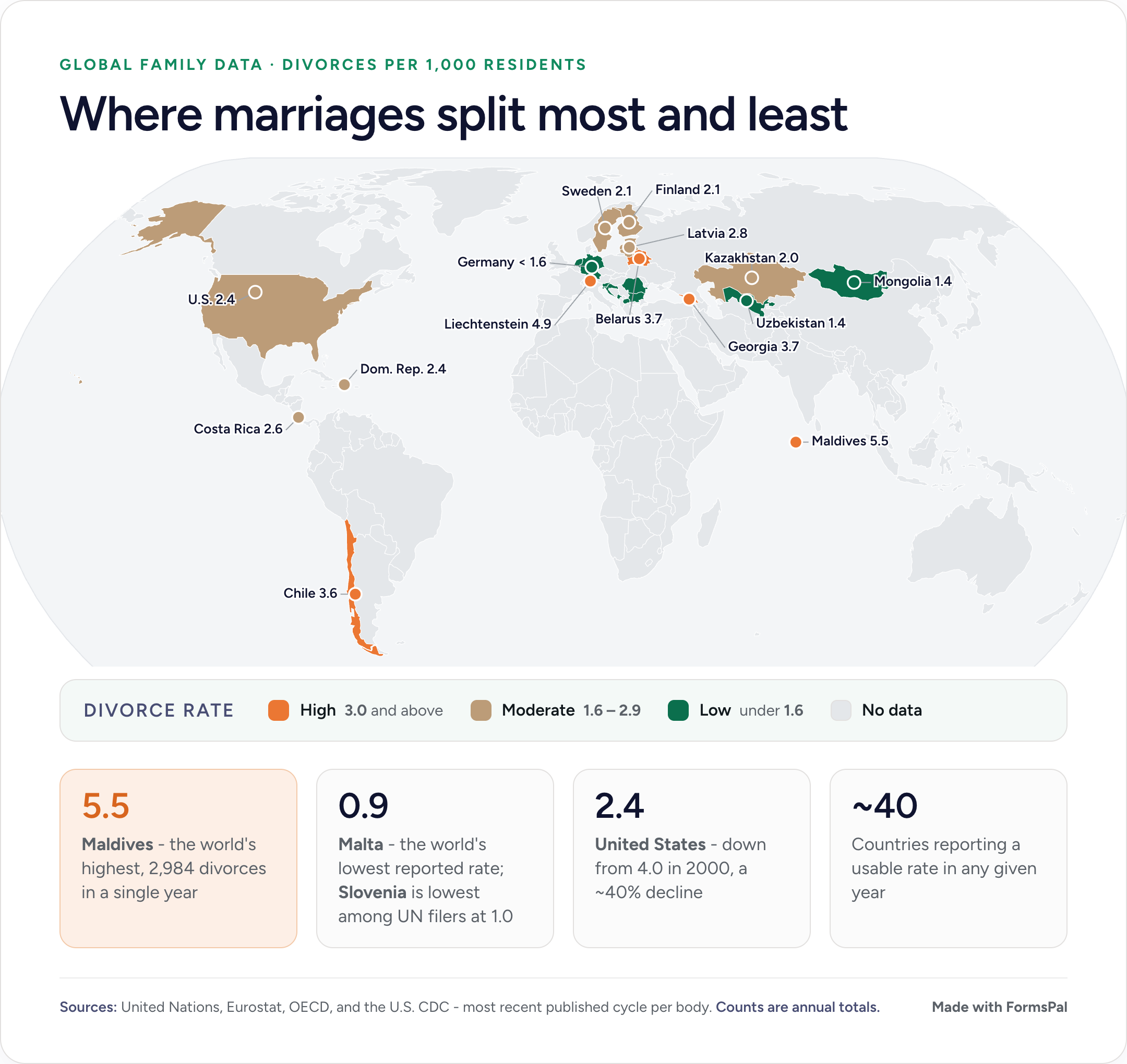
Among the countries with the highest divorce rate in the world are the Maldives, Liechtenstein, Belarus, and Georgia, each recording above 3.5 splits per 1,000 residents.
|
Country |
Divorce rate per 1,000 |
Source |
Context* |
|
Maldives |
5.5 |
UN |
2,984 divorces |
|
Liechtenstein |
4.9 |
UN |
Only 193 divorces total |
|
Belarus |
3.7 |
UN |
33,962 divorces |
|
Georgia |
3.7 |
UN |
13,664 divorces |
|
Chile |
3.6 |
OECD |
Divorce legalized only in 2004 |
|
Latvia |
2.8 |
Eurostat |
Highest rate in the EU |
|
Costa Rica |
2.6 |
UN |
13,425 divorces |
|
Lithuania |
2.5 |
Eurostat |
Second-highest in the EU |
|
United States |
2.4 |
CDC |
672,502 divorces, 45 states reporting |
|
Dominican Republic |
2.4 |
UN |
25,914 divorces |
|
Estonia, Finland, Sweden |
2.1 |
Eurostat |
Tied among the EU's highest |
|
Kazakhstan |
2.0 |
UN |
40,227 divorces |
*Counts in this column are annual totals.
Most reporting countries fall between 1.0 and 2.5 divorces per 1,000 residents. Slovenia records the lowest rate at 1.0, while Germany and the Netherlands both stay under 1.6. Anything above 3.0 is rare.[6][28]
Between the 1970s and the 1990s, divorce grew much more common across most of the developed world, and rates in the UK, Norway, and South Korea tripled or better over that stretch. But the past two decades reversed the pattern in wealthier countries.[23]
American filings dropped from 4.0 per 1,000 in 2000 to 2.4 today, about a 40% decline, and in England and Wales the share of couples who split within five years of marrying is now roughly half its 1990s peak.[3][22]
Does a High Divorce Rate Mean Unhappy Marriages?
A high divorce rate doesn't automatically mean that couples are less happy or that marriages fail more often. The numbers also reflect how simple or difficult divorce is, how people view it and how accurately each country records marital changes.
In many developed countries, higher rates often appear where divorce is easier to obtain and carries less social stigma. That doesn't mean relationships are worse. A low rate can tell a different story, especially where divorce costs too much, brings social pressure, or remains difficult to secure through the courts.
What Country Has the Highest Divorce Rate in the World?
The Maldives has the highest divorce rate, but what the actual numbers behind that title tell you is a lot more interesting than the crude rate. Between 2002 and 2024, the country recorded 120,393 marriages against 64,821 divorces. Better than half of all Maldivian marriages dissolved. Narrow the window to the past decade and the share climbs above 63%.[16]
Why Is the Divorce Rate So High in the Maldives?
Volume explains a lot of it. The Maldives has long posted one of the world's highest marriage rates, so there are more unions on the books to end. People marry young, and both the wedding and the split move fast through the courts.[13]
Remarriage is common too, which means the same residents can turn up in the count twice in a decade.[14]
Countries with the Lowest Divorce Rate in the World
Malta records the lowest rate in the EU at 0.9 divorces per 1,000 residents. Eurostat works a year ahead of the UN cycle, so its figures land first.[5][6]
Among countries reporting to the UN, Slovenia posts the lowest at 1.0, with Croatia and Romania at 1.1 and the Faroe Islands at 1.2. Montenegro comes in at 1.3, and Uzbekistan, the Netherlands, Bulgaria, and Mongolia all land on 1.4.
North Macedonia belongs in that lower band too, at roughly 1.1 per 1,000 from about 2,025 divorces, though the figures here come from the national statistical office rather than the UN.[25]
|
Country |
Divorce rate per 1,000 |
Source |
Context* |
|
Malta |
0.9 |
Eurostat |
Lowest in the EU |
|
Slovenia |
1.0 |
Eurostat |
2,165 divorces in 2023 |
|
North Macedonia |
~1.1 |
State Statistical Office |
About 2,025 divorces |
|
Croatia |
1.1 |
UN |
4,407 divorces |
|
Romania |
1.1 |
Eurostat |
Third-lowest in the EU |
|
Faroe Islands |
1.2 |
UN |
Only 63 divorces |
|
Montenegro |
1.3 |
UN |
775 divorces |
|
Uzbekistan |
1.4 |
UN |
49,198 divorces |
|
Netherlands |
1.4 |
UN |
24,310 divorces |
|
Bulgaria |
1.4 |
UN |
9,088 divorces |
|
Mongolia |
1.4 |
UN |
4,776 divorces |
*Counts in this column are annual totals.
Three factors push a country's crude rate down, and none of them measures marital stability directly.
Legal restriction accounts for a large share of the low end, since Malta permitted divorce only from 2011, Chile from 2004, and Ireland from 1997. The Philippines has no divorce law at all - a marriage there ends through annulment or death. But filings climbed sharply in Malta, Chile, and Ireland once each lifted its restrictions.[12][27]
In fault-based systems, one spouse must prove adultery, desertion, or cruelty in court, which can discourage couples from divorcing. Cost also matters. High filing fees or the risk of losing household income can make staying married the easier choice for many people.
And where fewer couples marry, fewer marriages exist to end, so the rate falls even though nothing has changed about how relationships actually break down. Cohabitation has replaced formal marriage across much of Latin America, which explains a share of the low figures reported there.[4]
The low end of this ranking therefore mixes countries with strong social protections and countries where women face financial or legal barriers to leaving. Slovenia and the Netherlands sit far above Uzbekistan on global gender equality measures, and all three land side by side here.[32]
What Shapes Divorce Rates Around the World?
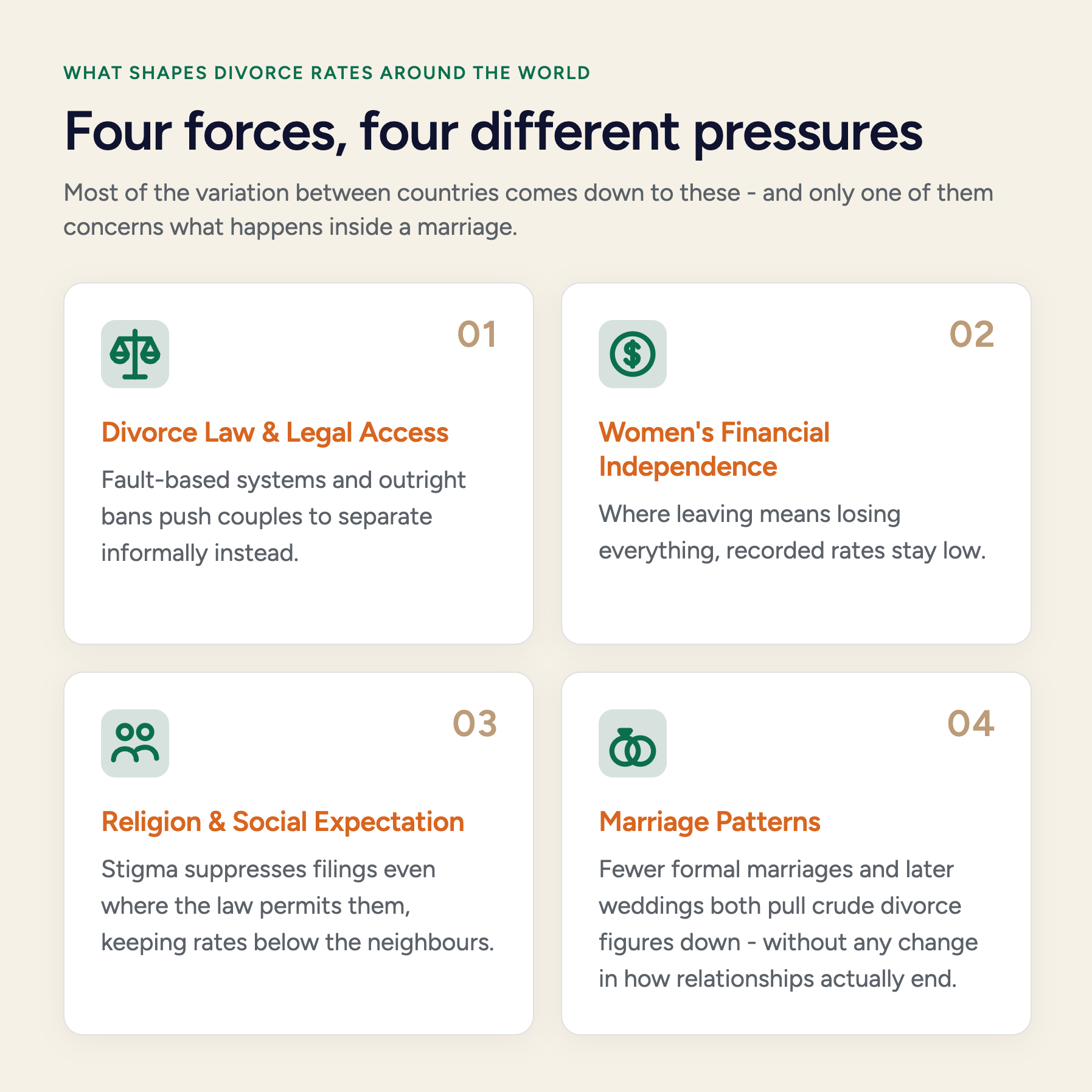
Four forces account for most of the variation between countries, and only one of them concerns what happens inside a marriage.
Divorce Law and Legal Access
Where the law makes divorce quick and affordable, more people use it. For example, after divorce became legal, filings rose in Malta, Chile, and Ireland.
Fault-based systems produce the opposite result, since one spouse has to prove adultery, cruelty, or desertion in court before a judge will grant anything. So, couples facing that requirement tend to separate informally instead.
Also, marriages in the Philippines end only through annulment or death, because the country has no divorce law.[1][24]
Women's Financial Independence
Where women earn their own income, they can leave marriages that no longer work. Divorce rose across most of the developed world as female workforce participation climbed through the 1970s and 1980s, and researchers link the two directly.[26]
The reverse holds as well. In countries where leaving a marriage costs a woman her household’s earnings and social standing, the recorded divorce rate stays low, even when many relationships have already broken down.
Religion and Social Expectation
But of course, it's not just the laws that affect the rate of divorce - religion and social expectation also play a big part. Stigma suppresses filings even where the law permits them, which describes much of South Asia, the Middle East, and parts of Latin America.
Irish voters kept a constitutional ban on divorce in place until 1995, partly on religious grounds. Catholic countries across southern Europe and Latin America continue reporting rates below their northern neighbors, though that difference has narrowed as religious observance has declined.[15][21]
Marriage Patterns
Crude rates depend on how many marriages exist to dissolve. Cohabitation has replaced formal marriage for large shares of Mexico, Guatemala, and Colombia, and that obviously pushes their divorce figures down without any change in how relationships end.[4]
Age at marriage cuts in reverse, and the effect runs strongest at the young end. Couples who marry at 25 are roughly half as likely to divorce as couples who marry at 20, and risk bottoms out in the late twenties. Past the early thirties it creeps back up.[11]
The rising median marriage age still explains part of the decline in divorce rates across wealthy countries since the 1990s.
Are Divorce Rates Rising or Falling?
Divorce rates are falling in most wealthy countries and rising across much of Asia, Latin America, and southern Europe. American filings peaked in 1980, England and Wales followed in the mid-1990s, and northern Europe turned around on roughly that schedule.[22][23]
People marry later than they used to, and many now live together for years before signing anything, which removes the shakiest relationships from the marriage pool before they can end in court.
In South Korea, divorce climbed steadily into the early 2000s and has stayed high since.[23]
Spain and Italy have both recorded substantial increases as legal access widened and religious observance dropped off. A country that legalized divorce twenty years ago still has room for its numbers to grow.[21]
Then there's the denominator problem. Marriage rates are falling nearly everywhere, so a shrinking divorce rate can coexist with relationships breaking up at exactly the same pace as before.[6]
Divorce Statistics in the United States
American divorce rates run above the world average, though the countries at the top of the ranking sit far higher still. That places the US somewhere in the middle rather than in a class by itself. Set the American numbers beside Latvia, Chile, or the Maldives, and you can see how much a country's laws and counting methods drive the result.[20][21]
So, two identical rates can describe two very different situations.
The Current U.S. Divorce Rate
Federal records counted 672,502 American divorces in 2023, or 2.4 per 1,000 residents, alongside 2,041,926 marriages at 6.1 per 1,000. That figure understates the real total, since California, Hawaii, Indiana, Minnesota, and New Mexico send no divorce data to the national system.[2][3]
Census-based measures cover the whole country and come out sooner. By the refined rate, 14.2 women per 1,000 married women divorced in 2024, down from 14.4 the previous year, while the raw count slipped from 992,677 women to 986,810. Neither drop is dramatic on its own. But American divorce peaked around 1980 and has trended downward ever since, so the 2024 figures extend a pattern that has held for over four decades.[17][19]
Weddings still outnumber splits by a wide margin. Americans recorded 2,390,482 marriages in 2024 against 986,810 divorces, a ratio of 2.42 to one.[18]
The familiar claim that half of all marriages end in divorce comes from projections made at the 1980 peak, and current estimates put the share of first marriages ending in divorce closer to 40%.[9][10]
U.S. Divorce Rate by Occupation
These percentages measure lifetime marital history rather than annual rates, counting workers currently divorced or separated plus anyone who has married twice or more.[7]
Highest shares:
- Other healthcare practitioners - 48.3%
- Telemarketers - 48.0%
- Massage therapists - 47.9%
- Bus drivers - 47.8%
- Correctional supervisors - 47.5%
- Ambulance drivers - 47.3%
- Vocational nurses - 47.2%
Lowest shares:
- Actuaries - 14.2%
- IT scientists - 18.7%
- Software developers - 18.9%
- Physical therapists - 19.0%
- Physicians - 20.1%
- Clergy - 20.2%
Night shifts and unpredictable schedules run through the entire top tier, while clergy ranks near the bottom despite modest pay.[31]
States with the Highest Divorce Rates
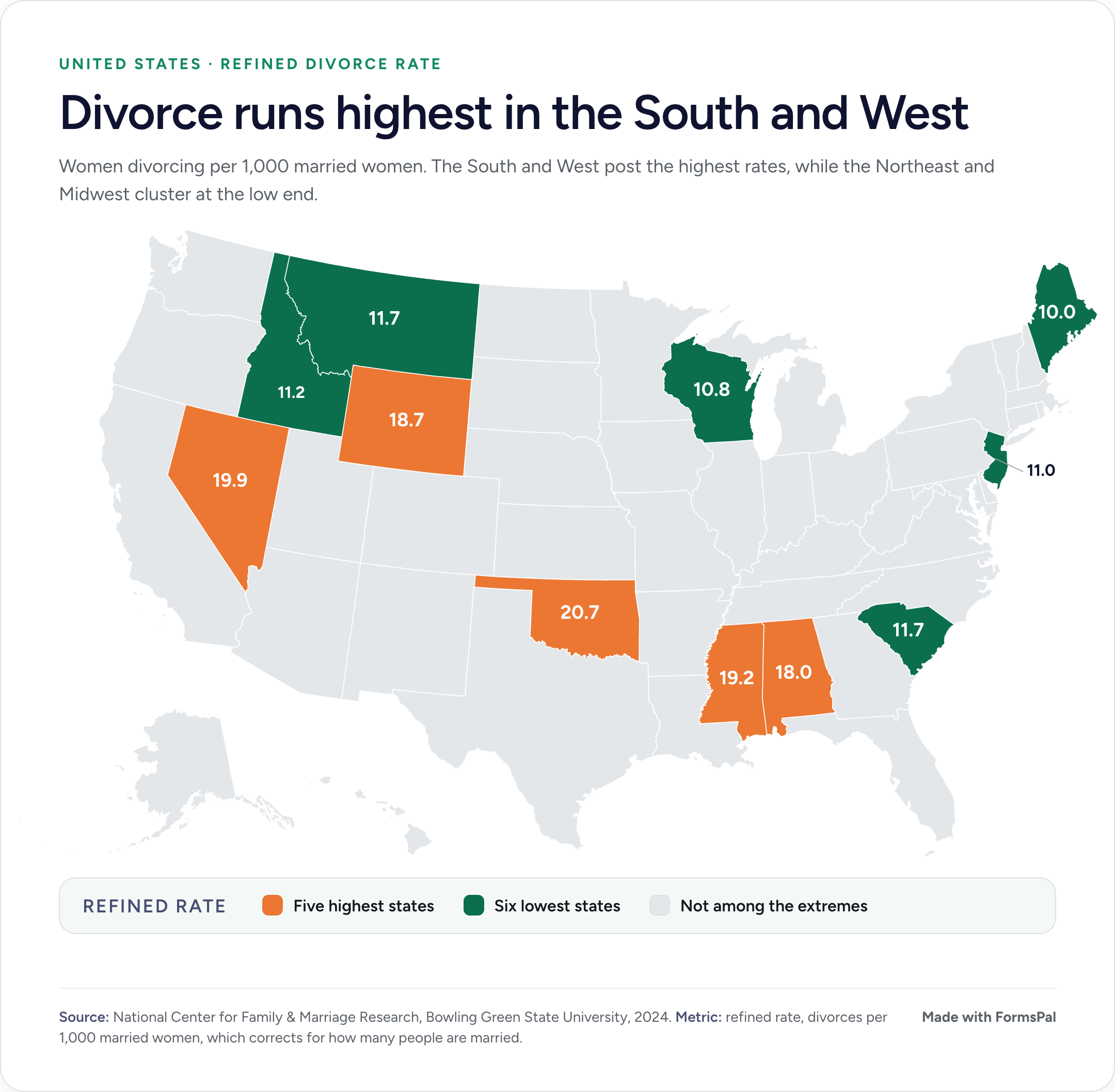
Oklahoma led the country in 2024. Its refined rate reached 20.7 women divorcing per 1,000 married women, followed by Nevada at 19.9, Mississippi at 19.2, Wyoming at 18.7, and Alabama at 18.0.[19]
- Oklahoma - 20.7
- Nevada - 19.9
- Mississippi - 19.2
- Wyoming - 18.7
- Alabama - 18.0
Regional clustering drives most of this. Three-quarters of Southern states landed in the top half of the rankings, with 8 of 16 Southern states plus DC in the highest quartile. Western states came second, though no Midwestern state placed in the top quartile at all.
Nevada's position surprises people who assume it reflects quick Las Vegas weddings; the state's high rate tracks the same regional and economic patterns as its neighbors.
States with the Lowest Divorce Rates
Maine recorded the lowest rate, roughly half Oklahoma's. Maine reached 10.0 women divorcing per 1,000 married women, with Wisconsin at 10.8, New Jersey at 11.0, Idaho at 11.2, and Montana and South Carolina tied at 11.7.[19]
- Maine - 10.0
- Wisconsin - 10.8
- New Jersey - 11.0
- Idaho - 11.2
- Montana - 11.7
- South Carolina - 11.7
The Northeast and Midwest dominate this end. Over two-fifths of Northeastern states fell into the bottom quartile, and Midwestern states clustered there too, with 42% in the lowest group. Only two Western states made the bottom quartile: Idaho and Montana.
South Carolina's appearance breaks the regional pattern, since Southern states otherwise fill the high end. Marriage rates explain part of the divide - states where fewer people marry produce fewer divorces without any difference in how relationships actually end.
From Divorce Statistics to Your Own Agreement
Global rates describe how populations behave, though none of that settles who keeps the home, how the debts get split, or what child and spousal support will look like. The details always come down to your state's laws and the specifics of your marriage.
Spouses who agree on the main terms can record their decisions in a marital settlement agreement, a single written document rather than a stack of verbal understandings. Property, financial accounts, debts, custody and visitation, child support, alimony - the agreement takes all of it and puts it on firmer ground.
FormsPal offers a free divorce settlement agreement template that's easy to use, complete with step-by-step instructions and options that are specific to your state. Prepare it online, save your progress, and download or print the finished document when you're ready to sign. A judge still has to review the settlement and issue the final decree.
And if you and your spouse agree on the main terms, our online divorce service can help you complete state-specific divorce forms through a guided questionnaire. You can review your documents and follow filing instructions before submitting them to the court.
World Divorce Rate FAQs
Which country has the highest divorce rate in the world?
The Maldives. Its record of 10.97 divorces per 1,000 residents still stands in the Guinness World Records, and the country has ranked near the top ever since. Liechtenstein leads among nations currently reporting to the UN, at 4.9 per 1,000.
Which country has the lowest divorce rate in the world?
Slovenia, at 1.0 divorces per 1,000 residents, holds the lowest confirmed rate among UN-reporting countries. Croatia comes in at 1.1 and the Faroe Islands at 1.2. Eurostat puts Malta lower still, at 0.9.
Does the United States have the highest divorce rate?
No. American filings run at 2.4 per 1,000 residents, above the world average but behind Liechtenstein, Belarus, Georgia, Chile, and Latvia. That figure has fallen roughly 40% since the start of the century.
Did COVID-19 change divorce rates worldwide?
Yes, divorce rates generally fell during the first year of COVID-19, largely because courts closed, hearings were delayed, and couples had fewer opportunities to file. Rates later rose in some places as courts cleared backlogs, but there was no single worldwide trend.
Is the global divorce rate rising or falling?
Divorce peaked decades ago in wealthy countries and has declined since, while parts of Asia, Latin America, and southern Europe have recorded increases as legal access widened.
Are there countries where divorce is illegal?
The Philippines has no divorce law, so a marriage there ends through annulment or death. Vatican City also prohibits it. Malta was the most recent country to legalize divorce, in 2011.
Why do divorce rates differ so much between countries?
Legal access, reporting quality, and marriage rates explain most of the variation. Fault-based systems record fewer divorces than no-fault ones, and where cohabitation has replaced marriage, the rate stays low because fewer marriages exist to end.
Sources & References
- Al Jazeera. 'We Are Not Criminals': Philippines Considers Making Divorce Legal.
- Centers for Disease Control and Prevention. FastStats: Marriage and Divorce.
- Centers for Disease Control and Prevention. National Marriage and Divorce Rate Trends.
- Esteve, Albert, Ron Lesthaeghe, and Antonio López-Gay. The Latin American Cohabitation Boom. Population and Development Review.
- Eurostat. Divorce Indicators. Dataset.
- Eurostat. Marriage and Divorce Statistics.
- FlowingData. Occupations with the Highest Divorce Rates.
- Guinness World Records. Highest Divorce Rate.
- Institute for Family Studies. Divorce in Decline: About 40% of Today's Marriages Will End in Divorce.
- Institute for Family Studies. No Longer a Coin Toss: Less than Half of Marriages Predicted to End in Divorce.
- Institute for Family Studies. Want to Avoid Divorce? Wait to Get Married, But Not Too Long.
- JURIST. Malta Parliament Passes Divorce Law.
- Maldives Bureau of Statistics. Statistical Yearbook of Maldives.
- Maldives Independent. Why Does the Maldives Have the World's Highest Divorce Rate?
- MaltaToday. The Watershed Moment When Malta Voted to Introduce Divorce.
- MV+. Divorce in the Maldives Is Not on the Rise. It Has Already Settled at a High.
- National Center for Family & Marriage Research. Divorce: More than a Century of Change.
- National Center for Family & Marriage Research. Marriage-Divorce Ratio in the U.S.: Geographic Variation.
- National Center for Family & Marriage Research. Refined Divorce Rate in the U.S.: Geographic Variation.
- OECD. Family Database SF3.1: Marriage and Divorce Rates.
- OECD. Society at a Glance: Marriage and Divorce.
- Office for National Statistics. Divorces in England and Wales.
- Our World in Data. Marriages and Divorces.
- South China Morning Post. Philippine Lawmakers Revive Divorce Bill, but Will It Be Passed This Time?
- State Statistical Office of the Republic of North Macedonia. Marriages and Divorces.
- Stevenson, Betsey, and Justin Wolfers. Marriage and Divorce: Changes and Their Driving Forces. Journal of Economic Perspectives.
- TIME. The Long Fight to Legalize Divorce in the Philippines.
- United Nations Statistics Division. Demographic Yearbook: Divorces and Crude Divorce Rates by Urban/Rural Residence.
- United Nations Statistics Division. Marriage and Divorce Statistics.
- United Nations Statistics Division. Technical Notes to Table 24, Demographic Yearbook.
- Visual Capitalist. Ranked: The Jobs With the Highest and Lowest Divorce Rates in America.
- World Economic Forum. Global Gender Gap Report.